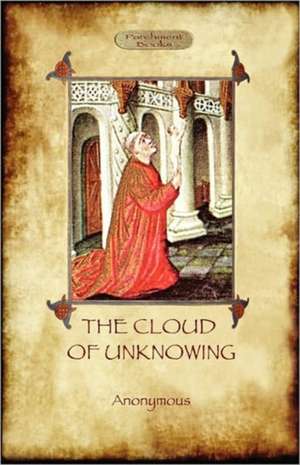
The Cloud of Unknowing
Autor Anonymousen Limba Engleză Paperback – 20 mai 2011
Preț: 67.99 lei
Puncte Express: 102
Carte tipărită la comandă
Livrare economică 07-21 decembrie
Livrare prin curier în România Termenul estimat este afișat lângă disponibilitate.
Transport gratuit de la 400.00 lei Plată online sau ramburs, în funcție de opțiunile comenzii.
Retur gratuit în 14 zile Comandă securizată și suport în română.
Specificații
ISBN-13: 9781908388131
ISBN-10: 1908388137
Pagini: 138
Dimensiuni: 129 x 198 x 8 mm
Greutate: 0.16 kg
Editura: AZILOTH BOOKS
ISBN-10: 1908388137
Pagini: 138
Dimensiuni: 129 x 198 x 8 mm
Greutate: 0.16 kg
Editura: AZILOTH BOOKS
V-ar putea interesa
-
 The Book of TaliesinGwyneth Lewis-31%Preț: 64.55 lei93.11 lei
 -
 Self-Actualization Against The OddsMarie ByrnePreț: 79.63 lei
 -
 Le processus de décision dans un synode diocésainChristiane AndlauerPreț: 230.29 lei
 -
 Dark Night of the SoulSt John Of The Cross-18%Preț: 29.36 lei35.99 lei
 -
 Ascent Of Mount CarmelR.H.J. Steuart-40%Preț: 127.57 lei211.30 lei
 -
 The Sandman Omnibus. Volume INeil Gaiman-18%Preț: 867.32 lei1053.98 lei
 -
 Sandman Omnibus Volume IINeil Gaiman-9%Preț: 863.58 lei948.99 lei
 -
 The Sandman Omnibus Vol. 3Neil Gaiman-9%Preț: 855.49 lei940.09 lei
 -
 The RevealingHuffman, Gary L.Preț: 118.51 lei
 -
 Ten Great ReligionsJames Freeman ClarkePreț: 61.55 lei
 -
 The Flaming Sword Sepher Sephiroth Volume TwoOliver St. JohnPreț: 284.86 lei
 -
 Preț: 82.30 lei
 -
 The Virgin of the WorldHermes TrismegistosPreț: 79.86 lei
 -
 Pistis SophiaAnonymousPreț: 106.39 lei
 -
 ManLouis-Claude De Saint-MartinPreț: 146.13 lei
 -
 Theosophic Correspondence between Saint-Martin & KirchbergerLouis-Claude De Saint-MartinPreț: 126.87 lei
 -
 The Voice of the SilenceHelena Petrovna BlavatskyPreț: 59.70 lei
 -
 Heaven and HellEmanuel SwedenborgPreț: 115.01 lei
 -
 Tertium OrganumP. D. OuspenskyPreț: 106.65 lei
 -
 Die Figur Jesus Und Die Christologie Des KoransLeutz, SimonPreț: 92.21 lei
 -
 Preț: 159.91 lei
 -
 Preț: 92.21 lei
 -
 Preț: 92.60 lei
 -
 Abschied vom betreuten DenkenJosef HülkenbergPreț: 116.87 lei
Notă biografică
Vyasa (c. 200 BC) is the legendary author of the Mahabharata, Vedas and Puranas, some of the most important works in the Hindu tradition. Vyasa appears for the first time as the compiler of, and an important character in, the Mahabharata. It is said that he was the expansion of the God Vishnu, who came in Dwaparayuga to make all the Vedic knowledge from oral tradition available in written form. He was the son of Satyavati, adopted daughter of the fisherman Dusharaj and the wandering sage Parashara, who is credited with being the author of the first Purana, Vishnu Purana. He was born on an island in the river Yamuna. Due to his dark complexion, Vyasa was also given the name Krishna, in addition to the name Dwaipayana, meaning "island-born." According to the Mahabharata, the sage Vyasa was the son of Satyavati and Parashara. During her youth, Satyavati was a fisherwoman who used to drive a boat. One day, sage Parashara was in a hurry to attend a Yajna. Satyavati helped him cross the river borders. On this account, the sage offered her a mantra which would result in begetting a son who would be a sage with wisdom and all good qualities. Satyavati immediately recited the mantra and thus Vyasa was born. She kept this incident a secret, not telling even King Shantanu. The festival of Guru Purnima is dedicated to Vyasa. It is also known as Vyasa Purnima, for it is the day believed to be both his birthday and the day he divided the Vedas. Vyasa is also considered to be one of the seven Chiranjivins (long-lived, or immortals), who are still in existence according to Hindu tradition.