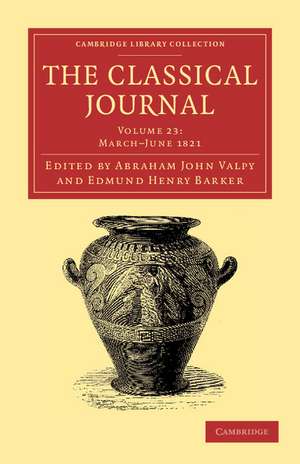
The Classical Journal: Cambridge Library Collection - Classic Journals
Editat de Abraham John Valpy, Edmund Henry Barkeren Limba Engleză Paperback – 27 feb 2013
Din seria Cambridge Library Collection - Classic Journals
-
 Preț: 303.86 lei
 -
 Preț: 393.58 lei
 -
 Preț: 304.96 lei
 -
 Preț: 439.68 lei
 -
 Preț: 306.13 lei
 - 19%
 Preț: 431.21 lei
 -
 Preț: 342.50 lei
 -
 Preț: 305.77 lei
 -
 Preț: 344.56 lei
 -
 Preț: 219.91 lei
Preț: 393.21 lei
Puncte Express: 590
Carte tipărită la comandă
Livrare economică 04-18 iulie
Specificații
ISBN-13: 9781108058049
ISBN-10: 1108058043
Pagini: 440
Ilustrații: 3 b/w illus. 1 map
Dimensiuni: 140 x 216 x 25 mm
Greutate: 0.55 kg
Editura: Cambridge University Press
Colecția Cambridge University Press
Seria Cambridge Library Collection - Classic Journals
Locul publicării:Cambridge, United Kingdom
ISBN-10: 1108058043
Pagini: 440
Ilustrații: 3 b/w illus. 1 map
Dimensiuni: 140 x 216 x 25 mm
Greutate: 0.55 kg
Editura: Cambridge University Press
Colecția Cambridge University Press
Seria Cambridge Library Collection - Classic Journals
Locul publicării:Cambridge, United Kingdom
V-ar putea interesa
-
 -10%Preț: 785.55 lei870.93 lei
 -
 Writing and Reading Byzantine Secular Poetry, 1025-1081Floris Bernard-27%Preț: 632.13 lei871.21 lei
 -
 -34%Preț: 651.05 lei982.56 lei
 -
 Selected SpeechesDemosthenes-19%Preț: 75.76 lei93.54 lei
 -
 Re-imagining the Past: Antiquity and Modern Greek CultureDimitris Tziovas-33%Preț: 703.46 lei1057.18 lei
 -
 God, Space, and City in the Roman ImaginationRichard Jenkyns-20%Preț: 437.04 lei544.51 lei
 -
 Augustus: Introduction to the Life of an EmperorKarl GalinskyPreț: 188.98 lei
 -
 Catullus: Poems, Books, ReadersIan M. le M. Du Quesnay-14%Preț: 683.59 lei794.88 lei
 -
 Multilingualism in the Graeco-Roman WorldsAlex Mullen-14%Preț: 796.65 lei926.34 lei
 -
 -14%Preț: 691.44 lei804.01 lei
 -
 -14%Preț: 693.42 lei806.30 lei
 -
 -14%Preț: 683.86 lei795.18 lei
 -
 Myth, Ritual, and the Warrior in Roman and Indo-European AntiquityRoger D. Woodard-14%Preț: 684.63 lei796.08 lei
 -
 Space and Society in the Greek and Roman WorldsMichael ScottPreț: 234.11 lei
 -
 A Companion to LivyBernard Mineo-9%Preț: 1200.92 lei1319.69 lei
 -
 -9%Preț: 1253.42 lei1377.39 lei
 -
 Alexander's Heirs CEdward M Anson-8%Preț: 636.65 lei692.02 lei
 -
 Veni, Vidi, ViciPeter Jones-18%Preț: 63.91 lei78.13 lei
Cuprins
Part XLV. The Symbolical Language of Ancient Art and Mythology; A future immortal existence; Classical criticism; On Mr Bellamy's new translation of the Bible; Latin poems; Sylva, or silva; Classical criticism; On the mythology of the Greeks; Miscellanea classica; A short account of the library at Vienna; Disputatio de linguae graecae pronunciatione; Prologue and epilogue to the Phormio of Terence; Oxford prize poem; Observations on Boissonade; Classical criticism; Palibothra, and the Golden Fleece; Oriental literature; De origine et vi verborum deponentium; Barkeri Amoenitates philosophicae; Sketch of the character of Thomas Dempster; On Mr Bellamy's new translation of the Bible; Prize Greek poem; Biblical criticism; Of the Latin historians before Livy; Thucydides misquoted; Notes on some parts of Potter's Antiquities of Greece; Greek inscriptions; On the metrical canons of Porson; Brief notice of Cousin's Procli opera; Adversaria literaria; Literary intelligence; Notes to correspondents; Part XLVI. Oriental Customs; Oxford prize Latin poem; Amoenitates philosophicae; On the genius and writings of Claudian; On the manners of the heroic ages; Notice sur les Découvertes philologiques; 'The elements of Greek prosody and metre'; Antiquarian intelligence; The symbolical language of ancient art and mythology; Latin poem; The collation of Syriac MSS; A short account of the library at Munich; Notae et curae sequentes in Arati Diosemea; Etymologicl researches; On the monuments of Cicero; Classical criticism; Emendation of a passage in Livy, iii. 5; African fragments; An Arabic paper relevant to Mungo Park's death; Notes on some parts of Potter's Antiquities of Greece; Miscellanea classica; The villas of Cicero; Critical remarks on the fragments of Sappho, Alcaeus, and Stesichorus; On the word silva, or sylva; Biblical criticism; Notes on Longinus; A specimen of a translation of Telemachus; Bibliography; On the origin, progress, prevalence, and decline of idolatry; Somnia Thucydidea; Knight's Carmina Homerica; Latin poem; Greek inscriptions; Professor Lee's answer; The new edition of Stephens' Greek thesaurus; Of the Latin historians before Livy; Remarks on the new edition of Stephens' Greek thesaurus; Adversaria literaria; Notice of Euripidou Bakchai; Literary intelligence; Notes to correspondents.
Descriere
This forty-volume collection comprises all the issues of an early and influential classical periodical, first published between 1810 and 1829.