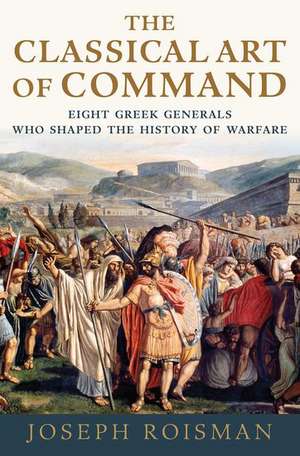
The Classical Art of Command: Eight Greek Generals Who Shaped the History of Warfare
Autor Joseph Roismanen Limba Engleză Hardback – 30 mar 2017
Publicul țintă format din studenți la istorie, cercetători ai antichității și practicieni interesați de leadership va descoperi în The Classical Art of Command o examinare riguroasă a modului în care viziunea individuală a influențat cursul războiului în Grecia Clasică. Ne-a atras atenția modul în care Joseph Roisman refuză generalizările abstracte, preferând să ancoreze „arta de a comanda” în carierele specifice ale unor figuri emblematice, de la ethosul eroic al lui Leonidas la inovațiile tehnice ale lui Dionysios I din Siracuza. Apreciem structura analitică ce urmărește transformarea generalului dintr-un simplu lider care conduce șarja într-un strateg capabil să gestioneze logistica și campaniile pe termen lung.
Această lucrare reprezintă o alternativă academică solidă la Greek Warfare de Lee L. Brice pentru cursurile de istorie militară antică, având avantajul unei abordări biografice care pune accent pe psihologia deciziei, nu doar pe cronologia conflictelor. În contextul operei sale, volumul sintetizează teme abordate anterior de Joseph Roisman în lucrări precum The General Demosthenes and His Use of Military Surprise, extinzând analiza de la tactica surprizei la un spectru larg de competențe de comandă. Spre deosebire de Masters of Command de Barry Strauss, care se concentrează pe marii cuceritori ca oameni de stat, Roisman păstrează un focus tehnic asupra modului în care acești generali au răspuns provocărilor militare specifice epocii lor, oferind o perspectivă nuanțată asupra succesului și eșecului pe câmpul de luptă.
Preț: 336.17 lei
Preț vechi: 437.30 lei
-23%
Carte tipărită la comandă
Livrare economică 02-13 octombrie
Specificații
ISBN-10: 0199985820
Pagini: 416
Ilustrații: 18 b/w line drawings; 20 b/w halftones
Dimensiuni: 135 x 218 x 33 mm
Greutate: 0.5 kg
Editura: Oxford University Press
Colecția OUP USA
Locul publicării:New York, United States
V-ar putea interesa
-
 Bullshit JobsDavid Graeber-31%Preț: 63.96 lei92.04 lei
 -
 The Roman RevolutionRonald SymePreț: 209.27 lei
 -
 The Roman CitizenshipA. N. Sherwin-White-28%Preț: 450.65 lei625.13 lei
 -
 -31%Preț: 567.80 lei819.42 lei
 -
 Holy Land Pilgrimage in the Later Roman Empire: AD 312-460Edward David Hunt-29%Preț: 417.58 lei584.05 lei
 -
 The GracchiDavid Stockton-29%Preț: 521.12 lei731.60 lei
 -
 Taken at the Flood: The Roman Conquest of GreeceRobin Waterfield-18%Preț: 82.56 lei100.48 lei
 -
 In the Grip of Disease: Studies in the Greek ImaginationG. E. R. Lloyd-29%Preț: 404.20 lei565.32 lei
 -
 The Jewish WarJosephus-18%Preț: 76.47 lei93.20 lei
 -
 Alexander’s Veterans and the Early Wars of the SuccessorsJoseph RoismanPreț: 217.49 lei
 -
 Winning the Hundred Battles: China and Asymmetric Warfare - War College SeriesNicholas R. ReisdorffPreț: 113.35 lei
 -
 50 Finds From CumbriaDot BoughtonPreț: 109.43 lei
 -
 Lost Voices of the NileCharlotte BoothPreț: 69.23 lei
 -
 How to Make Delicious Meat JerkyMiller, Tony JamesPreț: 90.25 lei
 -
 EgyptRose-Marie HagenPreț: 303.55 lei
De ce să citești această carte
Recomandăm această carte cititorilor care doresc să înțeleagă mecanismele din spatele victoriilor celebre ale antichității. Dincolo de faptele de arme, câștigați o perspectivă clară asupra modului în care personalitatea unui lider dictează strategia. Este o resursă esențială pentru a înțelege tranziția de la luptătorul hoplit la comandantul modern, fiind susținută de note bibliografice vaste și ilustrații care clarifică dinamica bătăliilor.
Despre autor
Joseph Roisman este profesor de studii clasice la Colby College și un cercetător consacrat al istoriei macedonene și ateniene. Expertiza sa este vastă, fiind autorul unor lucrări de referință precum Alexander’s Veterans and the Early Wars of the Successors și editor al volumului Companion to Ancient Macedonia. Interesul său academic s-a concentrat constant pe intersecția dintre retorică, politică și geniu militar, elemente care se regăsesc și în analiza sa asupra celor zece oratori atici sau în studiile dedicate lui Alexandru cel Mare. Această experiență îi permite să abordeze figurile militare grecești nu doar ca soldați, ci ca lideri complecși într-un context social și politic tensionat.
Descriere
Recenzii
The book is written in a flowing, easy style which makes it pleasure to read and accessible to undergraduates, and at the same time it contains insights which are valuable for modern scholarly discussions, some of which have been singled out above. Roisman succeeds in stressing the versatility expected from classical Greek generals and the importance of their personalities for the course of history.
[Roisman] is to be especially commended for the clarity, with which he traces the often complex shifts in alliances, particularly in the period after the Peloponnesian War -- a not insignificant detail, since the ability to cement or undermine these alliances was an important weapon in the commander's arsenal. With 38 illustrations and 38 maps, an extensive bibliography and a useful survey of primary sources, this is a welcome addition to the library of anyone interested in the ancient Greek world.
Overall, the material in this work is informed, well-presented, and supported by outstanding, careful research. This is an excellent contribution to this area of scholarship, and does a wonderful job of demonstrating the complexities of this type of leadership role, the planning and management of ancient warfare, and sheds new light on a number of well-known and important battles during this age. The general reader, as well as students and scholars, will find this work interesting and insightful. The Classical Art of Command will be a fundamental work for research into various aspects of Greek warfare and ancient Greek command during the Classical Age, as well as the lives and careers of these famous generals.