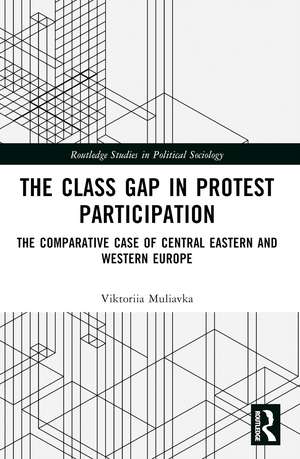
The Class Gap in Protest Participation: The Comparative Case of Central Eastern and Western Europe: Routledge Studies in Political Sociology
Autor Viktoriia Muliavkaen Limba Engleză Paperback – 27 oct 2025
In recent decades, mass protests have surged in both frequency and scale, yet there remains a significant variability in citizen involvement in non-electoral politics across Europe. While affluent Western democracies often witness robust civic engagement, countries of Central and Eastern Europe exhibit comparatively limited political participation. This regional gap is particularly pronounced when examining post-socialist workers who show minimal protest activity. Addressing this phenomenon, the book starts from the following question: Why do workers in Central and Eastern Europe demonstrate disproportionately lower rates of protest engagement compared to their Western European counterparts? The study reveals that the answer lies beyond conventional explanations such as legacies of communism. Cross-regional disparities in working-class protest activism are driven by differences in labor protection and left mobilization capacity. These variations stem from the historical context and the economic dependency of post-socialist countries, which create distinct conditions for workers' political engagement in the core and (semi-)periphery.
This book will be of interest to political scientists and sociologists, especially researchers interested in political participation, social inequality, and post-socialist transformations.
Din seria Routledge Studies in Political Sociology
- 9%
 Preț: 1350.53 lei
 -
 Preț: 409.59 lei
 -
 Preț: 419.51 lei
 - 18%
 Preț: 1137.15 lei
 -
 Preț: 427.83 lei
 -
 Preț: 410.01 lei
 -
 Preț: 410.99 lei
 -
 Preț: 441.18 lei
 -
 Preț: 397.82 lei
 -
 Preț: 370.28 lei
 -
 Preț: 379.41 lei
 - 18%
 Preț: 1112.48 lei
 -
 Preț: 444.29 lei
 -
 Preț: 198.11 lei
 - 18%
 Preț: 1113.07 lei
 - 18%
 Preț: 1113.42 lei
 - 18%
 Preț: 1117.60 lei
 -
 Preț: 213.58 lei
 -
 Preț: 405.33 lei
 -
 Preț: 396.17 lei
 -
 Preț: 422.48 lei
 -
 Preț: 420.37 lei
 - 5%
 Preț: 210.48 lei
 -
 Preț: 410.99 lei
 - 18%
 Preț: 1057.86 lei
 - 18%
 Preț: 1112.72 lei
 -
 Preț: 410.42 lei
 - 23%
 Preț: 1457.19 lei
 -
 Preț: 385.37 lei
 -
 Preț: 418.54 lei
Preț: 393.57 lei
Puncte Express: 590
Carte tipărită la comandă
Livrare economică 19 noiembrie-03 decembrie
Livrare prin curier în România Termenul estimat este afișat lângă disponibilitate.
Transport gratuit de la 400.00 lei Plată online sau ramburs, în funcție de opțiunile comenzii.
Retur gratuit în 14 zile Comandă securizată și suport în română.
Specificații
ISBN-13: 9781032632148
ISBN-10: 1032632143
Pagini: 132
Ilustrații: 28
Dimensiuni: 156 x 234 x 7 mm
Greutate: 0.2 kg
Ediția:1
Editura: Taylor & Francis
Colecția Routledge
Seria Routledge Studies in Political Sociology
Locul publicării:Oxford, United Kingdom
ISBN-10: 1032632143
Pagini: 132
Ilustrații: 28
Dimensiuni: 156 x 234 x 7 mm
Greutate: 0.2 kg
Ediția:1
Editura: Taylor & Francis
Colecția Routledge
Seria Routledge Studies in Political Sociology
Locul publicării:Oxford, United Kingdom
Public țintă
PostgraduateCuprins
1. Introduction
2. On the Intersection of Class and Region
2.1. Class Inequality and Protest Participation
2.2. Uneven Development and Post-socialist transformations
3. Production vs Service workers: Cross-Regional Disparities in Class Composition
4. Inequality, Redistribution and Protest Participation
4.1. Economic Inequality and the Relative Power
4.2. The Role of Labour Market Policies and Safety Nets in the Working-Class Protest Gap
5. Political Mobilisation from the Left
5.1. Union Membership and Mobilizing Infrastructure
5.2 Left Collective Attitudes and the Working-Class Protest Gap
6. Conclusion
Appendix A. Representation of Data across Time by Country (ESS 2002-2018)
Appendix B. Class Structure of Central Eastern and Western Europe based on Oesch 8-class scheme (2002-2018)
Appendix C. The Variance in the Share of Occupational Groups in Post-socialist and Western Europe by Countries based on Oesch 8-class Scheme (2018)
Index
2. On the Intersection of Class and Region
2.1. Class Inequality and Protest Participation
2.2. Uneven Development and Post-socialist transformations
3. Production vs Service workers: Cross-Regional Disparities in Class Composition
4. Inequality, Redistribution and Protest Participation
4.1. Economic Inequality and the Relative Power
4.2. The Role of Labour Market Policies and Safety Nets in the Working-Class Protest Gap
5. Political Mobilisation from the Left
5.1. Union Membership and Mobilizing Infrastructure
5.2 Left Collective Attitudes and the Working-Class Protest Gap
6. Conclusion
Appendix A. Representation of Data across Time by Country (ESS 2002-2018)
Appendix B. Class Structure of Central Eastern and Western Europe based on Oesch 8-class scheme (2002-2018)
Appendix C. The Variance in the Share of Occupational Groups in Post-socialist and Western Europe by Countries based on Oesch 8-class Scheme (2018)
Index
Recenzii
“Why do workers in the western part of Europe protest more than their counterparts in the former communist countries? A clichéd answer is that the main culprit is (usually poorly specified) legacies of communism. Equipped with a sophisticated understanding of the world-system theory, solid statistical skills, and creative mind, Muliavka shows that due to considerable differences in the institutional architecture, capitalism in the core and more peripheral regions of Europe works differently, generating different incentives for political and civic engagement, including participation in protest actions.”
Jan Kubik, Professor of Political Science, Rutgers University and University College London
"In 'The Class Gap in Protest Participation,' the author masterfully bridges critical gaps in our understanding of socio-political dynamics and protest movements. Building upon a rigorous analysis, the book unveils the nuanced interplay between class structures and political engagement. Essential for scholars and practitioners alike, it challenges and expands the discourse, offering fresh insights into the mechanics of protest participation. A seminal work, it is indispensable for anyone delving into contemporary social movements and political activism."
Mikołaj Cześnik, Professor of Political Science, SWPS University
"Muliavka’s book offers a most needed contribution on the relationship between class and protest participation across CEE and West European regions. In doing so, it succeeds at bringing the structural bases of political conflicts at centre stage, bridging different levels of analysis, and offering a role model for the organization of meaningful empirical research."
Martín Portos, Ramón y Cajal Fellow, Universidad Carlos III de Madrid
Jan Kubik, Professor of Political Science, Rutgers University and University College London
"In 'The Class Gap in Protest Participation,' the author masterfully bridges critical gaps in our understanding of socio-political dynamics and protest movements. Building upon a rigorous analysis, the book unveils the nuanced interplay between class structures and political engagement. Essential for scholars and practitioners alike, it challenges and expands the discourse, offering fresh insights into the mechanics of protest participation. A seminal work, it is indispensable for anyone delving into contemporary social movements and political activism."
Mikołaj Cześnik, Professor of Political Science, SWPS University
"Muliavka’s book offers a most needed contribution on the relationship between class and protest participation across CEE and West European regions. In doing so, it succeeds at bringing the structural bases of political conflicts at centre stage, bridging different levels of analysis, and offering a role model for the organization of meaningful empirical research."
Martín Portos, Ramón y Cajal Fellow, Universidad Carlos III de Madrid
Notă biografică
Viktoriia Muliavka is a postdoctoral researcher of comparative public policy at the University of Bamberg with a doctoral degree in sociology from the Polish Academy of Sciences. Her research and teaching focus on social inequalities, protest participation, welfare state preferences, and democratic resilience. Her work has been published in journals such as Social Movement Studies and Democratization.
Descriere
The Class Gap in Protest Participation discusses a theoretically grounded empirical analysis of the relationship between class and protest involvement across Central Eastern and Western Europe.