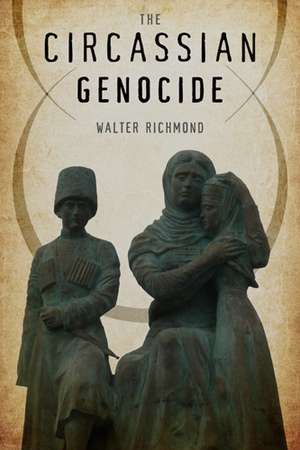
The Circassian Genocide: Genocide, Political Violence, Human Rights
Autor Walter Richmonden Limba Engleză Paperback – 9 apr 2013
Circassia was a small independent nation on the northeastern shore of the Black Sea. For no reason other than ethnic hatred, over the course of hundreds of raids the Russians drove the Circassians from their homeland and deported them to the Ottoman Empire. At least 600,000 people lost their lives to massacre, starvation, and the elements while hundreds of thousands more were forced to leave their homeland. By 1864, three-fourths of the population was annihilated, and the Circassians had become one of the first stateless peoples in modern history.
Using rare archival materials, Walter Richmond chronicles the history of the war, describes in detail the final genocidal campaign, and follows the Circassians in diaspora through five generations as they struggle to survive and return home. He places the periods of acute genocide, 1821–1822 and 1863–1864, in the larger context of centuries of tension between the two nations and updates the story to the present day as the Circassian community works to gain international recognition of the genocide as the region prepares for the 2014 Winter Olympics in Sochi, the site of the Russians’ final victory.
Using rare archival materials, Walter Richmond chronicles the history of the war, describes in detail the final genocidal campaign, and follows the Circassians in diaspora through five generations as they struggle to survive and return home. He places the periods of acute genocide, 1821–1822 and 1863–1864, in the larger context of centuries of tension between the two nations and updates the story to the present day as the Circassian community works to gain international recognition of the genocide as the region prepares for the 2014 Winter Olympics in Sochi, the site of the Russians’ final victory.
Din seria Genocide, Political Violence, Human Rights
-
 Preț: 315.84 lei
 -
 Preț: 300.58 lei
 -
 Preț: 262.30 lei
 -
 Preț: 352.60 lei
 -
 Preț: 293.13 lei
 -
 Preț: 246.82 lei
 -
 Preț: 170.46 lei
 -
 Preț: 331.45 lei
 -
 Preț: 328.02 lei
 -
 Preț: 304.20 lei
 -
 Preț: 283.45 lei
 -
 Preț: 540.51 lei
 -
 Preț: 325.52 lei
 -
 Preț: 326.70 lei
 -
 Preț: 328.12 lei
 - 12%
 Preț: 1016.88 lei
 -
 Preț: 318.89 lei
 -
 Preț: 402.63 lei
 - 10%
 Preț: 984.58 lei
 -
 Preț: 399.86 lei
 - 10%
 Preț: 984.43 lei
 -
 Preț: 404.58 lei
 -
 Preț: 451.67 lei
 - nou
 Preț: 996.62 lei
 -
 Preț: 388.19 lei
 - nou
 Preț: 632.02 lei
 - nou
 Preț: 320.20 lei
 - nou
 Preț: 405.45 lei
 - 21%
 Preț: 207.21 lei
 - 8%
 Preț: 1024.61 lei
 - 23%
 Preț: 842.50 lei
 - 27%
 Preț: 357.76 lei
Preț: 327.79 lei
Puncte Express: 492
Carte tipărită la comandă
Livrare economică 08-22 decembrie
Livrare prin curier în România Termenul estimat este afișat lângă disponibilitate.
Transport gratuit de la 400.00 lei Plată online sau ramburs, în funcție de opțiunile comenzii.
Retur gratuit în 14 zile Comandă securizată și suport în română.
Specificații
ISBN-13: 9780813560670
ISBN-10: 0813560675
Pagini: 232
Dimensiuni: 152 x 229 x 15 mm
Greutate: 0.31 kg
Ediția:None
Editura: Rutgers University Press
Colecția Rutgers University Press
Seria Genocide, Political Violence, Human Rights
ISBN-10: 0813560675
Pagini: 232
Dimensiuni: 152 x 229 x 15 mm
Greutate: 0.31 kg
Ediția:None
Editura: Rutgers University Press
Colecția Rutgers University Press
Seria Genocide, Political Violence, Human Rights
V-ar putea interesa
-
 Sex with the QueenEleanor HermanPreț: 126.88 lei
 -
 Brothers in WarMichael WalshPreț: 124.23 lei
 -
 Iron KingdomChristopher Clark-25%Preț: 115.28 lei152.99 lei
 -
 The Fall of ParisAlistair HornePreț: 125.52 lei
 -
 Ukraine: Birth of a Modern NationSerhy Yekelchyk-16%Preț: 216.07 lei258.11 lei
 -
 Great Tales From English History: Cheddar Man to DNARobert Lacey-25%Preț: 82.22 lei108.94 lei
 -
 GuerraJason Webster-25%Preț: 69.57 lei92.90 lei
 -
 Bringing the House DownDavid Profumo-27%Preț: 66.94 lei91.61 lei
 -
 History of the Byzantine StateGeorge OstrogorskyPreț: 486.34 lei
 -
 William WallaceAndrew FisherPreț: 79.01 lei
 -
 Lion and the UnicornRichard Aldous-17%Preț: 114.96 lei138.96 lei
 -
 The Mercurial EmperorPeter Marshall-19%Preț: 98.85 lei121.90 lei
 -
 -23%Preț: 84.34 lei110.22 lei
Notă biografică
WALTER RICHMOND is the director of the Russian Studies Program at Occidental College, Los Angeles. He is the author of The Northwest Caucasus: Past, Present, Future.
Cuprins
Acknowledgments
Introduction
1. "The Plague Was Our Ally"
2. A Pawn in the Great Game
3. From War to Genocide
4. 1864
5. A Homeless Nation
6. Survival in Diaspora
7. Those Who Stayed Behind
8. The Road to Sochi
Epilogue: The Cherkesove Affair
Notes
Bibliography
Index
Introduction
1. "The Plague Was Our Ally"
2. A Pawn in the Great Game
3. From War to Genocide
4. 1864
5. A Homeless Nation
6. Survival in Diaspora
7. Those Who Stayed Behind
8. The Road to Sochi
Epilogue: The Cherkesove Affair
Notes
Bibliography
Index
Recenzii
"[An] outstanding contribution to Caucasus studies. Richmond makes an important contribution to the understanding of the contemporary problems in the Caucasus, one that suggests that the deep-rooted wounds of the past do not cure themselves and do not simply go away with time but are still waiting to be resolved, even after a century and a half. All students and scholars, as well as policy makers, interested in the history and contemporary politics of the Caucasus will benefit from reading this excellent study."
"Walter Richmond's The Circassian Genocide is a timely work that masterfully investigates the ninteenth-century Russian policies over the Circassian lands, shedding light on one of the least-known and first genocides of modern history."
"Richmond provides a well-researched history of the deportation and destruction of the Circassians. This guide to the destruction of the Circassians, an often-overlooked tragedy, is valuable for a wide range of audiences. Recommended."
"[The Circassian Genocide] is well informed and contains a mass of information that will be new to most readers, about the events of 1863–1864 themselves, their background and subsequent developments."
"Richmond's work is a ground-breaking contribution to the history of Russia, the Caucasus, and genocide. For the first time it sheds light on this hidden tragedy on the frontier between Russia and the Middle East."
Descriere
This book chronicles the history of the war between Russia and Circassia, describes in detail the final genocidal campaign, and follows the Circassians in diaspora through five generations as they struggle to survive and return home. It updates the story to the present day as the Circassian community works to gain international recognition of the genocide as the region prepares for the 2014 Winter Olympics in Sochi, the site of the Russians’ final victory over the Circassians.