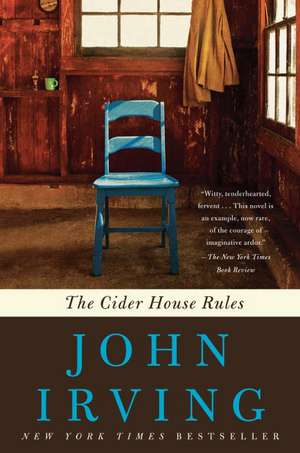
The Cider House Rules: Random House Publishing Group
Autor John Irvingen Limba Engleză Paperback – 23 iun 1997
Provenind din limba engleză, textul lui John Irving păstrează în traducere acea densitate a detaliului care face ca lumea orfelinatului St. Cloud’s să pară mai reală decât geografia imediată a statului Maine. Descoperim aici o odisee a identității, unde Homer Wells, un tânăr care refuză să fie adoptat pentru a-și găsi propriul loc, devine ucenicul doctorului Wilbur Larch. Notăm cu interes cum autorul construiește o relație tată-fiu neconvențională, marcată de dependența de eter a lui Larch și de refuzul lui Homer de a moșteni bisturiul mentorului său. În tradiția lui Amanda Coplin din The Orchardist, acest roman transformă livada de meri într-un spațiu al izolării și al maturizării, reimaginând familia nu ca pe o structură de sânge, ci ca pe un ansamblu de loialități fragile. Considerăm că forța narațiunii rezidă în capacitatea lui Irving de a aborda teme etice delicate fără a cădea în didacticism. Față de A Prayer For Owen Meany, unde destinul pare dictat de forțe supranaturale, aici personajele se confruntă cu reguli umane — uneori arbitrare, precum cele de la fabrica de cidru — și trebuie să decidă pe care să le încalce pentru a rămâne integri. Este un roman de o întindere generoasă, cu un ritm așezat, care permite cititorului să locuiască alături de personaje timp de decenii.
Din seria Random House Publishing Group
-
 Preț: 106.53 lei
 -
 Preț: 109.97 lei
 -
 Preț: 98.37 lei
 -
 Preț: 100.78 lei
 -
 Preț: 132.99 lei
 -
 Preț: 142.08 lei
 -
 Preț: 89.75 lei
 -
 Preț: 117.83 lei
 -
 Preț: 100.22 lei
 -
 Preț: 37.34 lei
 -
 Preț: 90.75 lei
 - 5%
 Preț: 90.05 lei
 -
 Preț: 121.46 lei
 -
 Preț: 78.81 lei
 -
 Preț: 145.91 lei
 -
 Preț: 126.68 lei
 -
 Preț: 106.49 lei
 -
 Preț: 98.20 lei
 -
 Preț: 121.42 lei
 -
 Preț: 113.54 lei
 -
 Preț: 113.92 lei
 -
 Preț: 98.09 lei
 - 25%
 Preț: 113.72 lei
 -
 Preț: 53.78 lei
 -
 Preț: 55.22 lei
 -
 Preț: 140.94 lei
 -
 Preț: 115.20 lei
 -
 Preț: 112.10 lei
 -
 Preț: 109.91 lei
 -
 Preț: 103.74 lei
 -
 Preț: 143.65 lei
 -
 Preț: 146.70 lei
 -
 Preț: 114.44 lei
 -
 Preț: 102.53 lei
 -
 Preț: 101.95 lei
 -
 Preț: 158.76 lei
 - 30%
 Preț: 88.29 lei
 -
 Preț: 89.43 lei
 -
 Preț: 150.73 lei
 -
 Preț: 47.85 lei
 -
 Preț: 115.60 lei
 -
 Preț: 97.77 lei
 -
 Preț: 35.24 lei
 -
 Preț: 52.95 lei
 -
 Preț: 94.06 lei
 - 12%
 Preț: 62.32 lei
 -
 Preț: 131.45 lei
 -
 Preț: 104.77 lei
 -
 Preț: 114.59 lei
Preț: 131.88 lei
Carte disponibilă
Livrare economică 29 octombrie-12 noiembrie
Specificații
ISBN-10: 0345417941
Pagini: 642
Dimensiuni: 142 x 210 x 33 mm
Greutate: 0.51 kg
Ediția:Ballantine Bks.
Editura: Random House
Colecția Random House Publishing Group
Seria Random House Publishing Group
V-ar putea interesa
-
 My AmericanStella GibbonsPreț: 104.30 lei
 -
 Here Be DragonsStella Gibbons-18%Preț: 59.37 lei72.61 lei
 -
 Treasures of MozartJohn IrvingPreț: 175.30 lei
 -
 BittersweetDanielle Steel-26%Preț: 52.89 lei71.32 lei
 -
 PoloJilly Cooper-16%Preț: 68.24 lei81.29 lei
 -
 This Other EdenBen Elton-19%Preț: 63.49 lei78.14 lei
 -
 Until I Find YouJohn Irving-16%Preț: 94.69 lei112.28 lei
 -
 Trying To Save Piggy SneedJohn Irving-31%Preț: 72.07 lei104.22 lei
 -
 East of the Setting SunGeorge Barr McCutcheonPreț: 126.21 lei
 -
 The Queen's Gambit: Now a Major Netflix DramaWalter Tevis-27%Preț: 57.35 lei78.23 lei
 -
 The Conspiracy & Other StoriesJaan KrossPreț: 114.55 lei
 -
 El Sueño de La RazónAntonio Buero VallejoPreț: 205.19 lei
 -
 Das Hotel New HampshireJohn IrvingPreț: 132.94 lei
 -
 Gottes Werk und Teufels BeitragJohn IrvingPreț: 144.68 lei
 -
 Die vierte HandNikolaus StinglPreț: 108.67 lei
 -
 Bis ich dich findeJohn IrvingPreț: 161.80 lei
De ce să citești această carte
Recomandăm această lectură celor care caută o proză densă, de tip clasic, despre complexitatea morală și formarea caracterului. Cititorul va câștiga o perspectivă profundă asupra modului în care ne alegem propriile „reguli” în viață. Este o carte fundamentală pentru a înțelege opera lui John Irving, oferind o poveste despre compasiune, secrete și curajul de a pleca de acasă pentru a înțelege ce înseamnă, de fapt, familia.
Despre autor
John Winslow Irving este un romancier și scenarist american de renume internațional, a cărui carieră a fost propulsată de succesul volumului „Lumea văzută de Garp”. Stilul său se caracterizează prin personaje excentrice, dar profund umane, și prin explorarea unor teme sociale controversate cu o empatie rară. Pentru ecranizarea romanului The Cider House Rules, Irving a fost recompensat cu Premiul Oscar pentru cel mai bun scenariu adaptat. Opera sa, care include titluri precum The Last Chairlift sau Avenue of Mysteries, este adesea ancorată în peisajul Noii Anglii, reflectând o preocupare constantă pentru destinul orfanilor și dinamica socială a Americii rurale.
Notă biografică
Extras
The Boy Who Belonged to St. Cloud’s
In the hospital of the orphanage-the boys’ division at St. Cloud’s, Maine-two nurses were in charge of naming the new babies and checking that their little penises were healing from the obligatory circumcision. In those days (in 192_), all boys born at St. Cloud’s were circumcised because the orphanage physician had experienced some difficulty in treating uncircumcised soldiers, for this and for that, in World War I. The doctor, who was also the doctor of the boys’ division, was not a religious man; circumcision was not a rite with him-it was a strictly medical act, performed for hygienic reasons. His name was Wilbur Larch, which, except for the scent of ether that always accompanied him, reminded one of the nurses of the tough, durable wood of the coniferous tree of that name. She hated, however, the ridiculous name of Wilbur, and took offense at the silliness of combining a word like Wilbur with something as substantial as a tree.
The other nurse imagined herself to be in love with Dr. Larch, and when it was her turn to name a baby, she frequently named him John Larch, or John Wilbur (her father’s name was John), or Wilbur Walsh (her mother’s maiden name had been Walsh). Despite her love for Dr. Larch, she could not imagine Larch as anything but a last name-and when she thought of him, she did not think of trees at all. For its flexibility as a first or as a last name, she loved the name of Wilbur-and when she tired of her use of John, or was criticized by her colleague for overusing it, she could rarely come up with anything more original than a Robert Larch or a Jack Wilbur (she seemed not to know that Jack was often a nickname for John).
If he had been named by this dull, love-struck nurse, he probably would have been a Larch or a Wilbur of one kind or another; and a John, a Jack, or a Robert-to make matters even duller. Because it was the other nurse’s turn, he was named Homer Wells.
The other nurse’s father was in the business of drilling wells, which was hard, harrowing, honest, precise work-to her thinking her father was composed of these qualities, which lent the word “wells” a certain deep, down-to-earth aura. “Homer” had been the name of one of her family’s umpteen cats.
This other nurse-Nurse Angela, to almost everyone-rarely repeated the names of her babies, whereas poor Nurse Edna had named three John Wilbur Juniors, and two John Larch the Thirds. Nurse Angela knew an inexhaustible number of no-nonsense nouns, which she diligently employed as last names-Maple, Fields, Stone, Hill, Knot, Day, Waters (to list a few)-and a slightly less impressive list of first names borrowed from a family history of many dead but cherished pets (Felix, Fuzzy, Smoky, Sam, Snowy, Joe, Curly, Ed and so forth).
For most of the orphans, of course, these nurse-given names were temporary. The boys’ division had a better record than the girls’ division at placing the orphans in homes when they were babies; too young ever to know the names their good nurses had given them; most of the orphans wouldn’t even remember Nurse Angela or Nurse Edna, the first women in the world to fuss over them. Dr. Larch made it a firm policy that the orphans’ adoptive families not be informed of the names the nurses gave with such zeal. The feeling at St. Cloud’s was that a child, upon leaving the orphanage, should know the thrill of a fresh start-but (especially the boys who were difficult to place and lived at St. Cloud’s the longest) it was hard for Nurse Angela and Nurse Edna, and even for Dr. Larch, not to think of their John Wilburs and John Larches (their Felix Hills, Curly Maples, Joe Knots, Smoky Waterses) as possessing their nurse-given names forever.
The reason Homer Wells kept his name was that he came back to St. Cloud’s so many times, after so many failed foster home, that the orphanage was forced to acknowledge Homer’s intention to make St. Cloud’s his home. It was not easy for anyone to accept, but Nurse Angela and Nurse Edna-and, finally, Dr. Wilbur Larch-were forced to admit that Homer Wells belonged to St. Cloud’s. The determined boy was not put up for adoption anymore.
Nurse Angela, with her love of cats and orphans, once remarked of Homer Wells that the boy must adore the name she gave him because he fought so hard not to lose it.
Descriere scurtă
Recenzii
“Superb in scope and originality, a novel as good as one could hope to find from any author, anywhere, anytime. Engrossing, moving, thoroughly satisfying.” —Joseph Heller
“An old-fashioned, big-hearted novel . . . with its epic yearning caught in the nineteenth century, somewhere between Trollope and Twain.”—Boston Sunday Globe
“The Cider House Rules is filled with people to love and to feel for. . . . The characters in John Irving’s novel break all the rules, and yet they remain noble and free-spirited.”—Houston Post
Descriere
As the oldest unadopted child at St Cloud's orphanage, Homer Wells strikes up a profound and unusual friendship with Wilbur Larch, the orphanage's founder, a man of rare compassion and an addiction to ether. What he learns from Wilbur takes him from his early apprenticeship in the orphanage surgery, to an adult life running a cider-making factory.