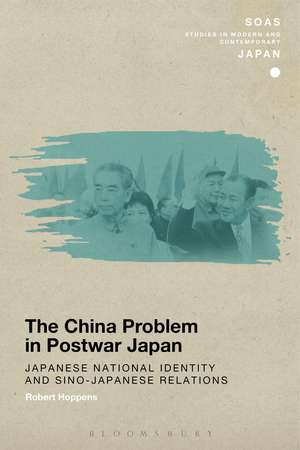
The China Problem in Postwar Japan: Japanese National Identity and Sino-Japanese Relations: SOAS Studies in Modern and Contemporary Japan
Autor Robert Hoppensen Limba Engleză Hardback – 29 ian 2015
The China Problem in Postwar Japan challenges some common assertions or assumptions about the role of Japanese national identity in postwar Sino-Japanese relations, showing how the history of Japanese relations with China in the 1970s is shaped by the strength of Japanese national identity, not its weakness.
Din seria SOAS Studies in Modern and Contemporary Japan
- 27%
 Preț: 247.85 lei
 - 26%
 Preț: 214.50 lei
 - 25%
 Preț: 251.37 lei
 - 21%
 Preț: 253.98 lei
 - 15%
 Preț: 250.53 lei
 - 25%
 Preț: 277.20 lei
 - 33%
 Preț: 623.19 lei
 - 25%
 Preț: 247.15 lei
 - 36%
 Preț: 597.88 lei
 -
 Preț: 349.84 lei
 - 25%
 Preț: 243.70 lei
 - 23%
 Preț: 240.63 lei
 - 25%
 Preț: 277.58 lei
 - 15%
 Preț: 283.99 lei
 - 23%
 Preț: 235.51 lei
 - 25%
 Preț: 277.48 lei
 - 32%
 Preț: 584.30 lei
 - 26%
 Preț: 260.53 lei
 - 15%
 Preț: 279.86 lei
 - 16%
 Preț: 271.07 lei
 - 27%
 Preț: 255.21 lei
 - 23%
 Preț: 236.30 lei
 - 24%
 Preț: 259.09 lei
 - 33%
 Preț: 645.41 lei
 - 25%
 Preț: 283.32 lei
 - 23%
 Preț: 241.07 lei
 - 33%
 Preț: 583.08 lei
 - 33%
 Preț: 851.75 lei
Preț: 837.75 lei
Preț vechi: 1243.99 lei
-33%
Puncte Express: 1257
Carte tipărită la comandă
Livrare economică 24 noiembrie-08 decembrie
Livrare prin curier în România Termenul estimat este afișat lângă disponibilitate.
Transport gratuit pentru acest produs Plată online sau ramburs, în funcție de opțiunile comenzii.
Retur gratuit în 14 zile Comandă securizată și suport în română.
Specificații
ISBN-13: 9781472575463
ISBN-10: 1472575466
Pagini: 312
Dimensiuni: 164 x 236 x 26 mm
Greutate: 0.61 kg
Editura: Bloomsbury Publishing
Colecția Bloomsbury Academic
Seria SOAS Studies in Modern and Contemporary Japan
Locul publicării:London, United Kingdom
ISBN-10: 1472575466
Pagini: 312
Dimensiuni: 164 x 236 x 26 mm
Greutate: 0.61 kg
Editura: Bloomsbury Publishing
Colecția Bloomsbury Academic
Seria SOAS Studies in Modern and Contemporary Japan
Locul publicării:London, United Kingdom
V-ar putea interesa
-
 The First CrusadePeter Frankopan-19%Preț: 75.24 lei93.04 lei
 -
 Samuel and the Shaping of TraditionMark Leuchter-14%Preț: 246.94 lei285.74 lei
 -
 Imperial Life in the Emerald CityRajiv Chandrasekaran-27%Preț: 67.20 lei91.77 lei
 -
 I Was Born There, I Was Born HereMourid Barghouti-27%Preț: 57.53 lei78.62 lei
 -
 Mecca: The Sacred CityZiauddin Sardar-27%Preț: 88.28 lei120.26 lei
 -
 The Nile: Downriver Through Egypt’s Past and PresentToby Wilkinson-27%Preț: 88.94 lei121.63 lei
 -
 Attila the HunNic Fields-32%Preț: 76.73 lei113.23 lei
 -
 The Invention of the Land of IsraelShlomo SandPreț: 184.43 lei
Cuprins
Introduction
Part I: The China Problem in Postwar Japan 1945-1970
Chapter 1: The China Problem in Postwar Japanese Foreign Policy
Chapter 2: The China Problem and Postwar Japanese National Identity
Part II: The Nixon Shock and the Normalization of Relations 1971-1972
Chapter 3: The Politics of the Nixon Shock and the Normalization of Relations
Chapter 4: The China Problem in a New Era
Part III: The Anti-Hegemony Issue 1973-1976
Chapter 5: The Anti-Hegemony Issue: Japan and the Sino-Soviet Cold War
Chapter 6: The China Problem in a Time of Crisis and Adaptation
Part IV: From the Peace Treaty to Economic Cooperation 1977-1979
Chapter 7: The Diplomacy of Peace and Cooperation
Chapter 8: Conservative Triumphalism and the China Problem
Epilogue: Toward the "History Problem"
Conclusion
Bibliography
Index
Part I: The China Problem in Postwar Japan 1945-1970
Chapter 1: The China Problem in Postwar Japanese Foreign Policy
Chapter 2: The China Problem and Postwar Japanese National Identity
Part II: The Nixon Shock and the Normalization of Relations 1971-1972
Chapter 3: The Politics of the Nixon Shock and the Normalization of Relations
Chapter 4: The China Problem in a New Era
Part III: The Anti-Hegemony Issue 1973-1976
Chapter 5: The Anti-Hegemony Issue: Japan and the Sino-Soviet Cold War
Chapter 6: The China Problem in a Time of Crisis and Adaptation
Part IV: From the Peace Treaty to Economic Cooperation 1977-1979
Chapter 7: The Diplomacy of Peace and Cooperation
Chapter 8: Conservative Triumphalism and the China Problem
Epilogue: Toward the "History Problem"
Conclusion
Bibliography
Index
Recenzii
This review cannot do justice to the author's wide-ranging analysis of the nationalist discourse by many Japanese intellectuals and political leaders and its linkage to Japan's China policy ... This book is a major contribution to the study of post-war Japan-China relations ... Written and structured well, it will assist students as well as researchers to better understand the tortuous development of this important bilateral relationship.
Hoppens' argument is backed by a solid base of Japanese, Chinese and English-language primary and secondary sources ... Hoppens is to be applauded for not merely relying on the "official" sources ... [as] in moving beyond just the "official" position, readers get a much more rich, nuanced analysis of how the Japanese general public viewed China in the 1970s ... [This book] will be the standard to which those interested in this period of Sino-Japanese relations first turn for the foreseeable future.
Richly detailed, the book is by far the most comprehensive English-language diplomatic history of this pivotal period in Sino-Japanese relations and the transformation of Japan's post-war national identity.
The book will be of great interest to anyone concerned with Sino-Japanese relations.
Very well researched ... A lucid and reasoned approach to important issues ... A very welcome addition to the large literature on Japanese "identity" and Japan's political discourse.
How China and Japan have regarded one another since 1945 has led to the expenditure of much ink, but the search for the right words to make sense of it all remains incomplete. As arguably the most important bilateral tie in East Asia-between the world's second and third largest economies, and two mighty militaries-an explanation is as desirable as it is necessary. Hoppens goes a long way toward that end with this book, especially in assessing the decade of the 1970s and addressing the ramifications of cataclysmic defeat on Japan's postwar national identity. He takes beyond Sino-Japanese diplomatic normalization, even touching on the debates over "history" that occupied many a mind in the early 1980s. For those interested or concerned with the China-Japan relationship, this book deserves our cogitation.
The China Problem in Postwar Japan is a fresh and ambitious new look at the complexities of the relationship that postwar Japan has pursued with its giant neighbor, China. Linked by geographic proximity as well as a shared history, Japan's leaders have always faced the challenge of adroitly maneuvering a foreign policy with China that would maximize Japan's national interests while also balancing domestic concerns (trade and national security) and its alliance with the United States. Utilizing a trove of archival material from Japan, China, and the US, Hoppens does a fine job of illuminating both the success and failures of Japan's quest in dealing with this so-called "China problem." This is a must read for not only those interested in postwar Sino-Japanese relations, but also for policy-makers who need to garner further insight into what kind of future awaits East Asia with a bolder and more confident China and a wary Japan that is increasingly leaning towards a more proactive security policy.
An excellent book ... We strongly recommend that you keep this book in the libraries of major universities.
Hoppens' argument is backed by a solid base of Japanese, Chinese and English-language primary and secondary sources ... Hoppens is to be applauded for not merely relying on the "official" sources ... [as] in moving beyond just the "official" position, readers get a much more rich, nuanced analysis of how the Japanese general public viewed China in the 1970s ... [This book] will be the standard to which those interested in this period of Sino-Japanese relations first turn for the foreseeable future.
Richly detailed, the book is by far the most comprehensive English-language diplomatic history of this pivotal period in Sino-Japanese relations and the transformation of Japan's post-war national identity.
The book will be of great interest to anyone concerned with Sino-Japanese relations.
Very well researched ... A lucid and reasoned approach to important issues ... A very welcome addition to the large literature on Japanese "identity" and Japan's political discourse.
How China and Japan have regarded one another since 1945 has led to the expenditure of much ink, but the search for the right words to make sense of it all remains incomplete. As arguably the most important bilateral tie in East Asia-between the world's second and third largest economies, and two mighty militaries-an explanation is as desirable as it is necessary. Hoppens goes a long way toward that end with this book, especially in assessing the decade of the 1970s and addressing the ramifications of cataclysmic defeat on Japan's postwar national identity. He takes beyond Sino-Japanese diplomatic normalization, even touching on the debates over "history" that occupied many a mind in the early 1980s. For those interested or concerned with the China-Japan relationship, this book deserves our cogitation.
The China Problem in Postwar Japan is a fresh and ambitious new look at the complexities of the relationship that postwar Japan has pursued with its giant neighbor, China. Linked by geographic proximity as well as a shared history, Japan's leaders have always faced the challenge of adroitly maneuvering a foreign policy with China that would maximize Japan's national interests while also balancing domestic concerns (trade and national security) and its alliance with the United States. Utilizing a trove of archival material from Japan, China, and the US, Hoppens does a fine job of illuminating both the success and failures of Japan's quest in dealing with this so-called "China problem." This is a must read for not only those interested in postwar Sino-Japanese relations, but also for policy-makers who need to garner further insight into what kind of future awaits East Asia with a bolder and more confident China and a wary Japan that is increasingly leaning towards a more proactive security policy.
An excellent book ... We strongly recommend that you keep this book in the libraries of major universities.