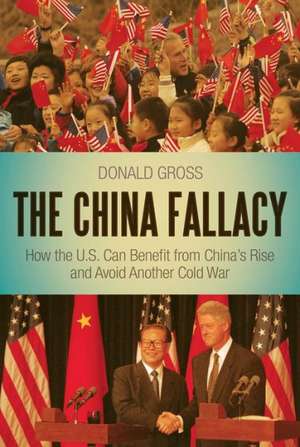
The China Fallacy: How the U.S. Can Benefit from China's Rise and Avoid Another Cold War
Autor Dr. Donald Grossen Limba Engleză Paperback – 3 ian 2013
This authoritative work examines why and how the U.S. should stabilize and improve its relations with China. It first assesses the threat posed by China, addressing such issues as military capability, Taiwan, the trade deficit, human rights and democracy. It then discusses the rationale for rapprochement between the two countries in order to achieve a stable peace. It makes the case for a fundamental shift in U.S. policy and efforts by both countries to increase their cooperation. It analyzes the benefits to the United States of this policy shift along with the potential impact on Japan, Taiwan, and both Koreas.
This significant work on U.S.-China relations will be an essential resource for the academic and policy community as well as of interest to the general reader on a topic of great public concern.
Preț: 281.15 lei
Preț vechi: 379.59 lei
-26%
Puncte Express: 422
Carte tipărită la comandă
Livrare economică 25 noiembrie-09 decembrie
Livrare prin curier în România Termenul estimat este afișat lângă disponibilitate.
Transport gratuit de la 400.00 lei Plată online sau ramburs, în funcție de opțiunile comenzii.
Retur gratuit în 14 zile Comandă securizată și suport în română.
Specificații
ISBN-13: 9781441147899
ISBN-10: 1441147896
Pagini: 320
Dimensiuni: 150 x 226 x 23 mm
Greutate: 0.5 kg
Editura: Bloomsbury Publishing
Colecția Bloomsbury Academic
Locul publicării:New York, United States
ISBN-10: 1441147896
Pagini: 320
Dimensiuni: 150 x 226 x 23 mm
Greutate: 0.5 kg
Editura: Bloomsbury Publishing
Colecția Bloomsbury Academic
Locul publicării:New York, United States
V-ar putea interesa
-
 The ABM Treaty: To Defend or not to Defend?Walther Stützle-14%Preț: 246.39 lei287.63 lei
 -
 -13%Preț: 315.04 lei362.40 lei
 -
 -23%Preț: 389.69 lei505.58 lei
 -
 Preț: 170.87 lei
 -
 The Soviet Nuclear Weapon LegacyMarco de Andreis-12%Preț: 239.89 lei271.92 lei
 -
 -15%Preț: 243.03 lei285.85 lei
 -
 The Evolution of Biological DisarmamentNicholas Sims-22%Preț: 364.77 lei467.77 lei
 -
 SIPRI Yearbook 2002: Armaments, Disarmament and International SecurityStockholm International Peace Research Institute-31%Preț: 1738.25 lei2522.97 lei
 -
 -13%Preț: 328.65 lei378.79 lei
 -
 Europe and Iran: Perspectives on Non-ProliferationShannon N. Kile-13%Preț: 358.62 lei413.05 lei
 -
 Modern War: A Very Short IntroductionRichard English-21%Preț: 55.34 lei69.84 lei
 -
 Preț: 423.13 lei
 -
 Politics of FearProfessor Frank FurediPreț: 267.20 lei
 -
 Preț: 179.23 lei
 -
 -16%Preț: 96.19 lei114.46 lei
Cuprins
1. Introduction: The Unfulfilled Promise of U.S.-China Relations
2. The Real Military Balance
3. Rapprochement and a Stable Peace
4. China's Economic Juggernaut
5. Democracy and Human Rights in China
6. The "Soft Power" of China's Foreign Policy
7. Getting It Right: A New Framework Agreement for U.S.-China Relations
8. Realizing Japan's Foreign Policy Goals
9. Achieving Korean Reunification
10. Conclusion: The China Fallacy
11. Epilogue
2. The Real Military Balance
3. Rapprochement and a Stable Peace
4. China's Economic Juggernaut
5. Democracy and Human Rights in China
6. The "Soft Power" of China's Foreign Policy
7. Getting It Right: A New Framework Agreement for U.S.-China Relations
8. Realizing Japan's Foreign Policy Goals
9. Achieving Korean Reunification
10. Conclusion: The China Fallacy
11. Epilogue
Recenzii
This thrilling and thought-provoking volume by Gross (senior associate, Pacific Forum, Center for Strategic and International Studies) seeks to challenge the conventional wisdom underlying current policy toward China. Summing Up: Highly recommended. All readership levels.
Donald Gross's The China Fallacy is a well written, well documented, and refreshing look into the myriad "shortcomings of current US trade and defense policy toward China."
The China Fallacy is essential reading for anyone who wants to understand American policy toward China. Its thoughtful recommendations on improving U.S.-China relations should be weighed seriously by all concerned with the impact of China's rise.
Understanding the complexity, risk and opportunity of China's rise will drive American opinions and policy making well into the 21st century. This book makes an important contribution to that end.
Considered as a whole, The China Fallacy forces debate on U.S-China relations by introducing bold policy recommendations which today remain outside of the mainstream. To be sure, hardliners will find ample material to criticize whereas those seeking accommodation may view this text as a blueprint for the next phase in Sino-American relations.
Donald Gross's The China Fallacy is a well written, well documented, and refreshing look into the myriad "shortcomings of current US trade and defense policy toward China."
The China Fallacy is essential reading for anyone who wants to understand American policy toward China. Its thoughtful recommendations on improving U.S.-China relations should be weighed seriously by all concerned with the impact of China's rise.
Understanding the complexity, risk and opportunity of China's rise will drive American opinions and policy making well into the 21st century. This book makes an important contribution to that end.
Considered as a whole, The China Fallacy forces debate on U.S-China relations by introducing bold policy recommendations which today remain outside of the mainstream. To be sure, hardliners will find ample material to criticize whereas those seeking accommodation may view this text as a blueprint for the next phase in Sino-American relations.