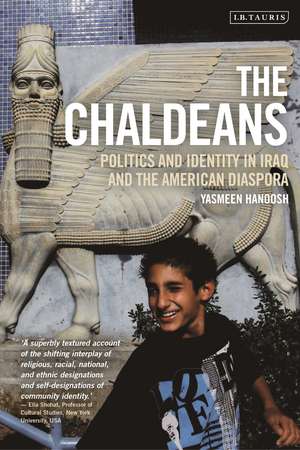
The Chaldeans: Politics and Identity in Iraq and the American Diaspora
Autor Yasmeen Hanooshen Limba Engleză Hardback – 30 mai 2019
Preț: 723.91 lei
Preț vechi: 1168.43 lei
-38%
Puncte Express: 1086
Carte disponibilă
Livrare economică 10-24 noiembrie
Livrare prin curier în România Termenul estimat este afișat lângă disponibilitate.
Transport gratuit pentru acest produs Plată online sau ramburs, în funcție de opțiunile comenzii.
Retur gratuit în 14 zile Comandă securizată și suport în română.
Specificații
ISBN-13: 9781788313698
ISBN-10: 1788313690
Pagini: 328
Ilustrații: 25 b&w
Dimensiuni: 156 x 234 mm
Greutate: 0.67 kg
Editura: Bloomsbury Publishing
Colecția I.B.Tauris
Locul publicării:London, United Kingdom
ISBN-10: 1788313690
Pagini: 328
Ilustrații: 25 b&w
Dimensiuni: 156 x 234 mm
Greutate: 0.67 kg
Editura: Bloomsbury Publishing
Colecția I.B.Tauris
Locul publicării:London, United Kingdom
Cuprins
Dedication
Figures
Abbreviations
Acknowledgements
Introduction
1. On the Politics of Appellation: The Making of the Modern Chaldeans 27
2. Archaeology, Philology and Mission: The Modern History of Ancient Chaldean History
3. Arab/Chaldean/Assyrian Distinctions: Political Survival in the New Nation State of Iraq
4. From Religious to Ethnic Minority: Between Iraq and America in the Twentieth Century
5. Family, Marriage and Ethnic Economy: A Transnational Social Field Perspective
6. The Modern Chaldean Church: Global Circuits of Ecclesial Power
7. A Safe Haven Dream: Home between Detroit and the Nineveh Plain
8. Chaldeanness: The Official Narrative and its Changing Displays
Epilogue: Centre and Peripheries of Chaldeanness in the Twilight of the Nation State
Appendix: Appellations and Languages
Notes
Works Cited
Index
Figures
Abbreviations
Acknowledgements
Introduction
1. On the Politics of Appellation: The Making of the Modern Chaldeans 27
2. Archaeology, Philology and Mission: The Modern History of Ancient Chaldean History
3. Arab/Chaldean/Assyrian Distinctions: Political Survival in the New Nation State of Iraq
4. From Religious to Ethnic Minority: Between Iraq and America in the Twentieth Century
5. Family, Marriage and Ethnic Economy: A Transnational Social Field Perspective
6. The Modern Chaldean Church: Global Circuits of Ecclesial Power
7. A Safe Haven Dream: Home between Detroit and the Nineveh Plain
8. Chaldeanness: The Official Narrative and its Changing Displays
Epilogue: Centre and Peripheries of Chaldeanness in the Twilight of the Nation State
Appendix: Appellations and Languages
Notes
Works Cited
Index
Recenzii
The Chaldeans offers a superbly textured account of the shifting interplay of religious, racial, national, and ethnic designations and self-designations of community identity, moving compellingly from the late Ottoman era to the present. Addressing the modern revival of ancient Mesopotamian civilization, Hanoosh develops a densely complex narrative of the fraught ideological politics swirling around "Iraq's Christians," especially as articulated vis-à-vis Arabness and Islam. In this astute analysis of the efforts to stabilize definitions of belonging, the book insightfully captures the tensions and paradoxes embedded not simply in regional but rather in transnational processes of minoritization.
The Chaldeans is the first study that successfully frames the community in a social fields perspective and retains an analytic lucidity that makes the work beautifully clear for scholarly and classroom audiences alike. Hanoosh demonstrates an unmatched ability to weave together competing perspectives in a way that compassionately represents them without condescension or side-taking. The book's findings are impressive on their own, but I was doubly struck by her modeling of empathetic scholarship for the many communities she writes about.
Hanoosh has written one of the most provocative 'identity' studies to date, compelling us to rethink key notion of relationality, citizenship, and displacement. The Chaldeans is a timely and sobering book precisely because it demonstrates that we come late in understanding the discursive politics that form our identities. Focusing on the complex historiography of Chaldean identities, it powerfully reveals how questions of ideology, history and geography set certain demands upon identity that can both be unsettling and revealing. This is a new classic that will forcefully redefine notions of minority, religion, ethnicity, and sectarianism in Iraq.
This is a vital book and essential reading for anyone who cares about the Christian minorities now living in a region beset by sectarian violence and colonial ambitions that map religious identities onto the landscape while also trying to erase them. The Chaldeans is brave, interesting, and well researched. It completely eviscerates the existing literature on the subject, which traps Chaldeans in their stores and churches and deprives them of political and cultural agency. Hanoosh's exploration of these themes is personal and sharply critical. She nonetheless holds open the possibility of defining self and community in alternative ways that defy and transgress institutional and national framings.
The Chaldeans is the first study that successfully frames the community in a social fields perspective and retains an analytic lucidity that makes the work beautifully clear for scholarly and classroom audiences alike. Hanoosh demonstrates an unmatched ability to weave together competing perspectives in a way that compassionately represents them without condescension or side-taking. The book's findings are impressive on their own, but I was doubly struck by her modeling of empathetic scholarship for the many communities she writes about.
Hanoosh has written one of the most provocative 'identity' studies to date, compelling us to rethink key notion of relationality, citizenship, and displacement. The Chaldeans is a timely and sobering book precisely because it demonstrates that we come late in understanding the discursive politics that form our identities. Focusing on the complex historiography of Chaldean identities, it powerfully reveals how questions of ideology, history and geography set certain demands upon identity that can both be unsettling and revealing. This is a new classic that will forcefully redefine notions of minority, religion, ethnicity, and sectarianism in Iraq.
This is a vital book and essential reading for anyone who cares about the Christian minorities now living in a region beset by sectarian violence and colonial ambitions that map religious identities onto the landscape while also trying to erase them. The Chaldeans is brave, interesting, and well researched. It completely eviscerates the existing literature on the subject, which traps Chaldeans in their stores and churches and deprives them of political and cultural agency. Hanoosh's exploration of these themes is personal and sharply critical. She nonetheless holds open the possibility of defining self and community in alternative ways that defy and transgress institutional and national framings.