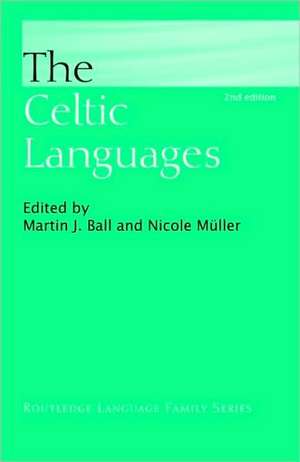
The Celtic Languages: Routledge Language Family Series
Editat de Martin J. Ball, Nicole Mülleren Limba Engleză Hardback – 27 aug 2009
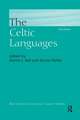
This second edition has been thoroughly revised to provide a comprehensive and up-to-date account of the modern Celtic languages and their current sociolinguistic status along with complete descriptions of the historical languages.
This comprehensive volume is arranged in four parts. The first part offers a description of the typological aspects of the Celtic languages followed by a scene setting historical account of the emergence of these languages. Chapters devoted to Continental Celtic, Old and Middle Irish, and Old and Middle Welsh follow. Parts two and three are devoted to linguistic descriptions of the contemporary languages. Part two has chapters on Irish, Scots Gaelic and Manx, while Part three covers Welsh, Breton and Cornish. Part four is devoted to the sociolinguistic situation of the four contemporary Celtic languages and a final chapter describes the status of the two revived languages Cornish and Manx.
With contributions from a variety of scholars of the highest reputation, The Celtic Languages continues to be an invaluable tool for both students and teachers of linguistics, especially those with an interest in typology, language universals and the unique sociolinguistic position which the Celtic languages occupy.
Dr Martin J. Ball is Hawthorne-BoRSF Endowed Professor, and Director of the Hawthorne Research Center, at the University of Louisiana at Lafayette. Dr Ball has over 120 academic publications. Among his books are The Use of Welsh, Mutation in Welsh, and Welsh Phonetics.
Dr Nicole Müller is Hawthorne-BoRSF Endowed Professor at the University of Louisiana at Lafayette. Among her books are Mutation in Welsh, and Agents in Early Irish and Early Welsh.
Din seria Routledge Language Family Series
-
 Preț: 489.68 lei
 - 15%
 Preț: 665.05 lei
 - 15%
 Preț: 714.78 lei
 - 18%
 Preț: 2907.56 lei
 - 15%
 Preț: 484.12 lei
 - 15%
 Preț: 716.47 lei
 - 18%
 Preț: 809.50 lei
 - 18%
 Preț: 780.97 lei
 - 9%
 Preț: 2427.50 lei
 - 18%
 Preț: 749.97 lei
 - 8%
 Preț: 452.25 lei
 -
 Preț: 500.31 lei
 -
 Preț: 463.24 lei
 - 15%
 Preț: 664.56 lei
 - 15%
 Preț: 749.26 lei
 - 15%
 Preț: 618.55 lei
 - 15%
 Preț: 645.05 lei
 -
 Preț: 503.42 lei
 -
 Preț: 486.54 lei
 - 15%
 Preț: 636.06 lei
 - 15%
 Preț: 631.05 lei
 - 15%
 Preț: 533.30 lei
 -
 Preț: 464.91 lei
 - 18%
 Preț: 699.41 lei
 - 18%
 Preț: 3210.42 lei
 - nou
 Preț: 2070.63 lei
Preț: 2774.80 lei
Preț vechi: 3383.90 lei
-18%
Puncte Express: 4162
Carte tipărită la comandă
Livrare economică 07-21 decembrie
Livrare prin curier în România Termenul estimat este afișat lângă disponibilitate.
Transport gratuit pentru acest produs Plată online sau ramburs, în funcție de opțiunile comenzii.
Retur gratuit în 14 zile Comandă securizată și suport în română.
Specificații
ISBN-13: 9780415422796
ISBN-10: 0415422795
Pagini: 800
Ilustrații: 145 tables and 47 halftones
Dimensiuni: 156 x 234 x 46 mm
Greutate: 1.64 kg
Ediția:2Revizuită
Editura: Taylor & Francis
Colecția Routledge
Seria Routledge Language Family Series
Locul publicării:Oxford, United Kingdom
ISBN-10: 0415422795
Pagini: 800
Ilustrații: 145 tables and 47 halftones
Dimensiuni: 156 x 234 x 46 mm
Greutate: 1.64 kg
Ediția:2Revizuită
Editura: Taylor & Francis
Colecția Routledge
Seria Routledge Language Family Series
Locul publicării:Oxford, United Kingdom
V-ar putea interesa
-
 Mutation in WelshMartin J. Ball-18%Preț: 1251.35 lei1526.04 lei
 -
 -5%Preț: 489.00 lei514.74 lei
 -
 Orobai's VisionMartin BallPreț: 130.26 lei
 -
 Speed up your French: Strategies to Avoid Common ErrorsMargaret JubbPreț: 409.96 lei
 -
 -8%Preț: 460.14 lei500.15 lei
 -
 Colloquial German 2: The Next Step in Language LearningAnnette DuensingPreț: 328.47 lei
 -
 Colloquial Indonesian: The Complete Course for BeginnersSutanto Atmosumarto-11%Preț: 481.09 lei540.55 lei
 -
 Colloquial Polish: The Complete Course for BeginnersBolesław Mazur-11%Preț: 523.41 lei588.10 lei
 -
 Colloquial Spanish: The Complete Course for BeginnersUntza Otaola AldayPreț: 402.80 lei
 -
 Challenging Sonority: Cross-Linguistic EvidenceMartin J. Ball-19%Preț: 684.56 lei845.13 lei
 -
 Assessing GrammarMartin J. Ball-5%Preț: 1153.97 lei1214.71 lei
 -
 Preț: 141.74 lei
 -
 Logisch! A1 - Kursbuch A1Ute KoithanPreț: 183.83 lei
 -
 Preț: 79.24 lei
 -
 Preț: 242.02 lei
 -
 Das neue Deutschmobil 2. Lehrbuch mit Audio-CDJutta Douvitsas-GamstPreț: 238.14 lei
 -
 Preț: 174.55 lei
 -
 Planet 2 / ArbeitsbuchGabriele KoppPreț: 172.53 lei
Public țintă
Academic and PostgraduateCuprins
Preface. List of Contributors. Part 1 Historical Aspects Part 2 The Goidelic Languages Part 3 The Brythonic Languages Part 4 The Sociolinguistics of the Celtic Languages Index
Recenzii
"This is an impressive and important collection of work about the Celtic language
family. It has something for everyone, from historical linguistics to phonology
to language policy. Any serious Celticist needs to have this close to hand." - Linguist List
family. It has something for everyone, from historical linguistics to phonology
to language policy. Any serious Celticist needs to have this close to hand." - Linguist List
Descriere
The Celtic Languages describes in depth all the Celtic languages from historical, structural and sociolinguistic perspectives with individual chapters on Irish, Scottish Gaelic, Manx, Welsh, Breton and Cornish.
This second edition has been thoroughly revised to provide a comprehensive and up-to-date account of the modern Celtic languages and their current sociolinguistic status along with complete descriptions of the historical languages.
With contributions from a variety of scholars of the highest reputation, The Celtic Languages continues to be an invaluable tool for both students and teachers of linguistics, especially those with an interest in typology, language universals and the unique sociolinguistic position which the Celtic languages occupy.
This second edition has been thoroughly revised to provide a comprehensive and up-to-date account of the modern Celtic languages and their current sociolinguistic status along with complete descriptions of the historical languages.
With contributions from a variety of scholars of the highest reputation, The Celtic Languages continues to be an invaluable tool for both students and teachers of linguistics, especially those with an interest in typology, language universals and the unique sociolinguistic position which the Celtic languages occupy.
Notă biografică
Martin J. Ball is Honorary Professor of Linguistics, Bangor University, Wales and Adjunct Professor of Speech and Hearing Sciences, University College Cork, Ireland.
Nicole Müller is professor of Speech and Hearing Sciences at University College Cork, Ireland.
Nicole Müller is professor of Speech and Hearing Sciences at University College Cork, Ireland.