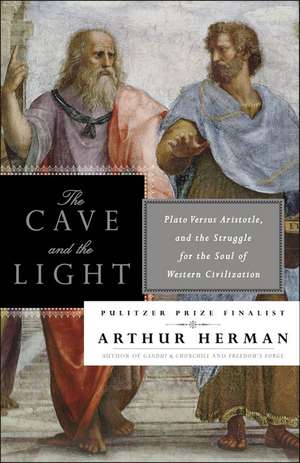
The Cave and the Light
Autor Arthur Hermanen Limba Engleză Paperback – 3 iun 2014
Apreciem modul în care Arthur Herman, istoric recunoscut și finalist al premiului Pulitzer, reușește să transforme istoria ideilor într-o narațiune vibrantă și accesibilă. În The Cave and the Light, Herman fundamentează întreaga evoluție a civilizației vestice pe tensiunea dialectică dintre doi coloși ai Antichității: Platon și Aristotel. Autorul nu se limitează la o analiză filozofică aridă, ci demonstrează cum această divergență fundamentală — între aspirația către adevăruri spirituale înalte (simbolizată de peștera lui Platon) și rigoarea observației empirice (promovată de Liceul lui Aristotel) — a modelat instituțiile, știința și politica noastră actuală. Găsim în această lucrare o continuare tematică a preocupărilor din The Scottish Enlightenment, unde Herman explora bazele modernității. Dacă în lucrările anterioare, precum Gandhi and Churchill, autorul se concentra pe dualități biografice specifice, aici miza este mult mai amplă, acoperind peste două milenii de istorie. Textul urmărește „umbra” celor doi filosofi asupra unor figuri precum Martin Luther sau Karl Marx, oferind o perspectivă rară asupra modului în care conceptele antice supraviețuiesc în era digitală. Considerăm această carte o alternativă cuprinzătoare la The Greek Philosophers de W. K. C. Guthrie pentru cursurile de istorie culturală sau filozofie. Față de introducerea sintetică a lui Guthrie, lucrarea lui Herman aduce avantajul unei perspective macro-istorice, legând direct metafizica greacă de evenimente contemporane, totul susținut de 46 de ilustrații și o documentare riguroasă. Stilul este alert, dar ancorat în fapte, evitând abstracțiunile excesive în favoarea unei clarități necesare oricărui cititor pasionat de științe umaniste.
Preț: 132.84 lei
Preț vechi: 164.08 lei
-19%
Carte disponibilă
Livrare economică 24-31 octombrie
Livrare express 10-16 octombrie pentru 65.34 lei
Specificații
ISBN-10: 0553385666
Pagini: 704
Ilustrații: 46 illustrations throughout
Dimensiuni: 131 x 203 x 43 mm
Greutate: 0.52 kg
Editura: RANDOM HOUSE USA INC
V-ar putea interesa
-
 To Rule the WavesArthur HermanPreț: 140.30 lei
 -
 Gandhi and ChurchillArthur Herman-19%Preț: 88.39 lei108.52 lei
 -
 Roman Luxuria: A Literary and Cultural HistoryFrancesca Romana Berno-33%Preț: 695.04 lei1030.57 lei
 -
 -23%Preț: 1218.90 lei1582.99 lei
 -
 Minds on Stage: Greek Tragedy and CognitionFelix Budelmann-33%Preț: 603.52 lei896.54 lei
 -
 -28%Preț: 512.41 lei710.19 lei
 -
 -28%Preț: 408.44 lei567.79 lei
 -
 Before and after Babel: Writing as Resistance in Ancient Near Eastern EmpiresMarc Van De Mieroop-12%Preț: 307.86 lei349.63 lei
 -
 -31%Preț: 693.31 lei1006.83 lei
 -
 The Fragments of the Roman HistoriansT. J. Cornell-32%Preț: 2882.38 lei4246.46 lei
 -
 Ancient Economies of the Northern Aegean: Fifth to First Centuries BCZosia Halina Archibald-31%Preț: 744.67 lei1078.72 lei
 -
 The Viking HeartArthur HermanPreț: 113.52 lei
 -
 The Ancient Near East: History, Society and EconomyMario Liverani-18%Preț: 1814.84 lei2213.22 lei
 -
 Gandhi & ChurchillArthur HermanPreț: 236.84 lei
 -
 How the Scots Invented the Modern WorldArthur HermanPreț: 111.46 lei
 -
 Freedom's ForgeArthur HermanPreț: 107.30 lei
 -
 Preț: 458.09 lei
 -
 Thucydides, Pericles, and Periclean ImperialismEdith FosterPreț: 337.28 lei
 -
 The Idea of Decline in Western HistoryArthur HermanPreț: 219.85 lei
 -
 Messalina: The Life and Times of Rome’s Most Scandalous EmpressHonor Cargill-Martin-26%Preț: 88.76 lei119.31 lei
 -
 The Scottish EnlightenmentArthur HermanPreț: 106.15 lei
 -
 -23%Preț: 1163.60 lei1511.18 lei
 -
 -23%Preț: 1024.07 lei1329.97 lei
De ce să citești această carte
Recomandăm această carte oricui dorește să înțeleagă „de ce” gândim așa cum gândim în Occident. Cititorul câștigă o hartă intelectuală clară a lumii moderne, descoperind că disputele politice sau științifice de azi sunt, în esență, continuări ale dialogului dintre Platon și Aristotel. Este o sinteză magistrală care transformă filozofia dintr-o disciplină de cabinet într-o forță vie ce a ridicat imperii și a declanșat revoluții.
Despre autor
Arthur Herman (născut în 1956) este un istoric american de prestigiu, cunoscut pentru capacitatea sa de a sintetiza perioade complexe în volume de succes. Finalist al premiului Pulitzer pentru biografia Gandhi and Churchill, Herman s-a specializat în istoria marilor idei și a instituțiilor care au definit lumea modernă. Opera sa, care include titluri precum To Rule the Waves sau The Viking Heart, reflectă un interes constant pentru forțele culturale și tehnologice care modelează civilizația. În The Cave and the Light, el își folosește expertiza de istoric social pentru a plasa filozofia greacă în centrul dinamicii istorice globale.
Descriere scurtă
Plato came from a wealthy, connected Athenian family and lived a comfortable upper-class lifestyle until he met an odd little man named Socrates, who showed him a new world of ideas and ideals. Socrates taught Plato that a man must use reason to attain wisdom, and that the life of a lover of wisdom, a philosopher, was the pinnacle of achievement. Plato dedicated himself to living that ideal and went on to create a school, his famed Academy, to teach others the path to enlightenment through contemplation.
However, the same Academy that spread Plato s teachings also fostered his greatest rival. Born to a family of Greek physicians, Aristotle had learned early on the value of observation and hands-on experience. Rather than rely on pure contemplation, he insisted that the truest path to knowledge is through empirical discovery and exploration of the world around us. Aristotle, Plato s most brilliant pupil, thus settled on a philosophy very different from his instructor s and launched a rivalry with profound effects on Western culture.
The two men disagreed on the fundamental purpose of the philosophy. For Plato, the image of the cave summed up man s destined path, emerging from the darkness of material existence to the light of a higher and more spiritual truth. Aristotle thought otherwise. Instead of rising above mundane reality, he insisted, the philosopher s job is to explain how the real world works, and how we can find our place in it. Aristotle set up a school in Athens to rival Plato s Academy: the Lyceum. The competition that ensued between the two schools, and between Plato and Aristotle, set the world on an intellectual adventure that lasted through the Middle Ages and Renaissance and that still continues today.
From Martin Luther (who named Aristotle the third great enemy of true religion, after the devil and the Pope) to Karl Marx (whose utopian views rival Plato s), heroes and villains of history have been inspired and incensed by these two master philosophers but never outside their influence.
Accessible, riveting, and eloquently written, "The Cave and the Light" provides a stunning new perspective on the Western world, certain to open eyes and stir debate.
Praise for "The Cave and the Light"
""
A sweeping intellectual history viewed through two ancient Greek lenses . . . breezy and enthusiastic but resting on a sturdy rock of research. "Kirkus Reviews"
Examining mathematics, politics, theology, and architecture, the book demonstrates the continuing relevance of the ancient world. "Publishers Weekly"
""
A fabulous way to understand over two millennia of history, all in one book. "Library Journal"
""
Entertaining and often illuminating. "The Wall Street Journal" "From the Hardcover edition.""