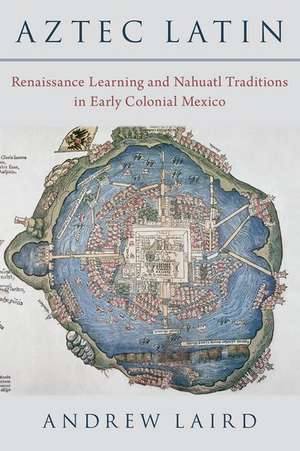
Aztec Latin: Renaissance Learning and Nahuatl Traditions in Early Colonial Mexico
Autor Andrew Lairden Limba Engleză Hardback – 29 aug 2024
Preț: 512.41 lei
Preț vechi: 710.19 lei
-28%
Puncte Express: 769
Carte tipărită la comandă
Livrare economică 27 noiembrie-08 decembrie
Livrare express 23-29 octombrie pentru 144.94 lei
Livrare prin curier în România Termenul estimat este afișat lângă disponibilitate.
Transport gratuit pentru acest produs Plată online sau ramburs, în funcție de opțiunile comenzii.
Retur gratuit în 14 zile Comandă securizată și suport în română.
Specificații
ISBN-13: 9780197586358
ISBN-10: 019758635X
Pagini: 488
Ilustrații: 42 b/w figures, 16 color plates
Dimensiuni: 155 x 226 x 38 mm
Greutate: 0.86 kg
Editura: Oxford University Press
Colecția OUP USA
Locul publicării:New York, United States
ISBN-10: 019758635X
Pagini: 488
Ilustrații: 42 b/w figures, 16 color plates
Dimensiuni: 155 x 226 x 38 mm
Greutate: 0.86 kg
Editura: Oxford University Press
Colecția OUP USA
Locul publicării:New York, United States
Recenzii
The encounter of the Nahua with Latin and the literate culture of the Renaissance is masterfully explored in this book. Medical treatises, vocabularies, grammars, biblical translations, pedagogical manuals, and edifying dialogues—some created to spread Christianity and others to account for the pre-Hispanic past—all pass under the careful gaze of the author, who manages to reconstruct the humanistic environment in which they were produced. With an unusual mix of directness and erudition, Andrew Laird changes our perspective and sheds new light on some of the most important works and personalities of sixteenth-century Mexico.
In Aztec Latin, Andrew Laird transforms the intellectual history of the early modern Atlantic world. His learned and lucid book reveals the deep impact of Renaissance humanism on Europeans and Nahua alike. As Franciscans set out to form a cultivated indigenous elite, Latin and Nahuatl, classical texts and myths, and indigenous traditions and practices fused in novel and fascinating ways. These exchanges, made possible by force and disease, were highly unequal. Nonetheless, Mexican authors mastered classical rhetoric and Latin style, and used them to create innovative texts and advance favorable interpretations of their society and its past.
Aztec Latin is important for several reasons. It explains how and why alphabetic writing, Latin, and humanism spread among indigenous elites in colonial Mexico; it uncovers the work of Amerindian scholars who mastered classical and biblical legacies which today are little known; and it revisits the politics of Spanish colonization in the Americas. Andrew Laird's book means that the contribution native Mexicans made to early modern intellectual history can no longer be ignored.
This book delves into over a dozen original texts and translations from 16th-century Mexico, written in Latin and Nahualt using Western alphabetic writing...this text is a valuable resource for scholars interested in the history of literature and philosophy in Mexico and Latin America... Highly recommended.
Aztec Latin is a magnificent exploration of the deployment of a humanistic educational system in Mexico that ensured the endurance of important aspects of Greek and Roman culture while retaining enough flexibility to accommodate indigenous cultural expressions…. It is too easy to assume that the process was just another aspect of the imperial suppression of indigenous culture, but Aztec Latin offers incontrovertible evidence that it is high time to begin to see it as one of the most remarkable--and remarkably neglected--episodes in the history of Christianity.
An artfully crafted study of the importance of Latin in early colonial Mexico. This is an important contribution to a growing literature concerning Latin and Nahuatl…. This study is grounded fully and completely in a thorough understanding of Latin and Nahuatl. Laird's insightful scholarship regarding both languages and his profound understanding of humanism in the early modern period are key to this excellent work. Just as the scholars about whom he writes, he clearly moves with ease between those worlds.
In sum, I do not say lightly that this is the authoritative study of the translation studii to the Valley of Mexico. It is no exaggeration to say that anyone interested in the classical tradition must read this book both for its insights into the sunken continent of Mexican humanism and for its implications for the study of the tradition in Europe and globally. The book's sheer girth and weight (500 pages and almost a kilogram in hard back) bespeak the breadth of Laird's erudition and the depth of his analysis.... If read alongside a modern general history, such as Martin Nesvig's Promiscuous Power (2018), it will provide expert knowledge about the intellectual worlds of the Valley of Mexico and New Spain more broadly. For these and other reasons, Aztec Latin now takes pride of place on my bookshelf.
A magisterial investigation into the intellectual production resulting from the spread of humanist learning in mid-1500s colonial Mexico and its encounter with Nahuatl traditions that highlights the contributions to early colonial history of the indigenous figures who acquired a mastery in Latin, historically overshadowed by the more visible Franciscan missionaries who served as its vectors, such as Fray Bernardino de Sahagún.... It can serve as a model for classicists towards rethinking how we engage with textual traditions and time periods beyond the traditionally circumscribed bounds of 'classics', most conservatively defined.
The thesis of the monograph as a whole is conscientiously not framed in terms of the 'afterlife of antiquity', but rather the impact of the Franciscans in New Spain, a position of weighted significance given the author and the current conversation being had in the subfield of classical reception studies more broadly. Laird's monograph should be commended for its commitment to such principles, and it can serve as a model for classicists towards rethinking how we engage with textual traditions and time periods beyond the traditionally circumscribed bounds of 'classics', most conservatively defined.
Insightful.... This monograph contributes to the study of humanism and Franciscan education in colonial Mexico while shedding new light on Renaissance humanism beyond Europe.
Andrew Laird's Aztec Latin: Renaissance learning and Nahuatl Traditions in Early Colonial Mexico presents not only a compelling study of the use of Latin in Spain's colonial project in the sixteenth century, but also a powerful model for future Latin language and reception scholarship, employing traditional philological methods to engage with global contexts and postcolonial questions about empire building and the inherent power of speech.
Aztec Latin is an insightful historical and philological study that focuses on the sixteenth-century Mexico, emphasising the educational and intellectual contributions of indigenous scholars in the decades following the Spanish conquest. The most important contribution of native Mexican writers to the development of early modern intellectual history is recognized in this book, which also examines the influence of Renaissance humanism on their writing.... Aztec Latin invites every classicist to look beyond the conventional boundaries of the discipline, recognizing the power of Latin not just as a legacy of antiquity or even as a tool of a social and intellectual transformation, but as a fundamental organising system-a kind of epistemology- in a global intellectual history.
In Aztec Latin, Andrew Laird transforms the intellectual history of the early modern Atlantic world. His learned and lucid book reveals the deep impact of Renaissance humanism on Europeans and Nahua alike. As Franciscans set out to form a cultivated indigenous elite, Latin and Nahuatl, classical texts and myths, and indigenous traditions and practices fused in novel and fascinating ways. These exchanges, made possible by force and disease, were highly unequal. Nonetheless, Mexican authors mastered classical rhetoric and Latin style, and used them to create innovative texts and advance favorable interpretations of their society and its past.
Aztec Latin is important for several reasons. It explains how and why alphabetic writing, Latin, and humanism spread among indigenous elites in colonial Mexico; it uncovers the work of Amerindian scholars who mastered classical and biblical legacies which today are little known; and it revisits the politics of Spanish colonization in the Americas. Andrew Laird's book means that the contribution native Mexicans made to early modern intellectual history can no longer be ignored.
This book delves into over a dozen original texts and translations from 16th-century Mexico, written in Latin and Nahualt using Western alphabetic writing...this text is a valuable resource for scholars interested in the history of literature and philosophy in Mexico and Latin America... Highly recommended.
Aztec Latin is a magnificent exploration of the deployment of a humanistic educational system in Mexico that ensured the endurance of important aspects of Greek and Roman culture while retaining enough flexibility to accommodate indigenous cultural expressions…. It is too easy to assume that the process was just another aspect of the imperial suppression of indigenous culture, but Aztec Latin offers incontrovertible evidence that it is high time to begin to see it as one of the most remarkable--and remarkably neglected--episodes in the history of Christianity.
An artfully crafted study of the importance of Latin in early colonial Mexico. This is an important contribution to a growing literature concerning Latin and Nahuatl…. This study is grounded fully and completely in a thorough understanding of Latin and Nahuatl. Laird's insightful scholarship regarding both languages and his profound understanding of humanism in the early modern period are key to this excellent work. Just as the scholars about whom he writes, he clearly moves with ease between those worlds.
In sum, I do not say lightly that this is the authoritative study of the translation studii to the Valley of Mexico. It is no exaggeration to say that anyone interested in the classical tradition must read this book both for its insights into the sunken continent of Mexican humanism and for its implications for the study of the tradition in Europe and globally. The book's sheer girth and weight (500 pages and almost a kilogram in hard back) bespeak the breadth of Laird's erudition and the depth of his analysis.... If read alongside a modern general history, such as Martin Nesvig's Promiscuous Power (2018), it will provide expert knowledge about the intellectual worlds of the Valley of Mexico and New Spain more broadly. For these and other reasons, Aztec Latin now takes pride of place on my bookshelf.
A magisterial investigation into the intellectual production resulting from the spread of humanist learning in mid-1500s colonial Mexico and its encounter with Nahuatl traditions that highlights the contributions to early colonial history of the indigenous figures who acquired a mastery in Latin, historically overshadowed by the more visible Franciscan missionaries who served as its vectors, such as Fray Bernardino de Sahagún.... It can serve as a model for classicists towards rethinking how we engage with textual traditions and time periods beyond the traditionally circumscribed bounds of 'classics', most conservatively defined.
The thesis of the monograph as a whole is conscientiously not framed in terms of the 'afterlife of antiquity', but rather the impact of the Franciscans in New Spain, a position of weighted significance given the author and the current conversation being had in the subfield of classical reception studies more broadly. Laird's monograph should be commended for its commitment to such principles, and it can serve as a model for classicists towards rethinking how we engage with textual traditions and time periods beyond the traditionally circumscribed bounds of 'classics', most conservatively defined.
Insightful.... This monograph contributes to the study of humanism and Franciscan education in colonial Mexico while shedding new light on Renaissance humanism beyond Europe.
Andrew Laird's Aztec Latin: Renaissance learning and Nahuatl Traditions in Early Colonial Mexico presents not only a compelling study of the use of Latin in Spain's colonial project in the sixteenth century, but also a powerful model for future Latin language and reception scholarship, employing traditional philological methods to engage with global contexts and postcolonial questions about empire building and the inherent power of speech.
Aztec Latin is an insightful historical and philological study that focuses on the sixteenth-century Mexico, emphasising the educational and intellectual contributions of indigenous scholars in the decades following the Spanish conquest. The most important contribution of native Mexican writers to the development of early modern intellectual history is recognized in this book, which also examines the influence of Renaissance humanism on their writing.... Aztec Latin invites every classicist to look beyond the conventional boundaries of the discipline, recognizing the power of Latin not just as a legacy of antiquity or even as a tool of a social and intellectual transformation, but as a fundamental organising system-a kind of epistemology- in a global intellectual history.
Notă biografică
Andrew Laird is the John Rowe Workman Distinguished Professor of Classics and Humanities at Brown University. His previous publications include Powers of Expression, Expressions of Power; The Epic of America; and, as editor with Carlo Caruso, Italy and the Classical Tradition: Language, Thought and Poetry 1300-1600.