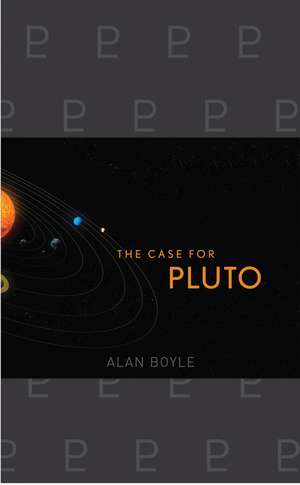
The Case for Pluto
Autor Alan Boyleen Limba Engleză Hardback – noi 2009
Evoluția astronomiei moderne a fost marcată în ultimele decenii de o reevaluare radicală a taxonomiei corpurilor cerești, un proces care a culminat cu faimoasa și controversata decizie din 2006 de a redefini conceptul de planetă. În acest volum, Alan Boyle analizează parcursul lui Pluto de la descoperirea sa accidentală în 1930 până la statutul actual de „underdog” cosmic. Putem afirma că lucrarea nu este doar o cronică științifică, ci și o pledoarie pentru complexitatea unui corp ceresc care a captivat imaginația publicului mai mult decât oricare altul din vecinătatea noastră solară. Structura narativă urmărește o progresie logică și accesibilă: de la capitolele dedicate căutării teoretice a „Planetei X”, trecând prin înțelegerea lunilor sale, până la relatarea detaliată a „Bătăliei de la Praga” (Adunarea Generală a IAU). Autorul reușește să echilibreze rigoarea datelor cu o perspectivă umană, dedicând secțiuni speciale modului în care Pluto a devenit o icoană culturală. Comparativ cu The Pluto Files de Neil De Grasse Tyson, care explorează fenomenul dintr-o perspectivă mai critică și adesea în favoarea reclasificării, The Case for Pluto reprezintă o alternativă solidă pentru cursurile de astronomie generală sau istoria științei, având avantajul unei structuri care argumentează pro-activ pentru reintegrarea micului astru în panteonul planetar. Deși Alan Boyle a mai abordat teme juridice și de mediu în lucrări precum International Law and the Environment, aici își folosește experiența de jurnalist de știință pentru a decripta mecanismele prin care comunitatea științifică ajunge la consens. Rezultatul este o analiză lucidă a modului în care clasificările științifice se pot ciocni cu percepția publică și cu noile descoperiri dincolo de centura Kuiper.
Preț: 129.60 lei
Carte disponibilă
Livrare economică 11-25 noiembrie
Specificații
ISBN-10: 0470505443
Pagini: 272
Dimensiuni: 136 x 186 x 24 mm
Greutate: 0.35 kg
Editura: Turner Publishing Company
Locul publicării:Hoboken, United States
V-ar putea interesa
-
 Thinking, Fast and SlowDaniel Kahneman-27%Preț: 90.79 lei123.57 leiRecomandat
 -
 -33%Preț: 808.38 lei1197.98 lei
 -
 Superintelligence: Paths, Dangers, StrategiesNick Bostrom-16%Preț: 80.32 lei95.97 lei
 -
 The Making of International LawAlan Boyle-22%Preț: 512.62 lei654.18 lei
 -
 -33%Preț: 1281.32 lei1907.85 lei
 -
 MindwiseNicholas Epley-19%Preț: 63.98 lei78.89 lei
 -
 Preț: 108.67 lei
 -
 Our Mathematical UniverseMax Tegmark-29%Preț: 66.48 lei94.27 lei
 -
 The Big Splat, or How Our Moon Came to BeDana MackenziePreț: 202.82 lei
 -
 Star WatchPhilip S HarringtonPreț: 128.30 lei
 -
 The Brightest StarsFred SchaafPreț: 92.10 lei
 -
 Star WarePhilip S HarringtonPreț: 175.52 lei
 -
 Uplifting LeadershipAndy Hargreaves-15%Preț: 117.70 lei138.47 lei
 -
 The Great Questions of TomorrowDavid RothkopfPreț: 82.62 lei
 -
 Dog, Inc.: The Uncanny Inside Story of Cloning Man's Best FriendJohn WoestendiekPreț: 121.11 lei
 -
 AstronomyDinah L MochéPreț: 178.77 lei
 -
 The Rise of the RobotsMartin FordPreț: 81.03 lei
 -
 Universal: A Guide Through the CosmosBrian CoxPreț: 149.72 lei
 -
 Peak: Secretele performanței de top și noua știință a expertizeiAnders EricssonPreț: 65.00 lei
De ce să citești această carte
Această carte este esențială pentru cei care doresc să înțeleagă dedesubturile politice și științifice ale retrogradării lui Pluto. Cititorul câștigă o perspectivă clară asupra modului în care se schimbă definițiile în știință și primește instrumente utile (prin anexele incluse) pentru a explica aceste concepte complexe copiilor sau studenților. Este o pledoarie documentată care transformă un subiect arid într-o poveste captivantă despre descoperire.
Despre autor
Alan Boyle este un jurnalist de știință de renume, ocupând funcția de editor pe teme științifice la MSNBC.com. Este cunoscut pentru blogul său premiat, Cosmic Log, și pentru prezența sa constantă în emisiuni precum NBC's Today Show, unde traduce concepte complexe pe înțelesul publicului larg. De-a lungul carierei sale, Boyle a acoperit subiecte diverse, de la explorarea spațială la tehnologia 3D, fiind recunoscut pentru capacitatea de a sintetiza dezbaterile academice în narațiuni accesibile. Expertiza sa în comunicarea științei face din prezentul volum o resursă valoroasă pentru înțelegerea astronomiei contemporane.
Descriere scurtă
In The Case for Pluto, award–winning science writer Alan Boyle traces the tiny planet′s ups and downs, its strange appeal, the reasons behind its demotion, and the reasons why it should be set back in the planetary pantheon.
- Tells the compelling story of Pluto′s discovery and how it became a cultural icon
- Makes the case for Pluto as planet, countering the books that argue against it
- Comes in a small, friendly package just like Pluto and features a handsome design, making it a great gift
Alan Boyle is MSNBC.com s science editor and the award–winning blogger behind Cosmic Log. He s been a talking head on NBC s The Today Show and the MSNBC cable channel, holding forth on scientific subjects ranging from the chances of an asteroid Armageddon to the 3–D wizardry behind the Harry Potter movies. But he writes better than he talks.
Descriere
"A must–read for any fan of astronomy!" Alan Stern, author of Pluto and Charon
Cuprins
2 Fellow Wanderers.
3 The Search for Planet X.
4 Pluto and Its Little Pals.
5 The Meaning of a Moon.
6 There Goes the Neighborhood.
7 Not Yet Explored.
8 Betting on the Tenth Planet.
9 The Battle of Prague.
10 The Lighter Side of Pluto.
1 1 The Great Planet Debate.
12 The Day of the Dwarfs.
13 Planet X Redux.
14 Alien Plutos.
15 The Case for Pluto.
Appendix A. What to Tell Your Kids about Planets.
Appendix B. The International Astronomical Union′s Resolutions and Revisions.
Appendix C. Planetary Vital Statistics.
Notes.
Selected Bibliography.
Credits.
Index.
Recenzii
Reviewed by D. Wayne Dworsky (Sacramento / San Francisco Book Review) Boyle, the science writer for msnbc.com, has written a charming and informative book that requires no science background. The International Astronomical Union′s decision to downgrade Pluto′s status from a planet is the book′s jumping–off point, from which Boyle backtracks to relate the history of Pluto′s discovery and naming, the discovery of its moon, its scientific features, and all the developments of its scientific study, including developments in the technology of telescopes and space missions. The personal element of the story adds spice to the narrative, with astronomers arguing over Pluto′s identity and the public weighing in with their own personal attachment to Pluto as a planet. The book concludes with an appendix on what to tell your kids about planets. (Sci–Tech Book News)
When the International Astronomical Union voted in 2006 to evict Pluto from the roster of planets in our solar system, little did they expect the public outcry that would arise. Boyle, an award–winning science writer and the science editor at MSNBC.com, presents the issues regarding Pluto′s status, both popular and scientific, in a winning fashion. After its discovery in 1930, the icy rock formerly known as Planet X was embraced by the public imagination, partly due to its status as "the oddball of the solar system"; no doubt having Walt Disney name a cartoon dog after it also helped. But as astronomers learned more about the solar system and the distant Kuiper Belt at its fringes, they realized that Pluto, with its lopsided spin and strangely tilted orbit was very special indeed. Now astronomers have identified at least five dwarf planets, or "mini–worlds," orbiting our Sun. When the New Horizons spacecraft reaches Pluto in 2015, we′ll know more about this "underdog of the solar system." Even then, the furor is bound to continue. Photos. (Nov.) (Publishers Weekly, September 14, 2009)