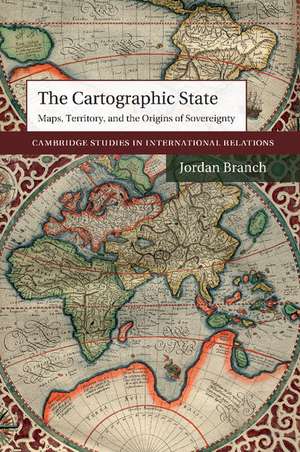
The Cartographic State
Autor Jordan Branchen Limba Engleză Paperback – 11 noi 2014
Preț: 235.56 lei
Puncte Express: 353
Carte tipărită la comandă
Livrare economică 05-19 decembrie
Livrare prin curier în România Termenul estimat este afișat lângă disponibilitate.
Transport gratuit de la 400.00 lei Plată online sau ramburs, în funcție de opțiunile comenzii.
Retur gratuit în 14 zile Comandă securizată și suport în română.
Specificații
ISBN-13: 9781107499720
ISBN-10: 1107499720
Pagini: 242
Ilustrații: 14 b/w illus.
Dimensiuni: 152 x 229 x 14 mm
Greutate: 0.33 kg
Editura: Cambridge University Press
Locul publicării:New York, United States
ISBN-10: 1107499720
Pagini: 242
Ilustrații: 14 b/w illus.
Dimensiuni: 152 x 229 x 14 mm
Greutate: 0.33 kg
Editura: Cambridge University Press
Locul publicării:New York, United States
V-ar putea interesa
-
 Infinite CityRebecca SolnitPreț: 212.30 lei
 -
 Preț: 300.45 lei
 -
 Explorations in Historical GeographyAlan R. H. BakerPreț: 326.81 lei
 -
 Human TerritorialityRobert David SackPreț: 348.58 lei
 -
 An Atlas of Historic New Mexico Maps, 1550 1941Peter L. EidenbachPreț: 558.03 lei
 -
 Bradshaw's Railway Map Great Britain and Ireland 1852George BradshawPreț: 147.91 lei
 -
 Kintyre Places and Place-NamesAngus MartinPreț: 163.88 lei
 -
 On The Map: Why the world looks the way it doesSimon Garfield-17%Preț: 78.24 lei94.83 lei
 -
 Preț: 83.29 lei
 -
 Preț: 77.50 lei
 -
 Preț: 202.66 lei
 -
 Bradshaw's Railway Folded Map 1907George Bradshaw-33%Preț: 50.21 lei75.06 lei
Cuprins
1. Introduction; 2. Authority, sovereignty, and international change; 3. The cartographic revolution; 4. Mapping the territorial state; 5. New World mapping and colonial reflection; 6. Peace treaties and political transformation; 7. Mapping the territorialization of France; 8. The cartographic state today.
Recenzii
'This is a fascinating book that retells history of modern cartography from an international relations perspective. As such, Branch skillfully brings together critical interpretations from two areas of scholarship to provide a compelling argument on how the developments of maps and political sovereignty are crucially linked. The primary thesis is that the depiction of bounded spaces on early modern maps preceded modern political practice premised upon bounded spaces. This has important theoretical ramifications for understanding how a uniquely modern form of relations between states was created … This book has stimulated me to engage with its ideas; it presents a very distinctive and distinguished argument that I recommend others to likewise engage with.' Peter J. Taylor, The Cartographic Journal
Descriere
This book describes the emergence of the territorial state and examines the role that cartography has played in shaping its linear boundaries.