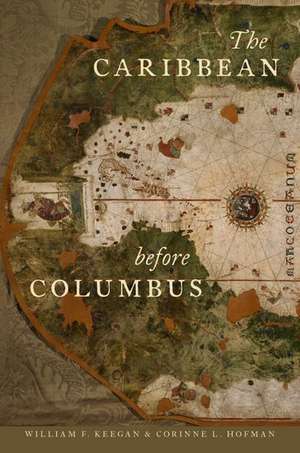
The Caribbean before Columbus
Autor William F. Keegan, Corinne L. Hofmanen Limba Engleză Hardback – 23 feb 2017
Preț: 917.24 lei
Preț vechi: 1332.75 lei
-31%
Puncte Express: 1376
Carte tipărită la comandă
Livrare economică 08-13 octombrie
Livrare prin curier în România Termenul estimat este afișat lângă disponibilitate.
Transport gratuit pentru acest produs Plată online sau ramburs, în funcție de opțiunile comenzii.
Retur gratuit în 14 zile Comandă securizată și suport în română.
Specificații
ISBN-13: 9780190605247
ISBN-10: 0190605243
Pagini: 356
Ilustrații: 25 b/w line drawings; 42 b/w halftones
Dimensiuni: 236 x 160 x 23 mm
Greutate: 0.65 kg
Editura: Oxford University Press
Colecția OUP USA
Locul publicării:New York, United States
ISBN-10: 0190605243
Pagini: 356
Ilustrații: 25 b/w line drawings; 42 b/w halftones
Dimensiuni: 236 x 160 x 23 mm
Greutate: 0.65 kg
Editura: Oxford University Press
Colecția OUP USA
Locul publicării:New York, United States
V-ar putea interesa
-
 The Crucible of Creation: The Burgess Shale and the Rise of AnimalsSimon Conway Morris-14%Preț: 252.90 lei295.68 lei
 -
 Scotland: An Oxford Archaeological GuideAnna Ritchie-19%Preț: 283.12 lei350.07 lei
 -
 -31%Preț: 826.23 lei1196.11 lei
 -
 -29%Preț: 503.15 lei704.77 lei
 -
 The Birth of Neolithic Britain: An Interpretive AccountJulian Thomas-31%Preț: 907.18 lei1313.04 lei
 -
 Death and Dying in the Neolithic Near EastKarina Croucher-31%Preț: 1091.64 lei1587.83 lei
 -
 How To Think Like a NeandertalThomas Wynn-25%Preț: 166.98 lei223.41 lei
 -
 An Archaeology of the Cosmos: Rethinking Agency and Religion in Ancient AmericaTimothy R. PauketatPreț: 451.67 lei
 -
 Social ZooarchaeologyNerissa Russell-11%Preț: 443.88 lei498.75 lei
 -
 Ancient IncaAlan L. KolataPreț: 198.53 lei
 -
 Taylor, J: Mummy: The Inside StoryJohn H. Taylor-19%Preț: 73.13 lei90.45 lei
 -
 Amenhotep IIIArielle P. KozloffPreț: 290.98 lei
 -
 A Companion to the Archaeology of the Roman RepublicJane Derose Evans-9%Preț: 1332.54 lei1464.33 lei
 -
 Egypt in EnglandChris ElliottPreț: 315.15 lei
 -
 Burren ArchaeologyHugh CarthyPreț: 112.68 lei
Recenzii
Few monographs have been able to successfully paint the picture of this complexity in a coherent way. The Caribbean before Columbus is a laudable attempt to fill the void...By attempting to redefine Caribbean archaeology, Keeganand Hofman have tackled a monster, but they have provided a commendable summary of where we are, and an excellent base to build roads to where we would like to be. It will be cited for many years to come.
This work offers new insights and alternative theories to refine or replace traditional and more commonly cited explanations of prehistory throughout the Caribbean region. It will inspire discussion and debate among scholars, and stimulate new generations of Caribbean researchers on prehistoric societies in the Caribbean. This volume serves as an important and useful tool for educators and students, and an essential reference in Caribbean prehistoric research.
An important feature of the book is its use of specific archaeological sites to illustrate important points. ... Summing Up: Essential. All university and four-year college libraries.
In conclusion, I commend the authors for taking on an extensive and intensive overview of the ancient Caribbean and expressing new ideas... The book will be a good source of information and references for professionals, as well as for graduate and undergraduate students.
This is a very significant contribution to Caribbean archaeology. Currently there is not a book out there that deals with as many new interpretations and frameworks or that clearly explains where things have gone wrong in the past. I consider this book to be essential for understanding Caribbean archaeology at any level from undergraduate to professional. ... I find the volume well written in a clear style and with good organisation. There are a lot of complex issues discussed but it is not by any means a difficult read. This is the best work I have found for teaching a senior level undergraduate seminar.
The most current and comprehensive survey of the pre-colonial archaeology of the region, this book presents for the first time the complete histories of the major islands and island groups. It is thorough yet accessible, an immersive intellectual exploration of a world before its 'discovery'.
This work offers new insights and alternative theories to refine or replace traditional and more commonly cited explanations of prehistory throughout the Caribbean region. It will inspire discussion and debate among scholars, and stimulate new generations of Caribbean researchers on prehistoric societies in the Caribbean. This volume serves as an important and useful tool for educators and students, and an essential reference in Caribbean prehistoric research.
An important feature of the book is its use of specific archaeological sites to illustrate important points. ... Summing Up: Essential. All university and four-year college libraries.
In conclusion, I commend the authors for taking on an extensive and intensive overview of the ancient Caribbean and expressing new ideas... The book will be a good source of information and references for professionals, as well as for graduate and undergraduate students.
This is a very significant contribution to Caribbean archaeology. Currently there is not a book out there that deals with as many new interpretations and frameworks or that clearly explains where things have gone wrong in the past. I consider this book to be essential for understanding Caribbean archaeology at any level from undergraduate to professional. ... I find the volume well written in a clear style and with good organisation. There are a lot of complex issues discussed but it is not by any means a difficult read. This is the best work I have found for teaching a senior level undergraduate seminar.
The most current and comprehensive survey of the pre-colonial archaeology of the region, this book presents for the first time the complete histories of the major islands and island groups. It is thorough yet accessible, an immersive intellectual exploration of a world before its 'discovery'.
Notă biografică
William F. Keegan is Curator of Caribbean Archaeology (FLMNH) and Professor of Anthropology at the University of Florida. He also serves as Associate Director for Research and Collections. He co-edited The Oxford Handbook of Caribbean Archaeology (OUP, 2013).Corinne L. Hofman is Professor of Caribbean Archaeology and Dean Faculty of Archaeology, Leiden University, as well as a co-editor of The Oxford Handbook of Caribbean Archaeology (OUP, 2013).
Cuprins
- List of Figures
- List of Tables
- 1. CARIBBEAN KALEIDOSCOPE
- The Caribbean Islands
- Different Ways of Seeing
- Far Tortuga
- The Name Game
- Ciboney and Guanahatebey
- Indios, Arawak, Taíno, Lucayan, Igneri
- Carib and Kalinago
- Changing Frames of Reference
- Underlying Structure
- 2. THE EARLIEST INHABITANTS
- FLAKED-STONE TOOL COMPLEXES
- Origins
- Cultural Characteristics
- Environmental Considerations
- Barrera-Mordán Site, Dominican Republic (representing circa 4000 BC)
- Lithic Age Assemblages
- GROUND-STONE TOOL COMPLEXES
- Banwari Trace Site, Trinidad (circa 5000 B.C)
- Origins
- Climate Change and Anthropogenic Landscapes
- Archaic Age Assemblages in the Greater Antilles
- Archaic Age Pottery
- European and Archaic Age Encounters
- Conclusions
- 3. THE EARLY CERAMIC AGE
- From Forest to Sea
- Creating Identities
- Trants Site, Montserrat (circa 400 BC to AD 500)
- Hacienda Grande Site, Puerto Rico (circa AD 150 to 500)
- Redefining the Early Ceramic Age
- Morel Site, Guadeloupe (circa 400 BC to AD 1400)
- Scale and Perspective
- Settlement Patterns
- Golden Rock Site, St. Eustatius (circa AD 600 to 850)
- Subsistence Economy
- Material Culture
- Sociopolitical Organization
- Cosmology
- Conclusions
- 4. POST-SALADOID PUERTO RICO
- Dispersion (circa AD 500 to 900)
- Crab/Shell Dichotomy
- A Plethora of Pottery Styles
- Population Growth and Settlement Patterns
- Río Tanamá 2 Site (cal AD 980 to 1490)
- Egalitarian, Hierarchical, or Heterarchical?
- Settlement Landscape and Community Structure (AD 950 and Beyond)
- Río Tanamá 1 site (circa cal AD 980 to 1490)
- Formalization of Exchange
- Plaza de Estrella, Tibes Ceremonial Center
- "Taíno" in Puerto Rico?
- Late Pottery Styles (Figure 4.6)
- Demography
- Stone-lined Courts and Plazas
- Cacicazgos
- Conclusions
- 5. MEILLACOID AND CHICOID WORLDS
- Foragers and Farmers
- Pottery Styles in Hispaniola
- An Island Divided
- El Cabo Site, Southeastern Dominican Republic (circa AD 600 to 1500)
- Northwestern Dominican Republic
- Meillacoid Revolution
- El Flaco Site, Northwestern Dominican Republic (circa AD 900 to 1500)
- Île à Rat Site, Haiti (circa AD 900 to 1500)
- Social Transformations
- Cacicazgos
- En Bas Saline, Haiti (circa AD 1492)
- Sweetness and Power
- Chicoid Expansion
- Conclusions
- 7. CUBA, THE BAHAMA ARCHIPELAGO, AND JAMAICA
- CUBA
- Preagroalfarera (Archaic Age)
- Protoagrícola (Incipient Agriculture)
- Agricultores Ceramistas (Ceramic Age)
- Regional Integration
- El Chorro de Maíta, Banes (circa AD 1200 to post AD 1600)
- Precious Metals
- Chicoid Influences
- Los Buchillones Site (circa AD 1220 to 1640)
- Conclusions
- BAHAMA ARCHIPELAGO
- Exploration and Colonization
- Coralie Site, Grand Turk, Turks and Caicos Islands (circa AD 700 to 1100)
- Small Islands
- Governors Beach Site, Grand Turk, Turks and Caicos Islands (circa AD 1100 to 1300)
- Permanent Settlement
- Late Ceramic Age
- MC-6, Middle Caicos, Turks and Caicos Islands (circa AD 1400 to 1600)
- The (Not So) Empty Islands
- JAMAICA
- Pottery Series as Distinct Cultures
- Paradise Park Sites, Westmoreland (circa AD 850 and AD 1430)
- Conclusions
- 8. LESSER ANTILLEAN NETWORKS
- The First Islanders
- Late Archaic Age
- Archaic Age Summary
- Neolithization of the Lesser Antilles
- Post-Saladoid Developments
- Anse à la Gourde Site, Guadeloupe (circa AD 450 to 1350)
- Windward Islands (Southern Lesser Antilles)
- Giraudy Site, Saint Lucia (circa AD 900 to 1500)
- Social and Political Networks
- Kelbey's Ridge 2 Site, Saba (circa AD 1350)
- Demographic Collapse after AD 1300
- Morne Cybèle and Morne Souffler Sites, La Désirade (circa AD 1440 to 1460)
- Kalinago Archaeology
- Argyle Site, St. Vincent
- Discussion
- 8. CARIBBEAN
- Columbus and Cannibals
- Cannibal Raids or Indigenous Trade?
- Colonial Emergence
- Language
- Archaeological Research
- Indigenous Settlements
- Subsistence
- Social Organization
- Cacicazgos (Chiefdoms)
- Mythology and Religion
- Demography
- Early Colonial European Chroniclers and the French Missionaries
- Kaleidoscope: The Final Turn
- REFERENCES CITED