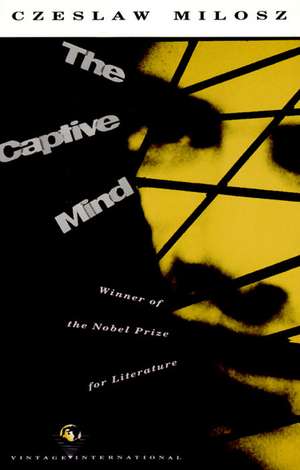
The Captive Mind
Autor Czeslaw Miloszen Limba Engleză Paperback – 11 aug 1990
| Toate formatele și edițiile | Preț | Express |
|---|---|---|
| Paperback (2) | 69.39 lei 25-31 zile | +27.89 lei 6-12 zile |
| Penguin Books – 6 iun 2001 | 69.39 lei 25-31 zile | +27.89 lei 6-12 zile |
| Knopf Doubleday Publishing Group – 11 aug 1990 | 95.50 lei 22-36 zile | +89.53 lei 6-12 zile |
Preț: 95.50 lei
Puncte Express: 143
Preț estimativ în valută:
16.91€ • 19.69$ • 14.69£
16.91€ • 19.69$ • 14.69£
Carte disponibilă
Livrare economică 02-16 februarie
Livrare express 17-23 ianuarie pentru 99.52 lei
Preluare comenzi: 021 569.72.76
Specificații
ISBN-13: 9780679728566
ISBN-10: 0679728562
Pagini: 272
Dimensiuni: 133 x 204 x 16 mm
Greutate: 0.2 kg
Ediția:Vintage Intl.
Editura: Knopf Doubleday Publishing Group
ISBN-10: 0679728562
Pagini: 272
Dimensiuni: 133 x 204 x 16 mm
Greutate: 0.2 kg
Ediția:Vintage Intl.
Editura: Knopf Doubleday Publishing Group
V-ar putea interesa
-
 The Year of Magical ThinkingJoan DidionPreț: 74.71 lei
 -
 New and Collected Poems: 1931-2001Czeslaw MiloszPreț: 138.18 lei
 -
 Yugoslavia: Death of a NationLaura SilberPreț: 91.35 lei
 -
 The Dream of Enlightenment: The Rise of Modern PhilosophyAnthony Gottlieb-20%Preț: 60.02 lei75.48 lei
 -
 Preț: 107.97 lei
 -
 Milosevic: A BiographyAdam LeBorPreț: 421.90 lei
 -
 A Bend in the RiverV. S. Naipaul-44%Preț: 49.04 lei86.92 lei
 -
 Road-Side DogCzeslaw MiloszPreț: 90.93 lei
 -
 To Begin Where I AmCzeslaw MiloszPreț: 184.68 lei
 -
 History of Western PhilosophyBertrand RussellPreț: 182.24 lei
 -
 The Age of Revolution: 1749-1848Eric HobsbawmPreț: 104.04 lei
 -
 Preț: 311.30 lei
 -
 Facing The RiverCzeslaw MiloszPreț: 83.94 lei
 -
 Josef Koudelka: ExilesJosef KoudelkaPreț: 410.27 lei
 -
 To the LighthouseVirginia WoolfPreț: 66.27 lei
Textul de pe ultima copertă
Written in the early 1950s, When Eastern Europe was in the grip of Stalinism and many Western intellectuals placed their hopes in the new order of the East, this classic work reveals in fascinating detail the often beguiling allure its frightening effects on the minds of those who embrace it.
Notă biografică
Czeslaw Milosz was a Polish poet, author, and diplomat. His book The Captive Mind became a classic of anti-Stalinism. He was awarded the Neustadt International Prize for Literature in 1978 and the 1980 Nobel Prize in Literature. He died in 2004.
Descriere
Descriere de la o altă ediție sau format:
Written in Paris in the early 1950s, this book created controversy in its analysis of 'modern' society that had allowed itself to be hypnotized by socio-political doctrines, and to accept totalitarian terror on the strength of a hypothetical future.
Written in Paris in the early 1950s, this book created controversy in its analysis of 'modern' society that had allowed itself to be hypnotized by socio-political doctrines, and to accept totalitarian terror on the strength of a hypothetical future.