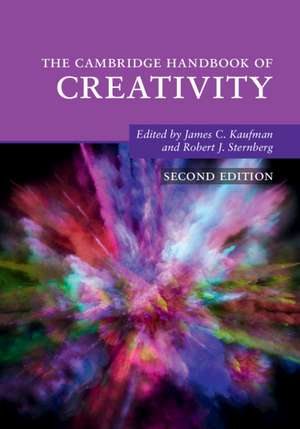
The Cambridge Handbook of Creativity: Cambridge Handbooks in Psychology
Editat de James C. Kaufman, Robert J. Sternbergen Limba Engleză Paperback – 24 apr 2019
Capitolul dedicat geneticii și neuroștiinței creativității reprezintă unul dintre pilonii centrali ai acestei noi ediții, oferind o perspectivă biologică riguroasă asupra unui fenomen adesea considerat abstract. Considerăm că The Cambridge Handbook of Creativity, aflat la a doua ediție, nu este doar o actualizare, ci o reconstrucție masivă a volumului de referință, având peste 70% conținut inedit. Această ediție extinde cadrul de analiză dincolo de psihologia clasică, integrând cercetări de ultimă oră din neuroștiințe și mediul organizațional.
Structura manualului facilitează o parcurgere sistematică, de la istoria și teoriile majore ale domeniului, până la modul în care creativitatea evoluează pe parcursul vieții. Merită menționat modul în care James C. Kaufman și Robert J. Sternberg abordează teme sensibile, precum „partea întunecată” a creativității (malevolența) și influența mediului fizic sau a stărilor emoționale asupra procesului generativ. Volumul este o alternativă cuprinzătoare la Creativity de James C. Kaufman pentru cursurile de psihologie cognitivă sau management, cu avantajul unei abordări interdisciplinare mult mai vaste, ce include 13 tabele de sinteză și studii de caz din educație și business.
În contextul operei lui James C. Kaufman, acest manual sintetizează direcțiile explorate în lucrări precum Creativity and Mental Illness sau Individual Creativity in the Workplace, oferind un cadru teoretic unitar. Tonul este academic și precis, fiind o resursă esențială pentru cercetători, care găsesc aici nu doar teorii, ci și metodologii de evaluare a geniului, jocului și esteticii, într-un format dens de peste 700 de pagini.
Din seria Cambridge Handbooks in Psychology
- 11%
 Preț: 453.05 lei
 - 11%
 Preț: 451.83 lei
 - 11%
 Preț: 383.62 lei
 - 23%
 Preț: 1246.61 lei
 - 23%
 Preț: 1260.45 lei
 - 11%
 Preț: 444.14 lei
 - 11%
 Preț: 455.68 lei
 - 11%
 Preț: 444.32 lei
 - 11%
 Preț: 455.74 lei
 - 8%
 Preț: 420.58 lei
 - 14%
 Preț: 2264.94 lei
 - 11%
 Preț: 451.65 lei
 - 18%
 Preț: 414.27 lei
 - 11%
 Preț: 435.11 lei
 - 11%
 Preț: 459.88 lei
 - 11%
 Preț: 430.28 lei
 - 11%
 Preț: 447.22 lei
 - 11%
 Preț: 476.92 lei
 - 23%
 Preț: 1290.21 lei
 -
 Preț: 318.65 lei
 - 14%
 Preț: 830.31 lei
 - 11%
 Preț: 435.95 lei
 - 11%
 Preț: 438.66 lei
 - 11%
 Preț: 443.78 lei
 - 23%
 Preț: 1275.82 lei
 - 19%
 Preț: 464.81 lei
 -
 Preț: 449.14 lei
 - 11%
 Preț: 451.65 lei
 - 5%
 Preț: 808.00 lei
 - 11%
 Preț: 445.08 lei
 - 23%
 Preț: 1268.26 lei
 - 19%
 Preț: 457.61 lei
 - 11%
 Preț: 432.89 lei
Preț: 424.79 lei
Preț vechi: 461.73 lei
-8%
Carte disponibilă
Livrare economică 18 mai-01 iunie
Livrare express 01-07 mai pentru 68.87 lei
Specificații
ISBN-10: 1316638545
Pagini: 778
Ilustrații: 9 b/w illus. 13 tables
Dimensiuni: 178 x 253 x 42 mm
Greutate: 1.41 kg
Ediția:2Revizuită
Editura: Cambridge University Press
Colecția Cambridge University Press
Seria Cambridge Handbooks in Psychology
Locul publicării:Cambridge, United Kingdom
De ce să citești această carte
Această ediție a The Cambridge Handbook of Creativity este indispensabilă pentru profesioniștii din psihologie, educație și resurse umane. Cititorul câștigă acces la cele mai noi date despre bazele genetice ale creativității și strategii concrete pentru stimularea inovației în școli și organizații. Este singura resursă care acoperă spectrul complet al creativității, de la neurobiologie la impactul cultural, fiind un instrument de referință pentru orice bibliotecă universitară sau departament de cercetare.
Despre autor
James C. Kaufman este profesor de psihologie la California State University, San Bernardino, unde coordonează Learning Research Institute. Cercetările sale se concentrează pe structura și evaluarea creativității, cu un interes deosebit pentru aplicabilitatea acesteia în educație și echitate socială. Autor și editor a peste 16 volume, Kaufman este recunoscut pentru explorarea legăturilor dintre creativitate și personalitate, inteligență sau sănătate mintală. Contribuția sa în seria Cambridge Handbooks in Psychology consolidează statutul său de expert internațional în cartografierea proceselor cognitive complexe.
Descriere scurtă
Cuprins
Recenzii
'Somewhat to my surprise, and very much to my fascinated delight, I have found that the second edition of The Cambridge Handbook of Creativity, has explained me to myself. This is a remarkably rich and nuanced book, which will benefit my own work. I return to my writing desk enlightened and expanded.' Robert Olen Butler, Francis Eppes Distinguished Professor, Florida State University, USA, and winner of the Pulitzer Prize for Fiction (1993) and the F. Scott Fitzgerald Award for Outstanding Achievement in American Literature (2013)
'Each and every chapter provides a concise contemporary summary of research by leaders in the field. The Cambridge Handbook of Creativity, second edition, is a must read for anyone doing research on the topic of cognitive abilities. It is ideal reading for an advanced undergraduate or graduate-level seminars on intelligence.' Andrew R. A. Conway, Claremont Graduate University, California
'In light of the ever-changing landscape of interest in the study, evolution, understanding, and application of creativity and creative thinking, this volume is not only valuable as a foundational textbook, it is a wonderful and vital resource for researchers, specialists, and professional development program developers. Its approach answers the 'who, what, where, why, and how?' of it all, while delivering impressive scholarly and timely research in the field. This book is a must-have!' Luanne E. Witkowski, Instructor for the Critical and Creative Thinking Graduate Program, University of Massachusetts
'In short, if you are limited to a single recent book about the psychology of creativity, the present Handbook is absolutely the one to check out.' Aaron Kozbelt, Academic Studies Press