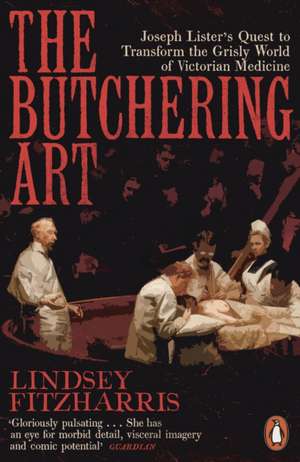
The Butchering Art: Arta măcelăritului
Autor Lindsey Fitzharrisen Limba Engleză Paperback – 4 oct 2018
Evoluția chirurgiei în ultimul secol și jumătate reprezintă poate cel mai radical salt de siguranță din istoria umanității. Suntem de părere că înțelegerea medicinei contemporane este incompletă fără explorarea perioadei în care spitalele erau focare de infecție, iar intervențiile chirurgicale reprezentau un risc asumat de 50% mortalitate. În The Butchering Art, istoricul Lindsey Fitzharris documentează clinic momentul de cotitură în care chirurgia a încetat să fie un spectacol sângeros de viteză și a devenit o disciplină riguroasă. Subliniem importanța figurii centrale a cărții, Joseph Lister, a cărui obsesie pentru igienă și antisepsie a fost inițial primită cu scepticism de o comunitate medicală ce ignora existența germenilor. Clinicienii care folosesc Medical Lives in the Age of Surgical Revolution de M. Anne Crowther ca referință vor găsi aici o analiză mult mai viscerală și mai focalizată pe mecanismele schimbării de paradigmă din sălile de operație victoriene. În timp ce Medical Lives... oferă un context sociologic larg al generației de medici, Fitzharris se concentrează pe detaliile tehnice și umane ale „artei măcelăritului” care a precedat epoca antiseptică. Această lucrare continuă preocuparea autoarei pentru aspectele macabre, dar fundamentale ale istoriei medicale, temă explorată și în Dead Ends! sau Der Horror der frühen Medizin. Spre deosebire de abordarea enciclopedică din Empire of the Scalpel de Ira Rutkow, care urmărește chirurgia din epoca de piatră până în prezent, Fitzharris alege un punct focal precis: anii 1860-1875. Este o analiză clinică a modului în care teoria germenilor a salvat profesia de ea însăși, transformând „măcelarul” în chirurgul modern.

Preț: 61.27 lei
Preț vechi: 93.10 lei
-34%
Carte disponibilă
Livrare economică 12-18 noiembrie
Livrare express 23-29 octombrie pentru 47.15 lei
Specificații
ISBN-10: 0141983388
Pagini: 286
Dimensiuni: 128 x 200 x 22 mm
Greutate: 0.23 kg
Editura: Penguin Books
Colecția Penguin Classics
Seria Arta măcelăritului
Locul publicării:London, United Kingdom
V-ar putea interesa
-
 The Odessa FileFrederick Forsyth-24%Preț: 60.89 lei80.29 lei
 -
 -17%Preț: 293.47 lei354.80 lei
 -
 The Land Where Lemons GrowHelena AttleePreț: 93.26 lei
 -
 Source Book of Medical HistoryLogan Clendening-5%Preț: 112.53 lei118.46 lei
 -
 The Big Book of PainDaniel Diehl-20%Preț: 156.80 lei195.12 lei
 -
 -18%Preț: 119.58 lei145.40 lei
 -
 The Communist ManifestoFriedrich EngelsPreț: 11.26 lei
 -
 GhostlandColin DickeyPreț: 101.39 lei
 -
 -35%Preț: 109.81 lei167.83 lei
 -
 Preț: 106.06 lei
 -
 Voices from ChernobylSvetlana AlexiévichPreț: 111.90 lei
 -
 The Anatomy of MelancholyRobert BurtonPreț: 282.43 lei
 -
 WomancodeAlisa Vitti-18%Preț: 90.10 lei109.27 lei
 -
 Can Science Explain Everything?John LennoxPreț: 64.47 lei
 -
 Call Me By Your NameAndre Aciman-18%Preț: 59.10 lei72.28 lei
 -
 -19%Preț: 68.56 lei84.83 lei
 -
 Better: A Surgeon's Notes on PerformanceAtul Gawande-22%Preț: 61.57 lei79.37 lei
 -
 Beam of MaliceAlex HamiltonPreț: 142.31 lei
 -
 ANATOMICAL TERMS & THEIR DERIVATIONLisowski FPreț: 510.23 lei
De ce să citești această carte
Recomandăm această carte oricărui profesionist din domeniul sănătății sau pasionat de istorie care dorește să înțeleagă originile protocoalelor de asepsie. Cititorul câștigă o perspectivă profundă asupra rezistenței la schimbare în mediul academic și a modului în care rigoarea științifică a lui Joseph Lister a redefinit standardele de supraviețuire în medicină. Este o lecție de istorie medicală scrisă cu precizie chirurgicală.
Despre autor
Lindsey Fitzharris (n. 1982) este un istoric medical american stabilit în Marea Britanie, recunoscută pentru capacitatea de a aduce la viață perioadele întunecate ale medicinei prin cercetare academică și narativă captivantă. Este creatoarea blogului „The Chirurgeon's Apprentice” și gazda seriei TV „The Curious Life and Death of...”. Cu un doctorat în istoria științei și medicinei la Universitatea Oxford, Fitzharris s-a specializat în transformările radicale ale practicii chirurgicale din secolul al XIX-lea, primind pentru The Butchering Art prestigiosul premiu PEN/E.O. Wilson.
Notă biografică
Lindsey Fitzharris received her doctorate in the History of Science, Medicine and Technology at the University of Oxford and was a post-doctoral research fellow at the Wellcome Institute. She is the creator of the popular website The Chirurgeon's Apprentice, and she writes and presents the YouTube series Under the Knife. She has written for the Guardian, the Lancet, the New Scientist, Penthouse, the Huffington Post and Medium, and appeared on PBS, Channel 4 UK, BBC and National Geographic.
Recenzii
Gloriously pulsating ... [Fitzharris] has an eye for morbid detail, visceral imagery and comic potential. From out of this hellish vision, Lister emerges as the cool, modern, scientific saviour to whom we should all give thanks
Atmospheric ... The Butchering Art has its share of resplendent gore
Thoroughly enjoyable ... With The Butchering Art, Fitzharris explores the intersection of Lister's life, the development of antiseptic surgery, and the horrors of the wards with an almost surgical precision
The Butchering Art is a formidable achievement - a rousing take told with brio, featuring a real-life hero worthy of the ages and jolts of Victorian horror to rival the most lurid moments of Wilkie Collins
Brilliant ... Thanks to Lister's dogged pursuit of knowledge and fervent attention to the needs of surgical patients, death rates plummeted. Fitzharris tells this story with an equal attention to detail
Scintillating and shocking ... A book full of gangrene, pus and hideous pain, which will make you thankful never to suffer the horror of having a tumour removed from your jaw with no pain relief
Hugely entertaining and informative ... Fitzharris brings [Joseph Lister's] sensibility to life with great energy and elegance, and her account is vivid and entertaining, as well as enjoyably (and sometimes eye-wateringly) graphic. The result is rich with anecdote and intellectual excitement, replete with emotional resonance and narrative pleasure
An illuminating and grisly look at the work of hacksaw-wielding surgeons of the 19th century
Well researched and written with verve... A fine read full of vivid detail, prompting thoughtful reflection on the past, and the challenging future, of surgical practice
Bloody, visceral, and fascinating
A lively read, constantly entertaining ... Fitzharris is an unapologetic showman. I imagine her as a ringmaster, inviting us to roll up and read if we dare
A brilliant and gripping account of the almost unimaginable horrors of surgery and post-operative infection before Lister transformed it all with his invention of antisepsis. It is the story of one of the truly great men of medicine and of the triumph of humane scientific method and dogged persistence over dogmatic ignorance
Engaging and extensively researched ... A riveting and sympathetic description of one man's quest to help humanity
Electric. The drama of Lister's mission to shape modern medicine is as exciting as any novel
Book of the Week
In The Butchering Art, Lindsey Fitzharris becomes our Dante, leading us through the macabre hell of nineteenth-century surgery to tell the story of Joseph Lister, the man who solved one of medicine's most daunting - and lethal - puzzles. With gusto, Dr. Fitzharris takes us into the operating 'theaters' of yore, as Lister awakens to the true nature of the killer that turned so many surgeries into little more than slow-moving executions. Warning: She spares no detail!
With an eye for historical detail and an ear for vivid prose, Lindsey Fitzharris tells a spectacular story about one of the most important moments in the history of medicine-the rise of sterile surgery. The Butchering Art is a spectacular book-deliciously gruesome and utterly gripping. You will race through it, wincing as you go, but never wanting to stop
An absolutely fascinating and grisly read that vividly brings to life the world of the Victorian operating theatre
Fitzharris slices into medical history with this excellent biography of Joseph Lister, the 19th-century "hero of surgery." ... She infuses her thoughtful and finely crafted examination of this revolution with the same sense of wonder and compassion Lister himself brought to his patients, colleagues, and students
The Butchering Art is medical history at its most visceral and vivid. It will make you forever grateful to Joseph Lister, the man who saved us from the horror of pre-antiseptic surgery, and to Lindsey Fitzharris, who brings to life the harrowing and deadly sights, smells, and sounds of a nineteenth-century hospital
Fascinating and shocking ... [Fitzharris] offers an important reminder that, while many regard science as the key to progress, it can only help in so far as people are willing to open their minds to embrace change
Descriere
DAILY MAIL, GUARDIAN AND OBSERVER BOOKS OF THE YEAR 2017
Winner of the 2018 PEN/E.O. Wilson Prize for Literary Science Writing
Shortlisted for the 2018 Wellcome Book Prize
Shortlisted for the 2018 Wolfson Prize
The story of a visionary British surgeon whose quest to unite science and medicine delivered us into the modern world - the safest time to be alive in human history
In The Butchering Art, historian Lindsey Fitzharris recreates a critical turning point in the history of medicine, when Joseph Lister transformed surgery from a brutal, harrowing practice to the safe, vaunted profession we know today.
Victorian operating theatres were known as 'gateways of death', Fitzharris reminds us, since half of those who underwent surgery didn't survive the experience. This was an era when a broken leg could lead to amputation, when surgeons often lacked university degrees, and were still known to ransack cemeteries to find cadavers. While the discovery of anaesthesia somewhat lessened the misery for patients, ironically it led to more deaths, as surgeons took greater risks. In squalid, overcrowded hospitals, doctors remained baffled by the persistent infections that kept mortality rates stubbornly high.
At a time when surgery couldn't have been more dangerous, an unlikely figure stepped forward: Joseph Lister, a young, melancholy Quaker surgeon. By making the audacious claim that germs were the source of all infection - and could be treated with antiseptics - he changed the history of medicine forever.
With a novelist's eye for detail, Fitzharris brilliantly conjures up the grisly world of Victorian surgery, revealing how one of Britain's greatest medical minds finally brought centuries of savagery, sawing and gangrene to an end.