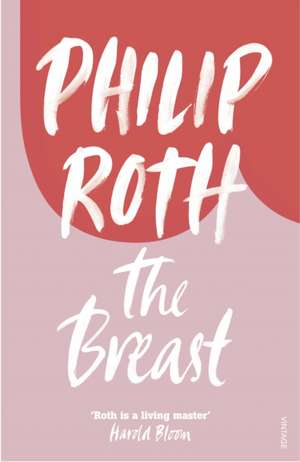
The Breast
Autor Philip Rothen Limba Engleză Paperback – 20 iul 1995
What follows is a deliriously funny yet moving exploration of the full implications of Kepesh's metamorphosis; audacious, heretical - as darkly hilarious as it is existentially unnerving - making new the silliness, triviality and wonderful meaninglessness of lived human experience.
Preț: 50.41 lei
Preț vechi: 63.40 lei
-20%
Puncte Express: 76
Carte disponibilă
Livrare economică 26 noiembrie-02 decembrie
Livrare express 07-13 noiembrie pentru 26.60 lei
Livrare prin curier în România Termenul estimat este afișat lângă disponibilitate.
Transport gratuit de la 400.00 lei Plată online sau ramburs, în funcție de opțiunile comenzii.
Retur gratuit în 14 zile Comandă securizată și suport în română.
Specificații
ISBN-13: 9780099477518
ISBN-10: 0099477513
Pagini: 96
Dimensiuni: 130 x 195 x 8 mm
Greutate: 0.08 kg
Editura: Vintage Publishing
Locul publicării:United Kingdom
ISBN-10: 0099477513
Pagini: 96
Dimensiuni: 130 x 195 x 8 mm
Greutate: 0.08 kg
Editura: Vintage Publishing
Locul publicării:United Kingdom
V-ar putea interesa
-
 Mrs Dalloway's PartyVirginia Woolf-20%Preț: 39.37 lei49.41 lei
-
 -57%Preț: 52.16 lei119.96 lei
-
 The WatchJoydeep Roy-BhattacharyaPreț: 116.27 lei
-
 The Diary of a Social ButterflyMoni Mohsin-51%Preț: 58.03 lei118.96 lei
-
 Group Portrait With LadyHeinrich BollPreț: 121.80 lei
-
 Night DancerChika UnigwePreț: 115.83 lei
-
 Preț: 67.02 lei
-
 Scent of the PastErin Marie BernardoPreț: 93.55 lei
-
 The 1001 Chicago Nights Novella: 1John A. BarkerPreț: 48.62 lei
-
 The Silicon WizardsRobert L SkidmorePreț: 264.72 lei
-
 Georges PerecDavid BellosPreț: 155.31 lei
-
 The Naked MadonnaJan WiesePreț: 92.70 lei
-
 Mendelssohn Is On The RoofJiri WeilPreț: 72.74 lei
-
 Mein Mann, der KommunistPhilip RothPreț: 125.37 lei
-
 Professor der BegierdePhilip RothPreț: 118.90 lei
-
 Der Ghost WriterPhilip RothPreț: 100.83 lei
-
 Verschwörung gegen AmerikaPhilip RothPreț: 159.93 lei
-
 Mein Leben als MannPhilip RothPreț: 96.73 lei
-
 JedermannPhilip RothPreț: 94.66 lei
-
 Exit GhostPhilip RothPreț: 117.29 lei
-
 Die DemütigungPhilip RothPreț: 92.11 lei
Notă biografică
Philip Roth was born in Newark, New Jersey on 19 March 1933, to second-generation Americans Bess and Herman. He grew up in the largely Jewish community of Weequahic, a neighbourhood his writing returned to time and again.
Roth received the National Book Award for his first book, Goodbye, Columbus (1959), but it was his fourth, Portnoy's Complaint (1969) which secured his reputation as one of America's finest writers, and American Pastoral (1997) which won the Pulitzer Prize. Roth wrote thirty-one books in all, winning the International Man Booker Prize and the National Book Critics Circle Award twice. He was presented with the National Medal of Arts and the National Humanities Medal by Presidents Clinton and Obama, respectively.
Roth died aged eighty-five on 22 May 2018, six years after retiring from writing.
Descriere
Like a latter-day Gregor Samsa, Professor David Kepesh wakes up one morning to find that he has been transformed. audacious, heretical - as darkly hilarious as it is existentially unnerving - making new the silliness, triviality and wonderful meaninglessness of lived human experience.
Recenzii
"A radical, complex, and moving book...the best example yet of Roth's astonishing prowess when he is at the top of his talent and control." —Ted Solotaroff, Esquire
"A new shock world of sensual possibility.... Need one say again that Roth is an admirable novelist who never steps twice into the same river?" —Anthony Burgess
"The Breast is terrific...inventive and sane and very funny. The trick which is the heart of the book is brilliant...and rich with meaning." —John Gardner, The New York TImes Book Review
"Hilarious, serious, visionary, logical, sexual-philosophical; the ending amazes—the joke takes three steps beyond savagery and satire and turns into a sublimeness of pity. One knows when one is reading something that will permanently enter the culture." —Cynthia Ozick