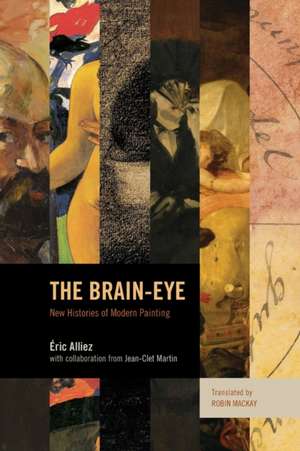
The Brain-Eye: New Histories of Modern Painting
Autor Eric Alliez Cu Jean-Clet Martin Traducere de Robin Mackayen Limba Engleză Paperback – 11 dec 2015
Rather than outlining a new 'philosophy of art,' The Brain-Eye details the singular problems pursued by each of its protagonists. Striking readings of the oeuvres of Delacroix, Seurat, Manet, Gauguin, and Cézanne recount the plural histories of artists who worked to free the differential forces of colour, discovered by Goethe in his Colour Theory, in the name of a "true hallucination" and of a logic proper to the Visual.
A rigorous renewal of the philosophical thinking of visual art, The Brain-Eye explores the complex relations between concept and sensation, theory and practice, the discursive and the visual, and draws out the political and philosophical stakes of the aesthetic revolution in modern painting.
Preț: 354.35 lei
Preț vechi: 531.95 lei
-33%
Puncte Express: 532
Carte tipărită la comandă
Livrare economică 18 noiembrie-02 decembrie
Livrare prin curier în România Termenul estimat este afișat lângă disponibilitate.
Transport gratuit de la 400.00 lei Plată online sau ramburs, în funcție de opțiunile comenzii.
Retur gratuit în 14 zile Comandă securizată și suport în română.
Specificații
ISBN-13: 9781783480685
ISBN-10: 1783480688
Pagini: 472
Ilustrații: 6 b/w photos; 20 textboxes;
Dimensiuni: 151 x 228 x 33 mm
Greutate: 0.48 kg
Editura: Bloomsbury Publishing
Colecția Rowman & Littlefield
Locul publicării:New York, United States
ISBN-10: 1783480688
Pagini: 472
Ilustrații: 6 b/w photos; 20 textboxes;
Dimensiuni: 151 x 228 x 33 mm
Greutate: 0.48 kg
Editura: Bloomsbury Publishing
Colecția Rowman & Littlefield
Locul publicării:New York, United States
V-ar putea interesa
-
 Ways of SeeingJohn BergerPreț: 76.73 lei
 -
 Painting as a Way of Life: Philosophy and Practice in French Art, 1620–1660Professor Richard NeerPreț: 427.42 lei
 -
 Reductionism in Art and Brain ScienceEric R. KandelPreț: 151.00 lei
 -
 Preț: 268.88 lei
 -
 Learning to Look at PaintingsMary ActonPreț: 294.97 lei
 -
 Preț: 242.78 lei
 -
 The Dehumanization of Art and Other Essays on Art, Culture, and LiteratureJosé Ortega Y. GassetPreț: 90.47 lei
 -
 Colours of ArtChloe Ashby-21%Preț: 160.78 lei204.23 lei
 -
 Visual Narrative and Lacanian PsychoanalysisEfrat BibermanPreț: 313.49 lei
 -
 Francis Bacon: The Logic of SensationGilles Deleuze-21%Preț: 159.74 lei200.98 lei
 -
 Cubism and Reality: Braque, Picasso, GrisChristopher Green-15%Preț: 219.92 lei258.89 lei
 -
 The Age of InsightEric Kandel-19%Preț: 314.37 lei386.49 lei
 -
 Concerning the Spiritual in ArtWassily KandinskyPreț: 38.49 lei
 -
 On Painting: Courses, March-June 1981Gilles DeleuzePreț: 207.21 lei
 -
 The Luminous and the GreyDavid Batchelor-31%Preț: 100.42 lei145.83 lei
 -
 Picturing the Artist's Studio, from Delacroix to PicassoHeather McPhersonPreț: 398.75 lei
 -
 ChromophobiaDavid Batchelor-24%Preț: 102.90 lei135.03 lei
 -
 Whose Truth, Whose Creativity? A 21st Century Art ManifestoGeorge J.E. SakkalPreț: 121.86 lei
 -
 The Book of Colour ConceptsAlexandra LoskePreț: 206.79 lei
 -
 Contemporary Painting in ContextMikkel Bogh-22%Preț: 197.30 lei253.30 lei
Cuprins
Translator's Preface / Epigraph / Note to the Viewer-Reader / Acknowledgements / Introduction / Chapter 1: 19 June 1799-The Goethe-Transformation / Chapter 2: Delacroix and the Massacre of Painting / Chapter 3. On the New Path of the Contemporary: The Manet Plane / Chapter 4. Grey Times on La Grande Jatte (The Extraterrestrial/Seurat/The Machine-Eye) / Chapter 5. Gauguin, or the Eye of the Earth / Chapter 6. Ten Variations on Cézanne's Concentric Eye / List of Works Studied / Bibliography / Index of Names
Recenzii
This amazingly erudite, visually sensitive, and philosophically innovative, post-phenomenological study offers multiple, rich perspectives on thinking in and through painting, as it interrogates five paradigmatic pathbreaking artists from Delacroix to Cezanne. Deploying innovative concepts of hallucination and the brain-eye, Alliez convincingly revises our thinking about color, atmosphere, diagram, seriality, and artists' ways of working.
Eric Alliez proposes a consummately erudite journey through modern painting, asking at each step of the way one crucial question: how does painting think? Not: how can we think the painting as a visual object? But rather: what force of thought moves through painting itself to constitute the visual, anterior to the objectivity of the painting as to the subjectivity of the viewer? The answer is kaleidoscopic: an adventure in philosophy through the vicissitudes of color. A major contribution to philosophy in its relation to art history and visual studies.
In my view, this is art history at its best: close to the sources and empirical in the sense of transformative encounters whose implications are at once explained and experienced. Robin Mackay's translation from the French is impressive in its effort to convey both dimensions, all the better to support what is perhaps the key lesson of the book: That the modern event work far exceeds the self-consciously performative art practices of the late twentieth century.
Eric Alliez proposes a consummately erudite journey through modern painting, asking at each step of the way one crucial question: how does painting think? Not: how can we think the painting as a visual object? But rather: what force of thought moves through painting itself to constitute the visual, anterior to the objectivity of the painting as to the subjectivity of the viewer? The answer is kaleidoscopic: an adventure in philosophy through the vicissitudes of color. A major contribution to philosophy in its relation to art history and visual studies.
In my view, this is art history at its best: close to the sources and empirical in the sense of transformative encounters whose implications are at once explained and experienced. Robin Mackay's translation from the French is impressive in its effort to convey both dimensions, all the better to support what is perhaps the key lesson of the book: That the modern event work far exceeds the self-consciously performative art practices of the late twentieth century.