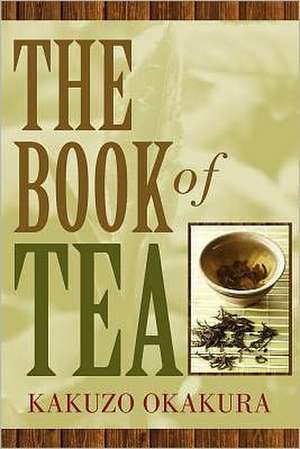
The Book of Tea: The Fallen Angels and Their Giant Sons
Autor Kakuzo Okakuraen Limba Engleză Paperback – 30 noi 2011
Preț: 60.67 lei
Carte disponibilă
Livrare economică 25 mai-08 iunie
Specificații
ISBN-10: 1619491907
Pagini: 56
Dimensiuni: 152 x 229 x 3 mm
Greutate: 0.09 kg
Editura: EMPIRE BOOKS
V-ar putea interesa
-
 Howl's Moving CastleDiana Wynne JonesPreț: 56.04 lei
 -
 The Phantom of the OperaGaston LerouxPreț: 24.60 lei
 -
 The Science of StorytellingWill StorrPreț: 75.59 lei
 -
 The Secret GardenFrances Hodgson BurnettPreț: 62.27 lei
 -
 Everything Is F*ckedMark MansonPreț: 130.33 lei
 -
 SupernaturalGraham Hancock-18%Preț: 75.62 lei92.40 lei
 -
 Circles of HellDante-40%Preț: 16.31 lei27.12 lei
 -
 Chinese ThoughtRoel Sterckx-20%Preț: 71.91 lei89.57 lei
 -
 Poetry by HeartJulie Blake-28%Preț: 74.90 lei104.61 lei
 -
 IntimationsZadie Smith-41%Preț: 31.87 lei53.76 lei
 -
 The Classic Tradition of HaikuFaubion Bowers-20%Preț: 21.84 lei27.38 lei
 -
 The Sun is also a StarNicola Yoon-26%Preț: 51.09 lei69.41 lei
 -
 The Psychology of Kundalini YogaC G JungPreț: 126.12 lei
 -
 What Matters Most is How Well You Walk Through the FireCharles BukowskiPreț: 74.30 lei
 -
 The Psychedelic Explorer's Guide: Safe, Therapeutic, and Sacred JourneysJames Fadiman Ph.D.-23%Preț: 93.06 lei121.63 lei
 -
 Tales of Mystery & the MacabreElizabeth GaskellPreț: 35.49 lei
 -
 A Dictionary of Japanese Food: Ingredients and CultureRichard Hosking-31%Preț: 70.76 lei103.04 lei
 -
 Connectedness: an incomplete encyclopedia of anthropoceneMarianne Krogh-19%Preț: 246.00 lei302.76 lei
 -
 LET'S STUDY KOREANBridge EducationPreț: 108.40 lei
Notă biografică
Descriere
The Book of Tea describes all aspects of the Japanese tea ceremony and explains how its rituals blend seamlessly with traditional Japanese life. Part of the Macmillan Collector's Library; a series of stunning, clothbound, pocket-sized classics. These beautiful books make perfect gifts or a treat for any book lover.
This edition has an afterword by Anna Sherman and delightful illustrations by Sayuri Romei. This short book, written in English by a Japanese scholar and artist, was first published in 1906 at a time when Japan was opening up to Western culture. In response to that, Okakura Kakuzo set out to explain the beauty and simplicity of Japanese daily life which was greatly inspired by teaism.
He describes in detail the different aspects of the tea ceremony, how it was founded, the role of the tea masters, the architecture of the tea-room and the stages of making and serving the tea. He then goes on to explain the connection between Taoism and Zennism with tea and he also writes chapters on art appreciation and the art of flower arranging.