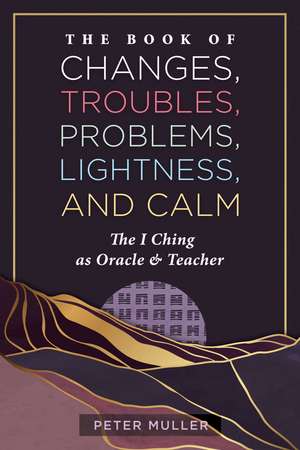
The Book of Changes, Troubles, Problems, Lightness, and Calm: The I Ching as Oracle and Teacher
Autor Peter Mulleren Limba Engleză Paperback – 18 dec 2025
Learn how to be fully present in the ever-changing moment
• Explains how to use the oracle for divination, detailing the 64 hexagrams and the esoteric significance of each changing line
• Explores key concepts that are culturally embedded in the Chinese understanding of the I Ching to give readers greater confidence in interpreting the oracle’s answers
• Teaches readers the way to secure favorable outcomes by properly aligning with each moment of change
For millennia people have consulted the I Ching to make sense of life’s challenges. This new translation of the ancient classic teaches readers how to be fully present in the ever-changing moment.
Readers will learn the mechanics of using the oracle, including how to properly phrase one’s questions. Peter reveals the traditional meanings of the 64 hexagrams and gives illustrations from daily life to amplify their meanings for our times. He explores the esoteric significance of each changing line for more complete and accurate readings. This book explains key concepts that are culturally embedded in the Chinese understanding of this system in order to give readers greater confidence in their interpretation of how the hexagrams respond to their questions. The oracle teaches one to fully accept and adapt to change and how to maintain one’s consciousness in a constantly fluid state. Learn how to work through challenges to secure favorable outcomes by properly aligning with each moment of change. Integrating the I Ching’s lessons will elevate your inner guidance so that, in time, you become a representation of the oracle itself, capable of sensing the energetic shifts of each moment and adapting to them effortlessly. When chaos overtakes order, the I Ching shows the path to equilibrium.
With wisdom and simplicity, The Book of Changes, Troubles, Problems, Lightness, and Calm offers a new reading of the classic text to serve as a light to illuminate our way.
Preț: 127.75 lei
Preț vechi: 177.91 lei
-28% Recomandat Precomandă
22.61€ • 26.36$ • 19.85£
Carte nepublicată încă
Specificații
Pagini: 432
Ilustrații: 101 b&w illustrations
Dimensiuni: 152 x 229 x 25 mm
Greutate: 0.62 kg
Editura: Inner Traditions/Bear & Company
Colecția Destiny Books
Notă biografică
Peter Muller has been a dramaturg at the Madách Theater in Budapest for sixty-four years. Winner of the Onassis Award for drama, his plays include Gloomy Sunday, Doctor Heart, God’s Money, The Brothers Karamazov, Gospel of Mary, King David, and Shadow of the Vampire, which have been produced worldwide. He’s written many novels and books of spiritual essays and this I Ching, in his native Hungarian, has sold nearly one million copies.
Extras
The Book of Fate
The I Ching is the only book that you can converse with.
You can ask it a question and it will answer you like a
living master.
The question can take hundreds of thousands of forms and
yet it is always the same.
“This is my problem here and now. What should I do?”
The I Ching is the book of fate shaping.
To use more modern parlance, it is an interactive book—according to ancient Chinese concepts, it is a “helping spirit” that directs, advises, cautions, and shows the way. This way is, in all cases, the way of Tao—in modern terms, following the will of God.
The role of the book is to make wiser a person who regularly turns to it. It is not by general teaching that the reader is made wiser, but by advice given for the smallest problems in life—demonstrating the hidden forces of fate that operate everyday events and how to sensibly resolve them.
A person who spends a lot of time with it doesn’t feel as if they are reading a book but rather that they are talking to a wise master. It is no coincidence that it was once written, “Even though you have no teacher, turn to it as you would to your parents.” That comment was written relatively late on, 2,500 years ago, when the world was in turmoil—as the 36th Oracle Sign says, “The Light has gone dark.” It was in this era that books took over the teaching role.
As the I Ching is primarily an oracle, you can ponder this sentence: it does not say “if you have no teacher,” but “even though you have no teacher.” Sages who peered into the magical crystal ball of times to come, knew exactly that we would no longer have living, flesh-and-blood teachers, that we would learn from books how to live and seek answers to the deeper meaning of life in general.
Who is it that you can go to today and ask what you should do for the best outcome? Who is it that can see so deeply into your heart that you accept the advice that they give? No one. And the sages of the I Ching knew this.
It was not always like this. The truth, the holy knowledge was carried by people of the Earth, mortal humans, and they passed this living word onto living people of whom anything could be asked. But a catastrophic event changed something in us; our spiritual eye became blind, our heavenly being dropped to the depths of the subconscious and was replaced on Earth by a too clever, too selfish, too unhappy, too deceitful, too rational, too godless, too lonely, too egotistical human race—to which we also belong.
There is not a single person among us—including the saints themselves—who would be free of these qualities. In fact, the “purer” a person is the more precisely they are aware that they “see through a glass darkly.” And even though they know what is good, they still do bad, and they do not play the role of the authentic teacher or faultless guru because they know themselves.
Jesus never promised living teachers. He no longer believed in the living chain of knowledge between masters and pupils—he promised us the help of the Holy Spirit: “I still have a great deal to tell you but you are not yet ready to accept it: when He comes, the Spirit of Truth, and leads you to the whole truth; because he does not speak from himself but tells the things that he hears and announces things of the future to you” (John 16:12–15).
That part of Christian tradition that works and is still genuine is based on the exact same relationship with the spirit world as the I Ching, in which divination and knowledge of things of the future are just as important as the recognition of the truth.
The I Ching comes from a supernatural source. It comes from a relationship with the “spirit of Truth” or as the Chinese knew it, the “light gods” and “holy spirits” (shen). It was an initiated shaman, a priest-medium, or a holy king himself with abilities as a medium who maintained the relationship with the heavenly order of the supernatural world. It worked in exactly the same way as a Christian priest has to work today—or at least how they should work.
While this contact lived, there was no need for books because the knowledge was passed from master to pupil, and this was kept alive by the relationship with the higher spirit world. The light, however, went out. Something went wrong about which all traditions know.
Humankind plummeted along with its sight. It also lost its purity, its humility, and spiritual ability that made it capable of such a relationship and it was now that the sages thought: the time has come to write these words of wisdom down. Like the captains of a sinking ship, the order was issued: “Here’s the lifeboat—row on your own from now on!” The I Ching—the Holy Book of Changes—was written “to help light the gods.’’
It is not only humans who find themselves in need of help, but also the holy spirits whose job it is to help us—they are not able to do this as we have grown deaf. We cannot hear, we have lost our direction, and we are being tossed around on ever more treacherous seas. This book was written for us, the shipwreck victims.
All of a sudden, a very familiar face looks out at us from behind the wise words. And like one who is no longer able to contain itself, it says, “The writers of the book had a lot of problems and troubles.” Yes, they did too.
Our fellow in fate speaks to humankind from one of its oldest books. Neither is he afraid—like the guardians of ancient traditions—that he is placing sacred secrets into profane hands. He says, “If you are not true, no sense will appear to you.” There are two types of people: those who understand the message of the book and those who don’t. Those who have an ear to hear—and others who do not.*
Both “people” are within us: sometimes we hear and sometimes we do not. There is no one, even in the lowest of states, who does not know, if even just for a split second, that there is a difference between the selfish self and what God wants. There is no one who is completely “deaf,” who does not know inspiration or even the glimpsing moments of a spiritual state, and who at such times does not suspect that life has a higher meaning and that it is more than meaningless piracy and stealing everything in sight before disappearing into the grave of eternal passing.
This does not require us to forget about God, but ourselves: to forget that we are People. Many have managed this in recent times, but I am not convinced that the process was complete.
J. F. Yan, an American-Chinese biochemist, warned that it was not possible to translate the book without knowledge of the Chinese soul. When, for example, I quoted, “Turn to me as you would to your parents”—this does not just mean with great respect, but a great deal more. It means with the reverence with which you would approach the gods! In ancient China, the family was a spiritual family, a sacred community where the father was the Creative and the mother the Receptive, while the siblings embodied some dignitary or other within the hierarchy. When one of Professor Yan’s students who suffered from a feeling of inferiority was advised by a Californian psychologist to “speak bravely back to your father,” the boy burst out of the clinic and ran all the way home convinced that he had been the victim of a terrible practical joke.
My father, however much I respect him, can make mistakes—but the “father” of those for whom the above words were written could not make mistakes as they were gods! In other words, this phrase means that the book is infallible. However, you can make mistakes because your “childish” knowledge means that you cannot always correctly interpret advice—but the I Ching never makes a mistake.
Wherever possible I have done my best to experience not only the words but also the meaning of the characters. Each and every ancient character communicates a great deal. It was Confucius who said, “Everything depends on the correct use of words.” Sometimes understanding of the whole Oracle Sign depends on understanding one single word. Any misunderstood word can lead to misunderstanding everything.
Cuprins
Reflections on the Oracle
PART ONE
HELPFUL SPIRITS
1 The Book of Fate
The Origins of the I Ching
2 Change, Trouble, Problem,
Lightness, Calm
3 Divination and Fortune-Telling
Framing the Question
What the Oracle Will Reveal
4 Thoughts of God
The Great Ancient Beginning
The Significance of 64
5 The Art of Life
Fundamental Principles of Practice
PART TWO
HOW TO MAKE DIVINATIONS
Practical Advice on Using the Oracle
6 Secrets of the I Ching
Changing Lines, Changing Signs
Calculating the Numeric Base of the Lines
7 Creating an Oracle
Using Coins to Create the Oracle Sign
Identifying the Oracle Sign: Basic Sign or Direction Sign
8 The Oracle Sign
Code Structure of the Oracle Signs:
Drama in Two Acts and Six Scenes
The Pa Kua Trigrams
9 Interpreting the Oracle Signs
How to Ask the Question
How to Listen to the Divination
10 Reading Your Oracle
The Significance of Basic Signs, Changing Lines,
and Direction Signs
Interpreting an Oracle Sign Both Inwardly and Outwardly
Different Meanings of the Oracle
Predictions Near and Far
11 Meditations on Chance
Preparing for Divination
Why Do the Coins Fall This Way and Not That Way?
PART THREE
ORACLE SIGNS
1 ䷀ Ch’ien • Creative
2 ䷁ K’un • Receptive
3 ䷂ Chun • Difficulty at the Beginning
(Sprouting)
4 ䷃ Meng • Immaturity
5 ䷄ Hsü • Waiting
6 ䷅ Sung • Conflict
7 ䷆ Shih • Army
8 ䷇ Pi • Holding Together
9 ䷈ Hsiao Ch’u • The Collection of the Small
10 ䷉ Lü • Treading Carefully
11 ䷊ T’ai • Blossoming (Harmony)
12 ䷋ P’i • Stagnation (Disharmony)
13 ䷌ T’ung Jeng • Fellowship with Men
14 ䷍ Ta Yu • Great Harvest
15 ䷎ Ch’ien • Modesty
16 ䷏ Yü • Enthusiasm
17 ䷐ Sui • Following (Adaptation)
18 ䷑ Ku • Work on the Spoiled
19 ䷒ Lin • Approach
20 ䷓ Kuan • Clear Sight (Attention)
21 ䷔ Shih Ho • Confrontation (Biting Through)
22 ䷕ Pi • Beautification
23 ䷖ Po • Splitting Apart
24 ䷗ Fu • Return (Rebirth)
25 ䷘ Wu Wang • Spontaneous Action
26 ䷙ Ta Ch’u • The Collection of the Great
27 ䷚ I • Nourishment
28 ䷛ Ta Kuo • The Preponderance of the Great
29 ䷜ K’an • Conquering Difficulty
30 ䷝ Li • Enlightenment
31 ䷞ Hsien • Harmonizing
32 ䷟ Heng • Persistence (Permanence)
33 ䷠ Tun • Retreat
34 ䷡ Ta Chuang • The Influence of the Great
35 ䷢ Chin • Progress (Emergence)
36 ䷣ Ming I • Darkening of the Light
37 ䷤ Chia Jen • A Man’s Family
38 ䷥ K’uei • Opposite
39 ䷦ Chien • Difficulty
40 ䷧ Hsieh • Solution
41 ䷨ Sun • Reduction
42 ䷩ I • Expansion
43 ䷪ Kuai • Removal
44 ䷫ Kou • Contact (Temptation)
45 ䷬ Ts’ui • The Gathering (Collection)
46 ䷭ Sheng • Upward Ambition
47 ䷮ K’un • Oppression (Exhaustion)
48 ䷯ Ching • Well
49 ䷰ Ko • Renewal (Revolution)
50 ䷱ Ting • Sacrificial Vessel
51 ䷲ Chen • Arousing (Shocking)
52 ䷳ Ken • Calm (Mountain)
53 ䷴ Chien • Gradual Development
54 ䷵ Kuei Mei • The Bride-to-Be
55 ䷶ Feng • Abundance
56 ䷷ Lü • The Wanderer
57 ䷸ Sun • Influence (Wind)
58 ䷹ Tui • Joy Shared with Others
59 ䷺ Huan • Dissolving (Reunification)
60 ䷻ Chieh • Restriction (Moderation)
61 ䷼ Chung Fu • Truth of the Center Point
62 ䷽ Hsiao Kuo • Advantage of the Small
(Moderation)
63 ䷾ Chi Chi • After Fulfillment (Crossing)
64 ䷿ Wei Chi • Before Completion (Crossing)
Recommended Reading
Recenzii
“There is no truer test of an I Ching book than to do an oracle with it. Upon review, I found that this version by Peter Muller—offering unique, relevant wisdom—did not disappoint. I always enjoy syncretistic works that show the universality of spirit; to see the bigger picture we need to look through many eyes. I loved the correlations between Christian theology and Taoism that were made throughout the tome as well as the personal experiences that brought the work to life. I highly recommend this edition.”
Descriere
Learn how to be fully present in the ever-changing moment