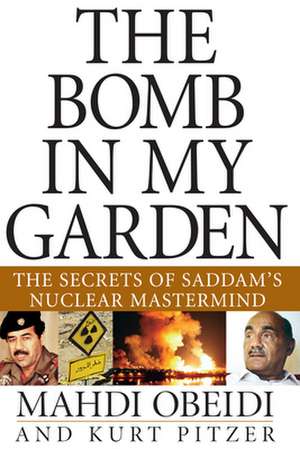
The Bomb in My Garden
Autor Mahdi Obeidi, Kurt Pitzeren Limba Engleză Hardback – sep 2004
Preț: 183.03 lei
Nou
Puncte Express: 275
Preț estimativ în valută:
32.39€ • 37.98$ • 28.44£
32.39€ • 37.98$ • 28.44£
Carte disponibilă
Livrare economică 14-28 ianuarie 26
Preluare comenzi: 021 569.72.76
Specificații
ISBN-13: 9780471679653
ISBN-10: 0471679658
Pagini: 242
Dimensiuni: 157 x 235 x 20 mm
Greutate: 0.59 kg
Editura: Turner Publishing Company
Locul publicării:Hoboken, United States
ISBN-10: 0471679658
Pagini: 242
Dimensiuni: 157 x 235 x 20 mm
Greutate: 0.59 kg
Editura: Turner Publishing Company
Locul publicării:Hoboken, United States
Descriere
Praise for The Bomb in My Garden "This one book will tell you more about Iraqs quest for weapons of mass destruction than all U.S. intelligence on the subject. It is a fascinating and rare glimpse inside Saddam Husseins Iraqand inside a tyrants mind." Fareed Zakaria author of The Future of Freedom "The Bomb in My Garden is important and utterly gripping. The old cliché is trueyou start reading, and you dont want to stop. Mahdi Obeidis story makes clear how hard Saddam Hussein tried to develop a nuclear weapon, and the reasons he fell short. It is also unforgettable as a picture of how honorable people tried to cope with a despots demands. I enthusiastically recommend this book." James Fallows National Correspondent, The Atlantic Monthly "Obeidi was the key scientist in Saddams centrifuge program, and he was central when they tried to conceal it. He was already thought to be too friendly to the weapons inspectors, and he showed considerable personal courage in coming forward as he did during very unsettled conditions after the war." David Kay former UN weapons inspector and Head of the Iraqi Survey Group in charge of searching for weapons of mass destruction
Textul de pe ultima copertă
Praise for The Bomb in My Garden
"This one book will tell you more about Iraq's quest for weapons of mass destruction than all U.S. intelligence on the subject. It is a fascinating and rare glimpse inside Saddam Hussein's Iraq-and inside a tyrant's mind."
-Fareed Zakaria
author of The Future of Freedom
"The Bomb in My Garden is important and utterly gripping. The old cliche is true-you start reading, and you don't want to stop. Mahdi Obeidi's story makes clear how hard Saddam Hussein tried to develop a nuclear weapon, and the reasons he fell short. It is also unforgettable as a picture of how honorable people tried to cope with a despot's demands. I enthusiastically recommend this book."
-James Fallows
National Correspondent, The Atlantic Monthly
"Obeidi was the key scientist in Saddam's centrifuge program, and he was central when they tried to conceal it. He was already thought to be too friendly to the weapons inspectors, and he showed considerable personal courage in coming forward as he did during very unsettled conditions after the war."
-David Kay
former UN weapons inspector and Head of the Iraqi Survey Group in charge of searching for weapons of mass destruction
-Fareed Zakaria
author of The Future of Freedom
"The Bomb in My Garden is important and utterly gripping. The old cliche is true-you start reading, and you don't want to stop. Mahdi Obeidi's story makes clear how hard Saddam Hussein tried to develop a nuclear weapon, and the reasons he fell short. It is also unforgettable as a picture of how honorable people tried to cope with a despot's demands. I enthusiastically recommend this book."
-James Fallows
National Correspondent, The Atlantic Monthly
"Obeidi was the key scientist in Saddam's centrifuge program, and he was central when they tried to conceal it. He was already thought to be too friendly to the weapons inspectors, and he showed considerable personal courage in coming forward as he did during very unsettled conditions after the war."
-David Kay
former UN weapons inspector and Head of the Iraqi Survey Group in charge of searching for weapons of mass destruction
Cuprins
Preface. 1. The Bomb in My Garden. 2. Early Ambitions. 3. The Centrifuge. 4. Saddam’s Grip. 5. Shopping in Europe. 6. The Crash Program. 7. Nuclear Hide–and–Seek. 8. The Dark Years. 9. The March to War. 10. The Time Capsule. Epilogue. Acknowledgments. Index.
Recenzii
"Indispensable one...Expertly organized and packed with telling vignettes, it is never less than riveting." ( The New York Times Book Review , October 31, 2004) What was really going in Iraq before the American invasion last year? Iraq′s nuclear weapons program was on the threshold of success before the 1991 invasion of Kuwait – there is no doubt in my mind that we could have produced dozens of nuclear weapons within a few years – but was stopped in its tracks by United Nations weapons inspectors after the Persian Gulf war and was never restarted. During the 1990′s, the inspectors discovered all of the laboratories, machines and materials we had used in the nuclear program, and all were destroyed or otherwise incapacitated. By 1998, when Saddam Hussein evicted the weapons inspectors from Iraq, all that was left was the dangerous knowledge of hundreds of scientists and the blueprints and prototype parts for the centrifuge, which I had buried under a tree in my garden. In addition to the inspections, the sanctions that were put in place by the United Nations after the gulf war made reconstituting the program impossible. During the 1980′s, we had relied heavily on the international black market for equipment and technology; the sanctions closed that avenue. Another factor in the mothballing of the program was that Saddam Hussein was profiting handsomely from the United Nations oil–for–food program, building palaces around the country with the money he skimmed. I think he didn′t want to risk losing this revenue stream by trying to restart a secret weapons program. Over the course of the 1990′s, most of the scientists from the nuclear program switched to working on civilian projects or in conventional–weapons production, and the idea of building a nuclear bomb became a vague dream from another era. So, how could the West have made such a mistaken assessment of the nuclear program before the invasion last year? Even to those of us who knew better, it′s fairly easy to see how observers got the wrong impression. First, there was Saddam Hussein′s history. He had demonstrated his desire for nuclear weapons since the late 1970′s, when Iraqi scientists began making progress on a nuclear reactor. He had used chemical weapons against his own people and against Iran during the 1980′s. After the 1991 war, he had tried to hide his programs in weapons of mass destruction for as long as possible (he even kept my identity secret from weapons inspectors until 1995). It would have been hard not to suspect him of trying to develop such weapons again. The Western intelligence services and policy makers, however, overlooked some obvious clues. One was the defection and death of Saddam Hussein′s son–in–law, Hussein Kamel, who was in charge of the unconventional weapons programs in the 1980′s. As my boss, Mr. Kamel was a brutal taskmaster who forced us to work under impossible deadlines and was the motivating force for our nuclear effort. The drive for nuclear weapons began in earnest when he rose to a position of power in 1987. He placed a detail of 20 fearsome security men on the premises of our centrifuge lab, and my staff and I worked wonders just to stay out of his dungeons. But after he defected to Jordan in 1995, and then returned months later only to be assassinated by his father–in–law′s henchmen, the nuclear, chemical and biological weapons programs lost their top promoter. In addition, the West never understood the delusional nature of Saddam Hussein′s mind. By 2002, when the United States and Britain were threatening war, he had lost touch with the reality of his diminished military might. By that time I had been promoted to director of projects for the country′s entire military–industrial complex, and I witnessed firsthand the fantasy world in which he was living. He backed mythic but hopeless projects like one for a long–range missile that was completely unrealistic considering the constraints of international sanctions. The director of another struggling missile project, when called upon to give a progress report, recited a poem in the dictator′s honor instead. Not only did he not go to prison, Saddam Hussein applauded him. By 2003, as the American invasion loomed, the tyrant was alternately working on his next trashy novel and giving lunatic orders like burning oil around Baghdad to "hide" the city from bombing attacks. Unbelievably, one of my final assignments was to prepare a 10–year plan for military–industrial works, even as tens of thousands of troops were gathering for invasion. To the end, Saddam Hussein kept alive the Iraqi Atomic Energy Commission, staffed by junior scientists involved in research completely unrelated to nuclear weapons, just so he could maintain the illusion in his mind that he had a nuclear program. Sort of like the emperor with no clothes, he fooled himself into believing he was armed and dangerous. But unlike that fairy–tale ruler, Saddam Hussein fooled the rest of the world as well. Was Iraq a potential threat to the United States and the world? Threat is always a matter of perception, but our nuclear program could have been reinstituted at the snap of Saddam Hussein′s fingers. The sanctions and the lucrative oil–for–food program had served as powerful deterrents, but world events – like Iran′s current efforts to step up its nuclear ambitions – might well have changed the situation. Iraqi scientists had the knowledge and the designs needed to jumpstart the program if necessary. And there is no question that we could have done so very quickly. In the late 1980′s, we put together the most efficient covert nuclear program the world has ever seen. In about three years, we gained the ability to enrich uranium and nearly become a nuclear threat; we built an effective centrifuge from scratch, even though we started with no knowledge of centrifuge technology. Had Saddam Hussein ordered it and the world looked the other way, we might have shaved months if not years off our previous efforts. o what now? The dictator may be gone, but that doesn′t mean the nuclear problem is behind us. Even under the watchful eyes of Saddam Hussein′s security services, there were worries that our scientists might escape to other countries or sell their knowledge to the highest bidder. This expertise is even more valuable today, with nuclear technology ever more available on the black market and a proliferation of peaceful energy programs around the globe that use equipment easily converted to military use. Hundreds of my former staff members and fellow scientists possess knowledge that could be useful to a rogue nation eager for a covert nuclear weapons program. The vast majority are technicians who, like the rest of us, care first about their families and their livelihoods. It is vital that the United States ensure they get good and constructive jobs in postwar Iraq. The most accomplished of my former colleagues could be brought, at least temporarily, to the West and placed at universities, research labs and private companies. The United States invaded Iraq in part to end what it saw as a nuclear danger. It is now vital to reduce the chance of Iraq′s dangerous knowledge spilling outside of its borders. The nuclear dangers facing the world are growing, not decreasing. My hope is that the Iraqi example can help people understand how best to deal with this threat. Mahdi Obeidi is the author of "The Bomb in My Garden: The Secrets of Saddam′s Nuclear Mastermind." Kurt Pitzer, who collaborated on the book, assisted with this article. ( The New York Times , September 26, 2004) This compact and absorbing book reads like a thriller and adds considerably to our knowledge of the Iraq WMD situation. Obeidi was a trained engineer in the Iraqi oil industry, but his brilliant record led to his transfer to the nuclear weapons program. After the bombing of Iraq’s Osirak reactor by Israel in 1981, he spearheaded the search for a working centrifuge as the best method of enriching fissionable material for a bomb. That work also involved him in a number of situations worthy of James Bond, as he sought classified knowledge and key components all over the world, under surveillance from both Saddam Hussein (and Saddam’s son–in–law, the vividly portrayed Hussein Kamel) and foreign intelligence agencies. The author finally buried most of the relevant data, drawings and sample components in his backyard and turned them over to Coalition forces before emigrating to the United States. Pitzer was embedded for U.S. News & World Report with the army’s 3rd Infantry, but left them as Baghdad fell, met Obeidi and played a role in the transfer of the documents. Together, they have produced an eloquent tale of a scientist who spent 20 years in a "damned if I do and damned if I don’t situation" and survived with family and sanity intact. (Sept. 24) ( Publishers Weekly , September 20, 2004)
"Indispensable one...Expertly organized and packed with telling vignettes, it is never less than riveting." ( The New York Times Book Review , October 31, 2004) "This compact and absorbing book reads like a thriller and adds considerably to our knowledge of the Iraq WMD situation." ( Publishers Weekly , September 20, 2004)
"Indispensable one...Expertly organized and packed with telling vignettes, it is never less than riveting." ( The New York Times Book Review , October 31, 2004) "This compact and absorbing book reads like a thriller and adds considerably to our knowledge of the Iraq WMD situation." ( Publishers Weekly , September 20, 2004)
Notă biografică
MAHDI OBEIDI oversaw Saddam’s top–secret centrifuge program and later became director–general of Iraq’s Ministry of Industry and Military Industrialization. The few remaining components and plans for the uranium enriching centrifuge that he voluntarily turned over to the United States during the war still represent the largest collection of evidence of weapons of mass destruction in Iraq. KURT PITZER began the Iraq war embedded with the U.S. Army’s 3rd Infantry Division and jumped his embed when Baghdad fell. He met Obeidi there and helped him turn his secrets over to the United States. A journalist with more than a decade’s experience, he has reported from the Balkans, the Middle East, and Afghanistan for the Associated Press, the Los Angeles Times, the Boston Globe, and numerous magazines.