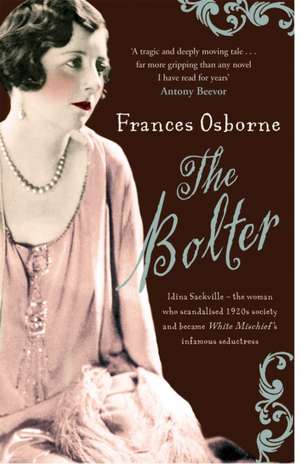
The Bolter: Idina Sackville - the 1920’s style icon and seductress said to have inspired Taylor Swift’s The Bolter
Autor Frances Osborneen Limba Engleză Paperback – 29 dec 2008
În 1934, o femeie care sfidase toate convențiile Imperiului Britanic își întâlnea fiul pe care nu îl mai văzuse de cincisprezece ani, de când alesese libertatea în detrimentul datoriei materne. Impactul Idinei Sackville asupra imaginarului colectiv al epocii jazz-ului a fost seismic; ea a întruchipat rebeliunea absolută într-o lume care cerea conformism. Ne-a atras atenția modul în care Frances Osborne reconstituie nu doar o biografie, ci o întreagă atmosferă de abandon și hedonism în Kenya colonială. Subliniem faptul că această lucrare depășește simplul scandal monden, fiind o investigație personală a autoarei despre o străbunică al cărei nume fusese șters din istoria familiei din cauza reputației sale de seducătoare cu „nenumărați amanți”. Ca și Behind the Mask de Matthew Dennison, această biografie transformă documentele de arhivă și scrisorile private într-o narațiune vibrantă despre o femeie care a refuzat să fie definită de bărbații din viața ei, în ciuda costurilor emoționale enorme. Ritmul este alert, oglindind viața agitată a Idinei, iar tonul pendulează între fascinația pentru eleganța anilor '20 și melancolia trădărilor care au marcat acea perioadă. Merită menționat că, spre deosebire de Irrepressible de Emily Bingham, care explorează o traiectorie similară de autodistrugere și strălucire în America, The Bolter păstrează un aer distinct britanic, analizând mecanismele de excludere ale aristocrației de la Londra până în „Happy Valley” din Africa.
Preț: 67.03 lei
Preț vechi: 91.84 lei
-27%
Carte disponibilă
Livrare economică 07-21 noiembrie
Livrare express 27-31 octombrie pentru 45.96 lei
Specificații
ISBN-10: 1844084809
Pagini: 336
Ilustrații: Section: 16, b/w pix
Dimensiuni: 200 x 130 x 23 mm
Greutate: 0.24 kg
Editura: Little Brown
Colecția Virago
Locul publicării:London, United Kingdom
V-ar putea interesa
-
 A Dangerous GameMandy RobothamPreț: 71.68 lei
 -
 TroublemakerCarla KaplanPreț: 255.90 lei
 -
 A Spy in the House of LoveAnais Nin-28%Preț: 50.99 lei70.68 lei
 -
 A Secret AffairMary BaloghPreț: 53.65 lei
 -
 -11%Preț: 111.73 lei126.12 lei
 -
 Portrait Of A Marriage: Vita Sackville-West and Harold NicolsonNigel Nicolson, MBE-26%Preț: 58.20 lei79.00 lei
 -
 Z: A Novel of Zelda FitzgeraldTherese Anne Fowler-26%Preț: 59.24 lei79.63 lei
 -
 Mrs. Wilson's Affair: A Great Gatsby Retelling (A Novel)Allyson Reedy-30%Preț: 54.10 lei77.74 lei
 -
 The Duchess CountessCatherine OstlerPreț: 77.24 lei
 -
 Rules of the HeartJanice HadlowPreț: 111.44 lei
 -
 -26%Preț: 47.82 lei64.29 lei
 -
 It Girl: The Life and Legacy of Jane BirkinMarisa Meltzer-19%Preț: 115.40 lei142.92 leiRecomandat
 -
 GabriëleAnne BerestPreț: 138.86 lei
 -
 The Duchess Who DaredCharles CastlePreț: 72.77 lei
 -
 No Country For a WomanJane DismorePreț: 156.07 lei
 -
 The Fabulous Frances FarquharsonCaroline YoungPreț: 127.65 lei
 -
 The Scandalous Life of Nancy RandolphKate BraithwaitePreț: 76.87 lei
 -
 The Baroness: The Search for Nica the Rebellious RothschildHannah Rothschild-27%Preț: 67.70 lei92.91 lei
 -
 A Scandalous LifeMary S. LovellPreț: 107.96 lei
De ce să citești această carte
Recomandăm această carte cititorilor pasionați de istorie socială și biografii feminine atipice. Veți descoperi povestea reală din spatele unui mit literar și muzical, explorând ce însemna cu adevărat independența feminină în perioada interbelică. Este o lectură captivantă pentru cei care vor să înțeleagă complexitatea unei figuri care a ales să trăiască după propriile reguli, asumându-și exilul și blamul public.
Despre autor
Frances Osborne este o scriitoare britanică recunoscută pentru abilitatea de a aduce la viață figuri istorice feminine complexe. Este autoarea volumelor Lilla's Feast și Park Lane, ambele fiind nominalizate la premii literare prestigioase sau recunoscute ca lucrări istorice semnificative. Cu o carieră solidă în jurnalism, colaborând cu publicații de renume mondial, Osborne a fost și membru al juriului pentru Booker Prize for Fiction în 2015. Locuiește la Londra, unde continuă să exploreze arhivele de familie pentru a extrage narațiuni care nuanțează istoria socială a secolului XX.
Descriere
Idina Sackville - the 1920's style icon and seductress who 'Taylor Swift fans think "The Bolter" could be inspired by' Bustle
In 1934 Idina Sackville met the son she had last seen fifteen years earlier when she shocked high society by running off to Africa with a near-penniless man, abandoning him, his brother and their father. So scandalous was Idina's life - she was said to have had 'lovers without number' - that it was kept a secret from her great-granddaughter, Frances Osborne. Now Osborne explores her moving tale of betrayal and heartbreak.'A corker of a subject... probably inspired The Bolter in Nancy Mitford's The Pursuit of Love... A breakneck-paced, thoroughly diverting story' THE TIMES
'A tragic and deeply moving tale... far more gripping than any novel I have read for years' ANTONY BEEVOR
'Frances Osborne has brilliantly captured not only one woman's life but an entire lost society' AMANDA FOREMAN
'An enthralling account of a dazzling, troubled life' JULIAN FELLOWES
Recenzii
Passionate and headstrong, Lady Idina was determined to be free even if the cost was scandal and ruin. Frances Osborne has brilliantly captured not only one woman's life but an entire lost society
A corker of a subject. Idina's behaviour... probably inspired The Bolter in Nancy Mitford's The Pursuit of Love. Osborne's richly wrought descriptions of glittering Paris nights and lush mountainous landscapes of Kenya's Happy Valley are fabulous... A breakneck-paced, thoroughly diverting story
Rich, title, witty, beguiling, Lady Idina Sackville had all the gifts, except, perhaps, judgement. Frances Osborne has written an enthralling account of a dazzling, troubled, life
Truly interesting. Osborne paints an enthralling portrait of upper-class English life just before, during and immediately after the Great War. Frivolous, rich, sexy, [and] achingly fashionable
Osborne is an imaginative scene painter... Idina wasn't admirable, but Osborne makes us sympathise with her
An engaging book and a definitive final look back at those naughty people who, between the wars, took their bad behaviour off to Kenya and whose upper-class delinquency became gilded with unjustified glamour
Osborne is a graceful writer, excellent at evoking the atmosphere of London during the First World War and Happy Valley in the Twenties. Her judgement is pitch-perfect, never letting Idina off the hook but at the same time sympathetic towards her, and she skilfully captures the myriad twists and turns of a turbulent life
The Bolter is a biographical treat
A bewitching character brilliantly painted
A superb portrait of an astonishing woman and her times
Frances Osborne has produced a racy romp underpinned by some impressive research. She understands the period and the world she describes
A wonderfully engaging book which combines the tingling immediacy of the best kind of history with the stay-up-till-3am-to-finish-it urgency of a bestseller
Osborne unearthed the moving truth behind the headlines. It's a melancholy, vivid portrait of a lost lady and her troubled world
Osborne has had, as you would expect a family member, unprecedented access to Sackville's diaries - and those of most of her husbands
A vivid portrait of her scandalous ancestor and her relationships with family members, while conjuring a vanished world with novelistic detail and flair
Osborne has written an engaging book, drawing a revealing portrait of a remarkable woman and adding humanity to her 'scandalous' life... And what a life it was
Fascinating... beautifully written... Frances Osborne brings the decadence of Britain's dying aristocracy vividly to life in this story of scandal and heartbreak
A rumbustious and harrowing biography that takes us from London to Newport to Kenya... A feast for the Anglophile
[Idina Sackville's] life story, speckled with the names of the rich and famous, is a miniature history lesson, bringing into sharp focus both world wars, the Jazz Age, and the colonization of Kenya. . . . Sackville's passion lights up the page
Osborne's lively narrative brings Lady Idina Sackville boldly to life. . . the text, most lyrical when describing the landscapes around Idina's African residences, proves than an adventurous spirit continues to run in this fascinating family
If notorious relatives make for the best dinner-party anecdotes, then Frances Osborne should be able to dine out for decades.... Enthralling
The Bolter is the real Idina's story told by her great-grand-daughter Frances Osborne. It whirls the reader through the London social scene during the First World War and the decadence of Kenya's Happy Valley via Idina's five marriages and innumerable love affairs. I loved it.
** 'On the literary pages, the wife of current shadow chancellor George Osborne, Frances, stepped into the limelight, as her new book, The Bolter, attracted the most reviews
Notă biografică
Extras
Thirty years after her death, Idina entered my life like a bolt of electricity. Spread across the top half of the front page of the Review section of the Sunday Times was a photograph of a woman standing encircled by a pair of elephant tusks, the tips almost touching above her head. She was wearing a drop-waisted silk dress, high-heeled shoes, and a felt hat with a large silk flower perching on its wide, undulating brim. Her head was almost imperceptibly tilted, chin forward, and although the top half of her face was shaded it felt as if she was looking straight at me. I wanted to join her on the hot, dry African dust, still stainingly rich red in this black-and-white photograph.
I was not alone. For she was, the newspaper told me, irresistible. Five foot three, slight, girlish, yet always dressed for the Faubourg Saint-Honoré, she dazzled men and women alike. Not conventionally beautiful, on account of a “shotaway chin,” she could nonetheless “whistle a chap off a branch.” After sunset, she usually did.
The Sunday Times was running the serialization of a book, White Mischief, about the murder of a British aristocrat, the Earl of Erroll, in Kenya during the Second World War. He was only thirty-nine when he was killed. He had been only twenty-two, with seemingly his whole life ahead of him, when he met this woman. He was a golden boy, the heir to a historic earldom and one of Britain’s most eligible bachelors. She was a twice-divorced thirty-year-old, who, when writing to his parents, called him “the child.” One of them proposed in Venice. They married in 1924, after a two-week engagement.
Idina had then taken him to live in Kenya, where their lives dissolved into a round of house parties, drinking, and nocturnal wandering. She had welcomed her guests as she lay in a green onyx bath, then dressed in front of them. She made couples swap partners according to who blew a feather across a sheet at whom, and other games. At the end of the weekend she stood in front of the house to bid them farewell as they bundled into their cars. Clutching a dog and waving, she called out a husky, “Good-bye, my darlings, come again soon,” as though they had been to no more than a children’s tea party.
Idina’s bed, however, was known as “the battleground.” She was, said James Fox, the author of White Mischief, the “high priestess” of the miscreant group of settlers infamously known as the Happy Valley crowd. And she married and divorced a total of five times.
IT WAS NOVEMBER 1982. I was thirteen years old and transfixed. Was this the secret to being irresistible to men, to behave as this woman did, while “walking barefoot at every available opportunity” as well
as being “intelligent, well-read, enlivening company”? My younger sister’s infinitely curly hair brushed my ear. She wanted to read the article too. Prudishly, I resisted. Kate persisted, and within a minute we were at the dining room table, the offending article in Kate’s hand. My father looked at my mother, a grin spreading across his face, a twinkle in his eye.
“You have to tell them,” he said.
My mother flushed.
“You really do,” he nudged her on.
Mum swallowed, and then spoke. As the words tumbled out of her mouth, the certainties of my childhood vanished into the adult world of family falsehoods and omissions. Five minutes earlier I had been reading a newspaper, awestruck at a stranger’s exploits. Now I could already feel my great-grandmother’s long, manicured fingernails resting on my forearm as I wondered which of her impulses might surface in me.
“Why did you keep her a secret?” I asked.
“Because”—my mother paused—“I didn’t want you to think her a role model. Her life sounds glamorous but it was not. You can’t just run off and . . .”
“And?”
“And, if she is still talked about, people will think you might. You don’t want to be known as ‘the Bolter’s’ granddaughter.”
MY MOTHER WAS RIGHT to be cautious: Idina and her blackened reputation glistened before me. In an age of wicked women she had pushed the boundaries of behavior to extremes. Rather than simply mirror the exploits of her generation, Idina had magnified them. While her fellow Edwardian debutantes in their crisp white dresses merely contemplated daring acts, Idina went everywhere with a jet- black Pekinese called Satan. In that heady prewar era rebounding with dashing young millionaires—scions of industrial dynasties—Idina had married just about the youngest, handsomest, richest one. “Brownie,” she called him, calling herself “Little One” to him: “Little One extracted a large pearl ring—by everything as only she knows how,” she wrote in his diary.
When women were more sophisticated than we can even imagine now, she was, despite her small stature, famous for her seamless elegance. In the words of The New York Times, Idina was “well known in London Society, particularly for her ability to wear beautiful clothes.” It was as if looking that immaculate allowed her to behave as disreputably as she did. For, having reached the heights of wealth and glamour at an early age, Idina fell from grace. In the age of the flappers that followed the First World War, she danced, stayed out all night, and slept around more noticeably than her fellows. When the sexual scandals of Happy Valley gripped the world’s press, Idina was at the heart of them. When women were making bids for independence and divorcing to marry again, Idina did so—not just once, but several times over. As one of her many in-laws told me, “It was an age of bolters, but Idina was by far the most celebrated.”
She “lit up a room when she entered it,” wrote one admirer, “D.D.,” in the Times after her death. “She lived totally in the present,” said a girlfriend in 2004, who asked, even after all these years, to remain anonymous, for “Idina was a darling, but she was naughty.” A portrait of Idina by William Orpen shows a pair of big blue eyes looking up excitedly, a flicker of a pink-red pouting lip stretching into a sideways grin. A tousle of tawny hair frames a face that, much to the irritation of her peers, she didn’t give a damn whether she sunburnt or not. “The fabulous Idina Sackville,” wrote Idina’s lifelong friend the travel writer Rosita Forbes, was “smooth, sunburned, golden—tireless and gay—she was the best travelling companion I have ever had . . .” and bounded with “all the Brassey vitality” of her mother’s family. Deep in the Congo with Rosita, Idina, “who always imposed civilization in the most contradictory of circumstances, produced ice out of a thermos bottle, so that we could have cold drinks with our lunch in the jungle.”
There was more to Idina, however, than being “good to look at and good company.” She was a woman with a deep need to be loved and give love in return. “Apart from the difficulty of keeping up with her husbands,” continued Rosita, Idina “made a habit of marrying whenever she fell in love . . . She was a delight to her friends.”
Idina had a profound sense of friendship. Her female friendships lasted far longer than any of her marriages. She was not a husband stealer. And above all, wrote Rosita, “she was preposterously—and secretly—kind.”
As my age and wisdom grew fractionally, my fascination with Idina blossomed exponentially. She had been a cousin of the writer Vita Sackville-West, but rather than write herself, Idina appears to have been written about. Her life was uncannily reflected in the writer Nancy Mitford’s infamous character “the Bolter,” the narrator’s errant mother in The Pursuit of Love, Love in a Cold Climate, and Don’t Tell Alfred. The similarities were strong enough to haunt my mother and her sister, two of Idina’s granddaughters. When they were seventeen and eighteen, fresh off the Welsh farm where they had been brought up, they were dispatched to London to be debutantes in a punishing round of dances, drinks parties, and designer dresses. As the two girls made their first tentative steps into each party, their waists pinched in Bellville Sassoon ball dresses, a whisper would start up and follow them around the room that they were “the Bolter’s granddaughters,” as though they, too, might suddenly remove their clothes.
In the novels, Nancy Mitford’s much-married Bolter fled to Kenya, where she embroiled herself in “hot stuff . . . including horse- whipping and the aeroplane” and a white hunter or two as a husband, although nobody is quite sure which ones she actually married. The fictional Bolter’s daughter lives, as Idina’s real daughter did, in England with her childless aunt, spending the holidays with an eccentric uncle and his children. When the Bolter eventually appears at her brother’s house, she looks immaculate, despite having walked across half a continent. With her is her latest companion, the much younger, non-English-speaking Juan, whom she has picked up in Spain. The Bolter leaves Juan with her brother while she goes to stay at houses to which she cannot take him. “ ‘If I were the Bolter,’ ” Mitford puts into the Bolter’s brother’s mouth, “ ‘I would marry him.’ ‘Knowing the Bolter,’ said Davey, ‘she probably will.’ ”
Like the Bolter, Idina famously dressed to perfection, whatever the circumstances. After several weeks of walking and climbing in the jungle with Rosita, she sat, cross-legged, looking “as if she had just come out of tissue paper.” And her scandals were manifold, including, perhaps unsurprisingly, a case of horsewhipping. She certainly married one pilot (husband number five) and almost married another. There was a white-hunter husband who, somewhat inconveniently, tried to shoot anyone he thought might be her lover. And, at one stage, she found an Emmanuele in Portugal and drove him right across the Sahara and up to her house in Kenya. He stayed for several months, returning the same way to Europe and Idina’s brother’s house. Idina then set off on her tour of the few British houses in which she was still an acceptable guest, leaving the uninvited Emmanuele behind. This boyfriend, however, she did not marry.
Even before that, the writer Michael Arlen had changed her name from Idina Sackville to Iris Storm, who was the tragic heroine of his best- selling portrait of the 1920s, The Green Hat, played by Garbo in A Woman of Affairs, the silent movie version of the book. Idina had been painted by Orpen and photographed by Beaton. Molyneux designed some of the first ever slinky, wraparound dresses for her, and her purchases in Paris were reported throughout the American press. When Molyneux had financial difficulties, Idina helped bail him out. In return he would send her some of each season’s collection, delicately ruffled silk dresses and shirts, in which she would lounge around the stone-and-timber shack of the Gilgil Club.
A FARM HALFWAY UP an African mountain is not the usual place to find such an apparently tireless pleasure-seeker as Idina. Clouds was by no means a shack: by African mountain standards it was a palace, made all the more striking by the creature comforts that Idina—who had designed and built the house—managed to procure several thousand feet above sea level. It was nonetheless a raw environment. Lethal leopard and lion, elephant and buffalo, roamed around the grounds of its working farm, where “Idina had built up one of the strongest dairy herds in Africa,” according to a fellow farmer who used to buy stock from her. Idina took farming immensely seriously, surprising the Kenyans who worked for her with her appetite for hard work. Like them, too, she camped out on safari for weeks on end. But then, as Rosita put it, Idina “was an extraordinary mixture of sybarite and pioneer.”
Up at Clouds, Idina filled her dining table with everyone visiting the house. She made no distinction between her friends and the people working for her, “including the chap who came to mend the gramophone etc.” The gin flowed. She was “always most hospitable . . . absolutely charming and put one completely at one’s ease and I was bowled over by her,” wrote an acquaintance.
However, behind this hard work and high living lay a deep sadness.
When the poet Frédéric de Janzé described his friends (and enemies) in Kenya alphabetically, for Idina he wrote: “I is for Idina, fragile and frail.” When Idina is described, sometimes critically, as living “totally in the present,” it should be remembered that her past was not necessarily a happy place. Driving her wild life, and her second, third, fourth, and fifth marriages, was the ghost of a decision Idina made back in 1918, which had led to that fall from grace. On the day the First World War ended, she had written to her young, handsome, extremely rich first husband, Euan Wallace, and asked for a divorce. She then left him to go and live in Africa with a second husband, in comparison with Euan a penniless man. She went in search of something that she hadn’t found with Euan. And when, not long after, that second marriage collapsed, Idina was left to go on searching. In the words of Michael Arlen’s Iris Storm, “There is one taste in us that is unsatisfied. I don’t know what that taste is, but I know it is there. Life’s best gift, hasn’t someone said, is the ability to dream of a better life.”
Idina dreamt of that better life. Whenever she reinvented her life with a new husband, she believed that, this time round, she could make it happen. Yet that better life remained frustratingly just out of reach. Eventually she found the courage to stop and look back. But, by then, it was too late.
When she died, openly professing, “I should never have left Euan,” she had a photograph of him beside her bed. Thirty years after that first divorce she had just asked that one of her grandsons—through another marriage—bear his name. Her daughter, the boy’s mother, who had never met the ex-husband her mother was talking about, obliged.
At the end of her life, Idina had clearly continued to love Euan Wallace deeply. Yet she had left him. Why?
The question would not leave me.
From the Hardcover edition.