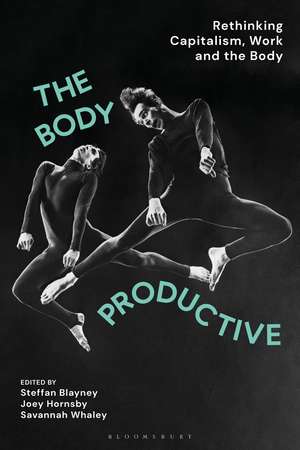
The Body Productive: Rethinking Capitalism, Work and the Body
Editat de Steffan Blayney, Joey Hornsby, Savannah Whaleyen Limba Engleză Paperback – 25 iul 2024
These are the questions at the heart of The Body Productive, a collection of original, radical new approaches to the relationships between capitalism, work and the body from an international group of scholars and activists. Taking inspiration from the neglected theoretical work of François Guéry and Didier Deleule, and bridging Marxist and Foucauldian traditions, this book rethinks the relationships between the biological and the social; the body and the mind; power and knowledge; discipline and control.
| Toate formatele și edițiile | Preț | Express |
|---|---|---|
| Paperback (1) | 205.03 lei 43-57 zile | |
| Bloomsbury Publishing – 25 iul 2024 | 205.03 lei 43-57 zile | |
| Hardback (1) | 525.56 lei 22-36 zile | +183.06 lei 5-11 zile |
| Bloomsbury Publishing – 26 ian 2023 | 525.56 lei 22-36 zile | +183.06 lei 5-11 zile |
Preț: 205.03 lei
Preț vechi: 274.49 lei
-25%
Puncte Express: 308
Preț estimativ în valută:
36.24€ • 42.63$ • 31.63£
36.24€ • 42.63$ • 31.63£
Carte tipărită la comandă
Livrare economică 06-20 aprilie
Specificații
ISBN-13: 9780755639557
ISBN-10: 0755639553
Pagini: 240
Dimensiuni: 154 x 234 x 18 mm
Greutate: 0.74 kg
Editura: Bloomsbury Publishing
Colecția Bloomsbury Academic
Locul publicării:London, United Kingdom
ISBN-10: 0755639553
Pagini: 240
Dimensiuni: 154 x 234 x 18 mm
Greutate: 0.74 kg
Editura: Bloomsbury Publishing
Colecția Bloomsbury Academic
Locul publicării:London, United Kingdom
Cuprins
1. Introduction: Rethinking Capitalism, Work, and the Body
Steffan Blayney, Joey Hornsby & Savannah Whaley
2. The Productive Body Revisited
François Guéry
2. The Productive Body Revisited
Dan Taylor
4. Corporeal and Abstract: Is There a 'Left Biopolitics' of Bodies?
Marina Vishmidt
5. Empty Promises: The Financialization of Labour
Phil Jones
6. The Dialectical Body: Bringing Science Back into Socialism
Graham Jones
7. Neither Appropriated nor Expropriated: Notes Towards an Autonomist Cripistemology of the Productive Body
Arianna Introna
8. The Quantified Self, the Ideology of Health, and Fat
Dawn Woolley
9. The Artefact of Losing: The (Bio)poetics of Miscarriage
Helen Charman & Christopher Law
10. Reproductive Data-Bodies: Privacy, Inequality and Anti-Abortion Politics in the Age of Platform Capitalism
Grace Tillyard
11. Algorithmic Capitalism, the New Machinofacture and the Productive Body
Stephen Shapiro & Philip Barnard
Steffan Blayney, Joey Hornsby & Savannah Whaley
2. The Productive Body Revisited
François Guéry
2. The Productive Body Revisited
Dan Taylor
4. Corporeal and Abstract: Is There a 'Left Biopolitics' of Bodies?
Marina Vishmidt
5. Empty Promises: The Financialization of Labour
Phil Jones
6. The Dialectical Body: Bringing Science Back into Socialism
Graham Jones
7. Neither Appropriated nor Expropriated: Notes Towards an Autonomist Cripistemology of the Productive Body
Arianna Introna
8. The Quantified Self, the Ideology of Health, and Fat
Dawn Woolley
9. The Artefact of Losing: The (Bio)poetics of Miscarriage
Helen Charman & Christopher Law
10. Reproductive Data-Bodies: Privacy, Inequality and Anti-Abortion Politics in the Age of Platform Capitalism
Grace Tillyard
11. Algorithmic Capitalism, the New Machinofacture and the Productive Body
Stephen Shapiro & Philip Barnard
Recenzii
If Marx taught us that capitalist labour 'mortifies' the body of the worker, this book is an urgent and critical analysis of that process of mortification. The book refocuses our attention to how the body is both produced and becomes productive under capital's strident demands upon it. But the authors urge us to consider not the passive trope of bodily resilience when it comes to the global working class, but the constant running script of bodily resistance as workers hide from, defy, or in some moments, dismantle capitalist logic.
This book is a bold intervention into ways of thinking about "the productive body" from Marx to twenty-first century digital capitalism. By encouraging us to reflect on bodies and the future of resistance, it is an essential text for anyone interested in contemporary regimes of power.
Taking François Guéry and Didier Deleule's The Productive Body as a starting point, the chapters collected in this wide-ranging and critical volume show how the dynamics of capitalist social form have shaped (and continue to shape) the practical and discursive treatment of bodies. As the editors and contributors insist, bodies are not transhistorical givens, the 'real' or 'natural' counterparts to capital's abstract forms. Rather, their varied uses and meanings appear in the course of those forms' historical elaboration.
This book is a bold intervention into ways of thinking about "the productive body" from Marx to twenty-first century digital capitalism. By encouraging us to reflect on bodies and the future of resistance, it is an essential text for anyone interested in contemporary regimes of power.
Taking François Guéry and Didier Deleule's The Productive Body as a starting point, the chapters collected in this wide-ranging and critical volume show how the dynamics of capitalist social form have shaped (and continue to shape) the practical and discursive treatment of bodies. As the editors and contributors insist, bodies are not transhistorical givens, the 'real' or 'natural' counterparts to capital's abstract forms. Rather, their varied uses and meanings appear in the course of those forms' historical elaboration.