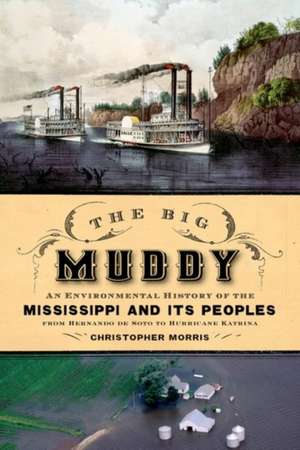
The Big Muddy: An Environmental History of the Mississippi and Its Peoples from Hernando de Soto to Hurricane Katrina
Autor Christopher Morrisen Limba Engleză Paperback – 13 apr 2017
Preț: 298.75 lei
Preț vechi: 356.58 lei
-16%
Puncte Express: 448
Carte disponibilă
Livrare economică 19-25 noiembrie
Livrare prin curier în România Termenul estimat este afișat lângă disponibilitate.
Transport gratuit de la 400.00 lei Plată online sau ramburs, în funcție de opțiunile comenzii.
Retur gratuit în 14 zile Comandă securizată și suport în română.
Specificații
ISBN-13: 9780190610760
ISBN-10: 019061076X
Pagini: 320
Ilustrații: 40 halftones
Dimensiuni: 231 x 155 x 20 mm
Greutate: 0.43 kg
Editura: Oxford University Press
Colecția OUP USA
Locul publicării:New York, United States
ISBN-10: 019061076X
Pagini: 320
Ilustrații: 40 halftones
Dimensiuni: 231 x 155 x 20 mm
Greutate: 0.43 kg
Editura: Oxford University Press
Colecția OUP USA
Locul publicării:New York, United States
V-ar putea interesa
-
 Hidden FiguresMargot Lee ShetterlyPreț: 92.41 lei
 -
 Texas RisingStephen L MoorePreț: 109.77 lei
 -
 Dictionary of EnergyCutler J. Cleveland-11%Preț: 674.80 lei758.21 lei
 -
 Handbook of Energy: Chronologies, Top Ten Lists, and Word CloudsCutler J. Cleveland-28%Preț: 651.79 lei906.85 lei
 -
 KissingerNiall Ferguson-16%Preț: 118.02 lei141.07 lei
 -
 The Natural History of the Long Expedition to the Rocky Mountains (1819-1820)Howard Ensign Evans-19%Preț: 360.03 lei445.85 lei
 -
 -11%Preț: 275.59 lei310.46 lei
 -
 "We Shall Meet Again"Joanna M McDonaldPreț: 206.39 lei
 -
 The American Intellectual Tradition: Volume II: 1865 to the PresentDavid A. Hollinger-20%Preț: 487.41 lei612.19 lei
 -
 -18%Preț: 382.10 lei464.10 lei
 -
 Mrs. Dred Scott: A Life on Slavery's FrontierLea Vandervelde-26%Preț: 434.20 lei590.30 lei
 -
 Benjamin FranklinEdwin S Gaustad-15%Preț: 88.11 lei104.26 lei
 -
 -12%Preț: 265.11 lei302.33 lei
 -
 The Populist VisionCharles Postel-11%Preț: 277.53 lei312.42 lei
 -
 Ronald ReaganMichael Schaller-18%Preț: 82.36 lei100.52 lei
 -
 Preț: 110.66 lei
 -
 The N WordJabari AsimPreț: 107.13 lei
 -
 The Imperial PresidencyArthur Meier Jr. SchlesingerPreț: 186.59 lei
 -
 Preț: 363.89 lei
 -
 Southern Writers and Their WorldsChristopher MorrisPreț: 183.15 lei
 -
 Preț: 258.24 lei
 -
 Preț: 446.59 lei
 -
 Black Hawk and the Warrior's PathRoger L NicholsPreț: 281.86 lei
 -
 Models of MisrepresentationChristopher MorrisPreț: 204.20 lei
 -
 All Our RelationsWinona LadukePreț: 114.36 lei
 -
 The Secret Societies of All Ages & Countries (Two Volumes in One)Charles William HeckethornPreț: 246.70 lei
 -
 Rio de JaneiroLuiz Eduardo SoaresPreț: 115.70 lei
Recenzii
[An] ambitious and cleanly argued environmental history of the lower Mississippi Valley....
The history of the Mississippi valley is the story of a constant tug-of-war between water and land. Morris has aptly told the stories that are often on the margin of the river, and have been on the margin of histories of the valley. In doing this, he has provided much-needed contexts for our endless fascination with the Mississippi River.
Christopher Morris has molded a thoroughly researched, smartly organized, and thoughtfully argued book. ... Morris deploys human stories and graceful prose to maintain the flow, making his an accessible study... The Big Muddy also comes in a compact size, ideal for adopting for a course, as this reviewer has done.
Christopher Morris has written an important book that is both history and advocacy. There is much to praise in this book, and it is certain to win acclaim and recognition for its author.
Elegantly written, The Big Muddy is a sweeping environmental history of a famous river told with an eye toward the relationship between water and land.
This environmental history of the Mississippi River Valley has a thesis that Morris explores as it relates to different peoples and their technologies, ranging from Native Americans and Spanish and French explorers to current residents in post-Hurrican Katrina times. This is a a multidisciplinary history; the extensive endnotes show that Morris did his homework thoroughly. Highly recommended.
Impressive in its chronological scope, thoughtfully covering five centuries of interactions between people and water, Morris's skilled and subtle work of environmental history shows how river-based ecological systems embed, underwrite, and challenge shore-bound human institutions. Demonstrating the possibility of writing a history of transnational scope while staying in the same place, The Big Muddy follows Spanish, French, and U.S. actors.
The Big Muddy makes a powerful argument that nature is trying to tell us 'something about the way we understand the natural environment and our place within it.'
A story as sprawling and powerful as the river it describes. In the wake of 2011's epic flooding, this volume could not be more timely.
Thoroughly researche, tightly written, and uncommonly well illustrated... Morris is at his best here.
Few authors have so elegantly and succinctly merged human history and natural history as Christopher Morris does in The Big Muddy, his environmental history of the Mississippi River. Eschewing easy answers and simple explanations, he makes clear what is at stake in how humans live in nature.
Chris Morris has written a thoroughly engaging account of human encounters with the Mississippi River. He penetrates and clarifies the complex environmental history of this murky torrent while offering up a flood of fresh insights. As much as any recent history I've seen, this work not only narrates the past, but speaks with a powerful voice to the future of the lower river valley and its inhabitants.
More than any other book written so far, The Big Muddy forces us to understand how stubborn efforts to dry wetlands in the Mississippi Valley not only caused vexing environmental problems but also shaped social and economic relationships in troublesome ways. A society plagued by inequality and instability can learn plenty from Christopher Morris's skillful documentation of why we must more wisely adapt to nature's irrepressible mixing of land and water.
Christopher Morris's The Big Muddy is an extremely important new addition to our ever growing environmental history library. It's a tragic story about how the Mississippi River has been abused for centuries. Morris is a superb researcher and talented writer. Highly recommended!
What is remarkable and fresh about this scholarly study of the Mississippi in the longue duree is its comprehensiveness, density, and nuance, as well as the fresh research upon which it is based. It is a sturdy, grand, and at times stunning achievement, deeply rooted in substantial interdisciplinary research and brimming with insight.
The history of the Mississippi valley is the story of a constant tug-of-war between water and land. Morris has aptly told the stories that are often on the margin of the river, and have been on the margin of histories of the valley. In doing this, he has provided much-needed contexts for our endless fascination with the Mississippi River.
Christopher Morris has molded a thoroughly researched, smartly organized, and thoughtfully argued book. ... Morris deploys human stories and graceful prose to maintain the flow, making his an accessible study... The Big Muddy also comes in a compact size, ideal for adopting for a course, as this reviewer has done.
Christopher Morris has written an important book that is both history and advocacy. There is much to praise in this book, and it is certain to win acclaim and recognition for its author.
Elegantly written, The Big Muddy is a sweeping environmental history of a famous river told with an eye toward the relationship between water and land.
This environmental history of the Mississippi River Valley has a thesis that Morris explores as it relates to different peoples and their technologies, ranging from Native Americans and Spanish and French explorers to current residents in post-Hurrican Katrina times. This is a a multidisciplinary history; the extensive endnotes show that Morris did his homework thoroughly. Highly recommended.
Impressive in its chronological scope, thoughtfully covering five centuries of interactions between people and water, Morris's skilled and subtle work of environmental history shows how river-based ecological systems embed, underwrite, and challenge shore-bound human institutions. Demonstrating the possibility of writing a history of transnational scope while staying in the same place, The Big Muddy follows Spanish, French, and U.S. actors.
The Big Muddy makes a powerful argument that nature is trying to tell us 'something about the way we understand the natural environment and our place within it.'
A story as sprawling and powerful as the river it describes. In the wake of 2011's epic flooding, this volume could not be more timely.
Thoroughly researche, tightly written, and uncommonly well illustrated... Morris is at his best here.
Few authors have so elegantly and succinctly merged human history and natural history as Christopher Morris does in The Big Muddy, his environmental history of the Mississippi River. Eschewing easy answers and simple explanations, he makes clear what is at stake in how humans live in nature.
Chris Morris has written a thoroughly engaging account of human encounters with the Mississippi River. He penetrates and clarifies the complex environmental history of this murky torrent while offering up a flood of fresh insights. As much as any recent history I've seen, this work not only narrates the past, but speaks with a powerful voice to the future of the lower river valley and its inhabitants.
More than any other book written so far, The Big Muddy forces us to understand how stubborn efforts to dry wetlands in the Mississippi Valley not only caused vexing environmental problems but also shaped social and economic relationships in troublesome ways. A society plagued by inequality and instability can learn plenty from Christopher Morris's skillful documentation of why we must more wisely adapt to nature's irrepressible mixing of land and water.
Christopher Morris's The Big Muddy is an extremely important new addition to our ever growing environmental history library. It's a tragic story about how the Mississippi River has been abused for centuries. Morris is a superb researcher and talented writer. Highly recommended!
What is remarkable and fresh about this scholarly study of the Mississippi in the longue duree is its comprehensiveness, density, and nuance, as well as the fresh research upon which it is based. It is a sturdy, grand, and at times stunning achievement, deeply rooted in substantial interdisciplinary research and brimming with insight.
Notă biografică
Christopher Morris is Associate Professor of History at the University of Texas at Arlington. He is the author of Becoming Southern: The Evolution of a Way of Life, Vicksburg and Warren County, Mississippi, 1770-1860.