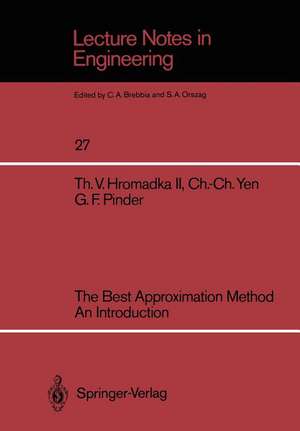
The Best Approximation Method An Introduction: Lecture Notes in Engineering, cartea 27
Autor Theodore V. II Hromadka, Chung-Cheng Yen, George F. Pinderen Limba Engleză Paperback – 31 mar 1987
Din seria Lecture Notes in Engineering
- 15%
 Preț: 615.66 lei
 - 15%
 Preț: 618.50 lei
 - 15%
 Preț: 608.28 lei
 - 18%
 Preț: 1066.35 lei
 - 15%
 Preț: 613.00 lei
 - 15%
 Preț: 614.24 lei
 - 15%
 Preț: 613.31 lei
 - 15%
 Preț: 611.43 lei
 - 15%
 Preț: 613.18 lei
 - 18%
 Preț: 919.98 lei
 -
 Preț: 381.92 lei
 - 15%
 Preț: 628.56 lei
 - 15%
 Preț: 613.94 lei
 - 15%
 Preț: 610.33 lei
 - 15%
 Preț: 619.29 lei
 - 15%
 Preț: 610.63 lei
 - 15%
 Preț: 613.31 lei
 - 15%
 Preț: 608.78 lei
 - 15%
 Preț: 628.56 lei
 - 15%
 Preț: 625.88 lei
 - 20%
 Preț: 620.38 lei
 - 15%
 Preț: 614.41 lei
 - 15%
 Preț: 608.78 lei
 - 15%
 Preț: 629.85 lei
 - 15%
 Preț: 627.31 lei
 - 15%
 Preț: 627.62 lei
 - 15%
 Preț: 618.64 lei
 - 15%
 Preț: 613.62 lei
 - 20%
 Preț: 615.76 lei
 - 15%
 Preț: 649.47 lei
 - 15%
 Preț: 614.90 lei
 - 15%
 Preț: 617.39 lei
 - 15%
 Preț: 613.80 lei
 - 15%
 Preț: 617.89 lei
 - 15%
 Preț: 622.29 lei
 - 15%
 Preț: 630.59 lei
 - 15%
 Preț: 640.03 lei
 -
 Preț: 395.98 lei
 -
 Preț: 391.34 lei
 - 15%
 Preț: 610.18 lei
 - 15%
 Preț: 625.75 lei
 - 18%
 Preț: 936.65 lei
 - 15%
 Preț: 617.89 lei
 - 15%
 Preț: 610.82 lei
 - 15%
 Preț: 615.66 lei
 - 15%
 Preț: 611.89 lei
 - 20%
 Preț: 634.14 lei
 - 15%
 Preț: 626.36 lei
 - 15%
 Preț: 610.01 lei
Preț: 611.89 lei
Preț vechi: 719.87 lei
-15%
Puncte Express: 918
Carte tipărită la comandă
Livrare economică 03-17 august
Livrare prin curier în România Termenul estimat este afișat lângă disponibilitate.
Transport gratuit pentru acest produs Plată online sau ramburs, în funcție de opțiunile comenzii.
Retur gratuit în 14 zile Comandă securizată și suport în română.
Specificații
ISBN-13: 9783540175728
ISBN-10: 3540175725
Pagini: 188
Ilustrații: XIV, 172 p.
Dimensiuni: 170 x 244 x 10 mm
Greutate: 0.31 kg
Ediția:Softcover reprint of the original 1st ed. 1987
Editura: Springer Berlin, Heidelberg
Colecția Springer
Seria Lecture Notes in Engineering
Locul publicării:Berlin, Heidelberg, Germany
ISBN-10: 3540175725
Pagini: 188
Ilustrații: XIV, 172 p.
Dimensiuni: 170 x 244 x 10 mm
Greutate: 0.31 kg
Ediția:Softcover reprint of the original 1st ed. 1987
Editura: Springer Berlin, Heidelberg
Colecția Springer
Seria Lecture Notes in Engineering
Locul publicării:Berlin, Heidelberg, Germany
V-ar putea interesa
-
 MATLAB DemystifiedDavid McMahonPreț: 146.82 lei
 -
 -23%Preț: 235.35 lei304.97 lei
 -
 -9%Preț: 129.45 lei142.06 lei
 -
 The Chemistry Maths BookErich Steiner-21%Preț: 408.59 lei516.79 lei
 -
 Engineering Mathematics Through ApplicationsKuldeep Singh-21%Preț: 426.87 lei543.66 lei
 -
 Principles of Quantum MechanicsR. Shankar-15%Preț: 609.98 lei717.62 lei
 -
 Brownian Motion CalculusUbbo F. WiersemaPreț: 363.99 lei
 -
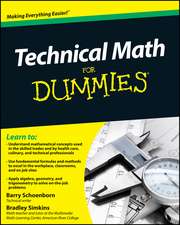 Technical Math For DummiesBarry SchoenbornPreț: 137.53 lei
 -
 Concepts and Applications of Finite Element AnalysisRobert D. Cook-18%Preț: 1328.08 lei1619.61 lei
 -
 Modern Signal ProcessingDaniel N. RockmorePreț: 366.81 lei
 -
 Mathematical Methods for Physics and EngineeringK. F. Riley-8%Preț: 441.78 lei480.20 lei
 -
 -15%Preț: 618.50 lei727.65 lei
Public țintă
ResearchCuprins
1. Work Spaces.- 1.1. Metric Spaces.- 1.2. Linear Spaces.- 1.3. Normed Linear Spaces.- 1.4. Banach Spaces.- 2. Integration Theory.- 2.0. Introduction.- 2.1. The Riemann and Lebesgue Integrals: Step and Simple Functions.- 2.2. Lebesque Measure.- 2.3. Measurable Functions.- 2.4. The Lebesgue Integral.- 2.5. Key Theorems in Integration Theory.- 2.6. Lp Spaces.- 2.7. The Metric Space, Lp.- 2.8. Convergence of Sequences.- 2.9. Capsulation.- 3: Hilbert Space and Generalized Fourier Series.- 3.0 Introduction.- 3.1. Inner Product and Hilbert Space (Finite Dimension Spaces).- 3.2. Infinite Dimension Spaces.- 3.3. Approximations in L2(E).- 3.4. Vector Space Representation for Approximations: An Application.- 4. Linear Operators.- 4.0. Introduction.- 4.1. The Derivative as a Linear Operator.- 4.2. Linear Operators.- 4.3. Examples of Linear Operators in Engineering.- 4.4. Linear Operator Norms.- 5. The Best Approximation Method.- 5.0. Introduction.- 5.1. An Inner Product for the Solution of Linear Operator Equations.- 5.2. Orthonormalization Process.- 5.3. Generalized Fourier Series.- 5.4. Approximation Error Evaluation.- 5.5. The Weighted Inner Product.- 6. The Best Approximation Method: Applications.- 6.0. Introduction.- 6.1. Sensitivity of Computational Results to Variation in the Inner Product Weighting Factor.- 6.2. Solving Two-Dimensional Potential Problems.- 6.3. Application to Other Linear Operators.- 6.4. Computer Program: Two-Dimensional Potential Problems Using Real Variable Basis Functions.- 7. Coupling the Best Approximation and Complex Variable Boundary Element Methods.- 7.0. Introduction.- 7.1. The Complex Variable Boundary Element Method.- 7.2. Mathematical Development.- 7.3. The CVBEM and W?.- 7.4. The Space W?A.- 7.5. Applications.- 7.6. Computer Program:Two-Dimensional Potential Problems Using Analytic Basis Functions (CVBEM).- References.- Appendix A: Derivation of CVBEM Approximation Function.- Appendix B: Convergence of CVBEM Approximator.