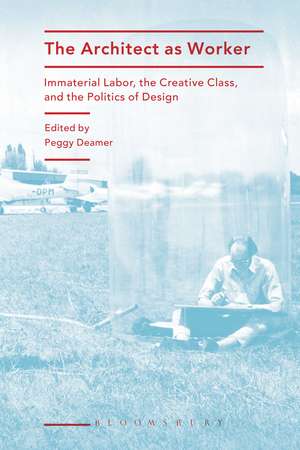
The Architect as Worker: Immaterial Labor, the Creative Class, and the Politics of Design
Editat de Professor Peggy Deameren Limba Engleză Hardback – 30 iul 2015
The Architect as Worker presents a range of essays exploring the issues central to architectural labor. These include questions about the nature of design work; immaterial and creative labor and how it gets categorized, spatialized, and monetized within architecture; the connection between parametrics and BIM and labor; theories of architectural work; architectural design as a cultural and economic condition; entrepreneurialism; and the possibility of ethical and rewarding architectural practice.
The book is a call-to-arms, and its ultimate goal is to change the practice of architecture. It will strike a chord with architects, who will recognize the struggle of their profession; with students trying to understand the connections between work, value, and creative pleasure; and with academics and cultural theorists seeking to understand what grounds the discipline.
Preț: 774.09 lei
Preț vechi: 1022.71 lei
-24%
Puncte Express: 1161
Carte tipărită la comandă
Livrare economică 26 noiembrie-10 decembrie
Livrare prin curier în România Termenul estimat este afișat lângă disponibilitate.
Transport gratuit pentru acest produs Plată online sau ramburs, în funcție de opțiunile comenzii.
Retur gratuit în 14 zile Comandă securizată și suport în română.
Specificații
ISBN-13: 9781472570505
ISBN-10: 1472570502
Pagini: 296
Ilustrații: 16 halftones
Dimensiuni: 156 x 234 x 18 mm
Greutate: 0.64 kg
Editura: Bloomsbury Publishing
Colecția Bloomsbury Academic
Locul publicării:London, United Kingdom
ISBN-10: 1472570502
Pagini: 296
Ilustrații: 16 halftones
Dimensiuni: 156 x 234 x 18 mm
Greutate: 0.64 kg
Editura: Bloomsbury Publishing
Colecția Bloomsbury Academic
Locul publicării:London, United Kingdom
Cuprins
Foreword
Joan Ockman, University of Pennsylvania School of Design, USA
Introduction
Peggy Deamer, Yale University, USA
Part I: The Commodification of Design Labor
1. Dynamic of the General Intellect
Franco Berardi, Nuova Accademia di Belle Arti, Milano, Italy
2. White Night before a Manifesto
Daniel van der Velden and Vinca Kruk, Metahaven, The Netherlands
3. The Capitalist Origin of the Concept of Creative Work
Richard Biernacki, University of California, San Diego, USA
4. The Architect as Entrepreneurial Self: Hans Hollein's TV Performance 'Mobile Office' (1969)
Andreas Rumpfhuber, Expanded Design, Vienna, Austria
Part II: The Concept of Architectural Labor
5. Work
Peggy Deamer, Yale University, USA
6. More for Less: Architectural Labor and Design Productivity
Paolo Tombesi, University of Melbourne, Australia
7. Form and Labor: Towards a History of Abstraction in Architecture
Pier Vittorio Aureli, Architectural Association, UK
Part III: Design(ers)/Build(ers)
8. Writing Work: Changing Practices of Architectural Specification
Katie Lloyd Thomas, Newcastle University, UK and Tilo Amhoff, University of Brighton, UK
9. Working Globally: The Human Networks of Transnational Architectural Projects
Mabel O. Wilson, Columbia University, USA, Jordan Carver, University at Buffalo School of Architecture, USA and Kadambari Baxi, Barnard College, USA
Part IV: The Construction of the Commons
10. Labor, Architecture, and the New Feudalism: Urban Space as Experience
Norman M. Klein, California Institute of the Arts, USA
11. The Hunger Games: Architects in Danger
Alicia Carrió, Carrió Studio, Spain
12. Foucault's 'Environmental' Power: Architecture and Neoliberal Subjectivization
Manuel Shvartzberg, University of Columbia, USA
Part V: The Profession
13. Three Strategies for New Value Propositions of Design Practice
Phillip G. Bernstein, Yale University, USA and Autodesk, USA
14. Labor and Talent in Architecture
Thomas Fisher, University of Minnesota, USA
15. The (Ac)Credit(ation) Card
Neil Leach, University of Southern California, USA
Afterword
Michael Sorkin, Bernard and Anne Spitzer School of Architecture, CUNY, USA
Index
Joan Ockman, University of Pennsylvania School of Design, USA
Introduction
Peggy Deamer, Yale University, USA
Part I: The Commodification of Design Labor
1. Dynamic of the General Intellect
Franco Berardi, Nuova Accademia di Belle Arti, Milano, Italy
2. White Night before a Manifesto
Daniel van der Velden and Vinca Kruk, Metahaven, The Netherlands
3. The Capitalist Origin of the Concept of Creative Work
Richard Biernacki, University of California, San Diego, USA
4. The Architect as Entrepreneurial Self: Hans Hollein's TV Performance 'Mobile Office' (1969)
Andreas Rumpfhuber, Expanded Design, Vienna, Austria
Part II: The Concept of Architectural Labor
5. Work
Peggy Deamer, Yale University, USA
6. More for Less: Architectural Labor and Design Productivity
Paolo Tombesi, University of Melbourne, Australia
7. Form and Labor: Towards a History of Abstraction in Architecture
Pier Vittorio Aureli, Architectural Association, UK
Part III: Design(ers)/Build(ers)
8. Writing Work: Changing Practices of Architectural Specification
Katie Lloyd Thomas, Newcastle University, UK and Tilo Amhoff, University of Brighton, UK
9. Working Globally: The Human Networks of Transnational Architectural Projects
Mabel O. Wilson, Columbia University, USA, Jordan Carver, University at Buffalo School of Architecture, USA and Kadambari Baxi, Barnard College, USA
Part IV: The Construction of the Commons
10. Labor, Architecture, and the New Feudalism: Urban Space as Experience
Norman M. Klein, California Institute of the Arts, USA
11. The Hunger Games: Architects in Danger
Alicia Carrió, Carrió Studio, Spain
12. Foucault's 'Environmental' Power: Architecture and Neoliberal Subjectivization
Manuel Shvartzberg, University of Columbia, USA
Part V: The Profession
13. Three Strategies for New Value Propositions of Design Practice
Phillip G. Bernstein, Yale University, USA and Autodesk, USA
14. Labor and Talent in Architecture
Thomas Fisher, University of Minnesota, USA
15. The (Ac)Credit(ation) Card
Neil Leach, University of Southern California, USA
Afterword
Michael Sorkin, Bernard and Anne Spitzer School of Architecture, CUNY, USA
Index
Recenzii
This landmark volume will jumpstart conversations that are long overdue in the world of architecture. Its contributors help us understand the profession's blind spot about labor while generating sharp insights on a full range of fundamental questions: Who constructs the buildings? Who renders the designs? Who gets paid, and who doesn't?
Compared to endless speculations about the implications of digital technologies for architecture, almost no attention has been given to the much more fundamental question of architecture's relationship to recent changes in the structural organisation of labour. The Architect as Worker is a pioneering investigation of this topical but as yet little discussed issue. Drawing upon new theories of labour and of the development of the 'knowledge economy' - in particular Maurizio Lazzarato's concept of immaterial labour - these essays set out an agenda for us to consider what kind of work architecture might be under present day conditions.
The Architect as Worker is completely relevant to understanding the architect's current professional and political predicament. At once historical, theoretical, practical and clear-eyed, it should start urgent conversations across the design disciplines, not just architecture.
Architects, students, academics-workers of all kinds-concerned with the question of how the fragmented, homogenized, financialized, blind field that is architecture can simultaneously exploit and allow us to produce new forms of knowledge, need this book. It represents a point of departure for research and a call to act.
Compared to endless speculations about the implications of digital technologies for architecture, almost no attention has been given to the much more fundamental question of architecture's relationship to recent changes in the structural organisation of labour. The Architect as Worker is a pioneering investigation of this topical but as yet little discussed issue. Drawing upon new theories of labour and of the development of the 'knowledge economy' - in particular Maurizio Lazzarato's concept of immaterial labour - these essays set out an agenda for us to consider what kind of work architecture might be under present day conditions.
The Architect as Worker is completely relevant to understanding the architect's current professional and political predicament. At once historical, theoretical, practical and clear-eyed, it should start urgent conversations across the design disciplines, not just architecture.
Architects, students, academics-workers of all kinds-concerned with the question of how the fragmented, homogenized, financialized, blind field that is architecture can simultaneously exploit and allow us to produce new forms of knowledge, need this book. It represents a point of departure for research and a call to act.