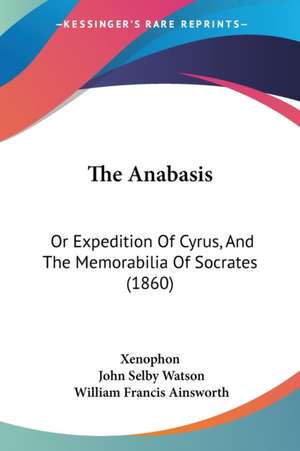
The Anabasis
Autor Xenophonen Limba Engleză Paperback – 6 noi 2009
Xenophon's Anabasis is a true story of remarkable adventures. Hellenica, a history of Greek affairs from 411 to 362, begins as a continuation of Thucydides' account. There are four works on Socrates (collected in Volume IV of the Loeb Xenophon edition). In Memorabilia Xenophon adds to Plato's picture of Socrates from a different viewpoint. The Apology is an interesting complement to Plato's account of Socrates' defense at his trial. Xenophon's Symposium portrays a dinner party at which Socrates speaks of love; and Oeconomicus has him giving advice on household management and married life. Cyropaedia, a historical romance on the education of Cyrus (the Elder), reflects Xenophon's ideas about rulers and government; the Loeb edition is in two volumes. We also have his Hiero, a dialogue on government; Agesilaus, in praise of that king; Constitution of Lacedaemon (on the Spartan system); Ways and Means (on the finances of Athens); Manual for a Cavalry Commander; a good manual of Horsemanship; and a lively Hunting with Hounds. The Constitution of the Athenians, though clearly not by Xenophon, is an interesting document on politics at Athens. These eight books are collected in the last of the seven volumes of the Loeb Classical Library edition of Xenophon.
Preț: 287.42 lei
Puncte Express: 431
Carte tipărită la comandă
Livrare economică 16-22 iulie
Livrare prin curier în România Termenul estimat este afișat lângă disponibilitate.
Transport gratuit de la 400.00 lei Plată online sau ramburs, în funcție de opțiunile comenzii.
Retur gratuit în 14 zile Comandă securizată și suport în română.
Specificații
ISBN-13: 9781120512390
ISBN-10: 1120512395
Pagini: 546
Dimensiuni: 152 x 229 x 29 mm
Greutate: 0.78 kg
Editura: Kessinger Publishing
ISBN-10: 1120512395
Pagini: 546
Dimensiuni: 152 x 229 x 29 mm
Greutate: 0.78 kg
Editura: Kessinger Publishing
V-ar putea interesa
-
 The Persian ExpeditionXenophon-20%Preț: 73.20 lei91.99 lei
 -
 A History of My TimesXenophon-20%Preț: 74.34 lei92.67 lei
 -
 The Campaigns of AlexanderArrianPreț: 92.92 lei
 -
 The Expedition of CyrusXenophon-20%Preț: 56.49 lei70.86 lei
 -
 Meditations: with selected correspondenceMarcus Aurelius-21%Preț: 50.37 lei63.49 lei
 -
 -20%Preț: 68.83 lei85.68 lei
 -
 Preț: 145.39 lei
 -
 MeditationsMarcus AureliusPreț: 32.15 lei
 -
 Xenophon's RetreatRobin WaterfieldPreț: 88.87 lei
 -
 Cyropaedia, Volume IXenophonPreț: 203.29 lei
 -
 Cyropaedia, Volume IIXenophonPreț: 206.74 lei
 -
 Hellenica, Volume I – Books 1–4 (Greek)Xenophon XenophonPreț: 227.47 lei
 -
 Hellenica, Volume II – Books 5–7 (Greek)Xenophon XenophonPreț: 223.61 lei
 -
 The Persian Wars, Volume IIHerodotusPreț: 229.26 lei
 -
 The Landmark Xenophon's HellenikaRobert B StrasslerPreț: 229.60 lei
 -
 The Falcon of SpartaConn Iggulden-19%Preț: 63.97 lei79.07 lei
 -
 HellenicaXenophonPreț: 56.01 lei
 -
 The Memorable Thoughts of SocratesXenophonPreț: 43.91 lei
 -
 Nobody's ChildCatherine KennyPreț: 128.80 lei
 -
 Preț: 102.21 lei
 -
 Preț: 74.41 lei
 -
 HistoriesHerodotusPreț: 46.98 lei
 -
 Preț: 133.82 lei
 -
 HellenikaXenophonPreț: 267.97 lei
Notă biografică
Xenophon of Athens (c.¿431 BC - 354 BC) was an ancient Greek philosopher, historian, soldier, mercenary, and student of Socrates. As a soldier, Xenophon became commander of the Ten Thousand at about 30, with noted military historian Theodore Ayrault Dodge saying of him, "the centuries since have devised nothing to surpass the genius of this warrior." He established the precedent for many logistical operations and was among the first to use flanking maneuvers, feints and attacks in depth. He was among the greatest commanders of antiquity. As a historian, Xenophon is known for recording the history of his time, the late-5th and early-4th centuries BC, in such works as the Hellenica, which covered the final seven years and the aftermath of the Peloponnesian War (431-404 BC), thus representing a thematic continuation of Thucydides' History of the Peloponnesian War. As one of the Ten Thousand (Greek mercenaries), Xenophon participated in Cyrus the Younger's failed campaign to claim the Persian throne from his brother Artaxerxes II of Persia. He recounted the events in Anabasis, his most notable history. Like Plato, Xenophon is an authority on Socrates, about whom he wrote several books of dialogues (the Memorabilia) and an Apology of Socrates to the Jury, which recounts the philosopher's trial in 399 BC. Despite being born an Athenian citizen, Xenophon was also associated with Sparta, the traditional enemy of Athens. His pro-oligarchic politics, military service under Spartan generals in the Persian campaign and elsewhere, and his friendship with King Agesilaus II endeared Xenophon to the Spartans. Some of his works have a pro-Spartan bias, especially the royal biography Agesilaus and the Constitution of the Spartans. Xenophon's works span several genres and are written in plain-language Attic Greek, for which reason they serve as translation exercises for contemporary students of the Ancient Greek language. In the Lives and Opinions of Eminent Philosophers, Diogenes Laërtius observed that, as a writer, Xenophon of Athens was known as the "Attic Muse," for the sweetness of his diction.