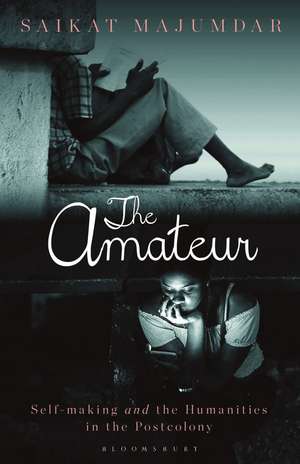
The Amateur: Self-Making and the Humanities in the Postcolony
Autor Professor Saikat Majumdaren Limba Engleză Paperback – 11 iul 2024
În capitolul introductiv, „The colonial map of misreading”, Professor Saikat Majumdar propune o perspectivă provocatoare asupra eșecului educațional: ideea că ignoranța sau greșeala pot deveni instrumente de formare intelectuală. The Amateur explorează modul în care autodidactismul a înflorit în spațiile unde sistemele formale de învățământ britanic au fost fie restrictive, fie pur instrumentale. Găsim în această carte o analiză detaliată a intelectualilor de culoare din Africa de Sud post-1953, a scriitorilor din Caraibe și a figurilor publice din India, a căror relație tensionată cu instituțiile de cunoaștere le-a permis, în mod paradoxal, succesul ca intelectuali publici.
Această lucrare completează perspectiva oferită de Africa's Hidden Histories de Karin Barber, adăugând o dimensiune teoretică despre „lectura slabă” și modul în care subiecții coloniali au deviat de la proiectul administrativ de profesionalizare. În timp ce Disciplined Subjects de Sutapa Dutta se concentrează pe modul în care curriculumul școlar a modelat subiectivitatea indiană în secolul al XVIII-lea, The Amateur mută discuția spre secolele XIX și XX, celebrând formele accidentale de învățare de la periferia imperiului.
Structura volumului reflectă o progresie de la teorie la studii de caz geografice, culminând cu o reflecție asupra violenței educației umaniste. Autorul continuă aici temele explorate în co-editarea volumului The Critic as Amateur și în monografia sa Prose of the World, rafinând distincția dintre impulsul amator și disciplina academică specializată. Recunoscută de The Chronicle of Higher Education drept una dintre cele mai bune cărți academice ale anului 2024, lucrarea este esențială pentru înțelegerea istoriei criticii literare în context global.
Preț: 134.82 lei
Preț vechi: 167.37 lei
-19%
Carte disponibilă
Livrare economică 16-30 noiembrie
Specificații
ISBN-10: 150139987X
Pagini: 232
Dimensiuni: 138 x 214 x 18 mm
Greutate: 0.3 kg
Editura: Bloomsbury Publishing
Colecția Bloomsbury Academic
Locul publicării:New York, United States
De ce să citești această carte
Această carte se adresează cercetătorilor și studenților interesați de studii postcoloniale și istoria educației. Cititorul câștigă o înțelegere profundă a modului în care lectura „greșită” a textelor canonice vestice a generat noi forme de rezistență intelectuală. Este o recomandare solidă pentru cei care doresc să exploreze cum s-au format marii gânditori ai sudului global în afara sau în pofida sistemelor universitare rigide.
Descriere
Can ignorance, mistake, failure shape ways of reading, or do they disrupt its proper practice? What happens when the authority of modern education and culture places canonical western texts in the way of readers who live in worlds remote from their material contexts?
The Amateur reads patterns of autodidactism and intellectual self-formation under systems of colonial education that are variously repressive, exclusionary, broken, or narrowly instrumental. It outlines the development of a wide range of writers, activists, and thinkers whose failed relationships with institutions of knowledge curiously enabled their later success as popular intellectuals. Bringing current debates around reading together with the history of higher education in the postcolony, it focuses on three primary locations: Black intellectuals in apartheid-era South Africa in the aftermath of the Bantu Education Act of 1953, 20th century Caribbean writers who sought to understand the disembodied legacy of the diaspora through accidental encounters with literature and history, and writers from late-colonial and postcolonial India whose disruptive self-formation departed from the administrative project of professionalizing a particular kind of colonial subject.
Celebrating flawed and accidental forms of reading, writing, and learning along the periphery of the historical British Empire, Majumdar reveals an unexpected account of the humanities in the postcolony.
Cuprins
1. The colonial map of misreading
2. Poor reading, weak theory
3. Autodidactic nation
4. Books, roots, pasts
5. The light and shadow of Empire
6. The violence of humanistic education
Notes
Bibliography
Index
Recenzii
The Amateur is evidently a work of polymathic, autodidactic scholarship. Saikat Majumdar's 'scholarly flanerie', to borrow his phrase, crosses artfully the line between academic and amateur approaches to literature, weaving these varied reading lives together with his own. The intimacy this generates is inviting.
In gorgeous prose, Saikat Majumdar conjures up scenes of autodidacts and amateur readers in the colonies, describing their idiosyncratic, haphazard, and ambivalent encounters with books. These encounters, he shows, have much to teach scholars of literature. A brilliant and groundbreaking contribution to postcolonial studies as well as to debates about the aims, methods, and value of reading.
This fascinating, beautifully written book opens up a whole new world. It's about colonial amateur readers, readers from Africa, the Caribbean and South Asia, who loved literature from the far-reaches of empire and who often struggled to come to terms with what their love of canonical white literature meant to them and others. Funnily enough that is now a struggle even those of us who love literature closer to the centre share: why do we love these classics so much, remote as they are from most of those around us and indeed from the world we actually live in? A book, then, that anyone interested in great literature can learn from.
In an age of hyper-professionalism, where the amateur and the autodidact has been deemed marginal, The Amateur shows the possibilities, pleasures and productive potential of amateur reading, even -perhaps especially - when undertaken in colonial and postcolonial settings. Readers in the colonies and in the postcolony avidly read the literature of their imperial overlords in ways which were unexpected and sometimes, as with Naipaul, Toru Dutt, CLR James and others discussed here, highly generative. Majumdar's deft history of amateur reading and criticism doubles up as a history of literary humanities across the reaches of the British empire, including India, South Africa and the Caribbean. Scholarly and erudite, but also playful and engaging, this is an important book that should be read by all those interested in English literature, colonial and postcolonial studies.
An unusual and innovative work, The Amateur reads a long line of colonial readers who blossom into writers - in India, Africa, and the Caribbean - and miraculously turn the reading of the colonizers' literature into an improbable vehicle for their personal and at times collective means of imaginative liberation.
Saikat Majumdar's The Amateur opens up a startlingly fresh perspective on [the role of Western education in Britain's colonies] ... [A] beautifully written scholarly book on the limits of scholarly reading and writing.
This exceedingly well-researched book merits the attention of readers interested in the philosophy of literature and in literary criticism as a phenomenon in its own right. Particularly crucial is the area where the postcolony meets the amateur reader-the socially active amateur. This very approachable monograph reads like a good novel-the sort where, by the ending, a reader wants more.