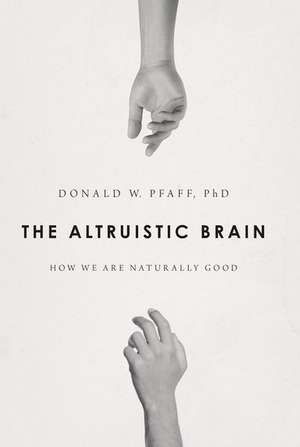
The Altruistic Brain: How We Are Naturally Good
Autor Donald W. Pfaffen Limba Engleză Hardback – 18 dec 2014
Preț: 218.96 lei
Preț vechi: 285.74 lei
-23%
Puncte Express: 328
Carte tipărită la comandă
Livrare economică 03-09 decembrie
Livrare prin curier în România Termenul estimat este afișat lângă disponibilitate.
Transport gratuit de la 400.00 lei Plată online sau ramburs, în funcție de opțiunile comenzii.
Retur gratuit în 14 zile Comandă securizată și suport în română.
Specificații
ISBN-13: 9780199377466
ISBN-10: 0199377464
Pagini: 306
Dimensiuni: 145 x 211 x 31 mm
Greutate: 0.59 kg
Editura: Oxford University Press
Colecția OUP USA
Locul publicării:New York, United States
ISBN-10: 0199377464
Pagini: 306
Dimensiuni: 145 x 211 x 31 mm
Greutate: 0.59 kg
Editura: Oxford University Press
Colecția OUP USA
Locul publicării:New York, United States
V-ar putea interesa
-
 Handbook of NeuroendocrinologyGeorge Fink-16%Preț: 891.67 lei1057.63 lei
 -
 Neuroendocrinology: Pathological Situations and DiseasesLuciano Martini-32%Preț: 1325.90 lei1936.12 lei
 -
 Reclaim Your HealthIsabel Bertran-HunsingerPreț: 80.43 lei
 -
 Freedom from StutteringPatricia a. Vitek McClainPreț: 84.79 lei
 -
 Pure Water for Better LivingEldon C MuehlingPreț: 150.29 lei
 -
 Nourishing Space WithinDr Allegra HartPreț: 119.20 lei
 -
 Preț: 112.80 lei
 -
 Sick of Sick Healthy Hints from HeavenCheryall Sparks R. N.Preț: 63.74 lei
 -
 Preț: 97.48 lei
 -
 Preț: 104.00 lei
 -
 -5%Preț: 388.14 lei408.57 lei
 -
 Ethical Questions in Brain and BehaviorDonald W. PfaffPreț: 383.27 lei
 -
 Sahrap Soysalla Saglikli MutfakSahrap SoysalPreț: 128.93 lei
 -
 Hos GeldimRayka KumruPreț: 127.91 lei
 -
 Acilin Ben CocugumMüjdat AtamanPreț: 85.46 lei
Recenzii
A worthwhile read for those wishing to familiarize themselves with potential mechanisms underlying altruistic behaviour.
A splendid read and a real tour de force of brain science, this book proves that altruistic behaviour has the power to shape our brains and, consequently, our destiny
Ground-breaking
Pfaff convincingly shows the science of altruism...
Written in a highly readable style, The Altruistic Brain summarizes the current state of knowledge in the field and offers an excellent starting point for readers who are interested in learning more about the biology and neuroscience of human prosociality.
By recognising these benevolent brain patterns, we can correspondingly strengthen them, thus giving more hope for a positive future a visionary conclusion from a scientific book.
A splendid read and a real tour de force of brain science, this book proves that altruistic behaviour has the power to shape our brains and, consequently, our destiny
Ground-breaking
Pfaff convincingly shows the science of altruism...
Written in a highly readable style, The Altruistic Brain summarizes the current state of knowledge in the field and offers an excellent starting point for readers who are interested in learning more about the biology and neuroscience of human prosociality.
By recognising these benevolent brain patterns, we can correspondingly strengthen them, thus giving more hope for a positive future a visionary conclusion from a scientific book.
Notă biografică
Professor of Neurobiology and Behavior, The Rockefeller University New York, New York