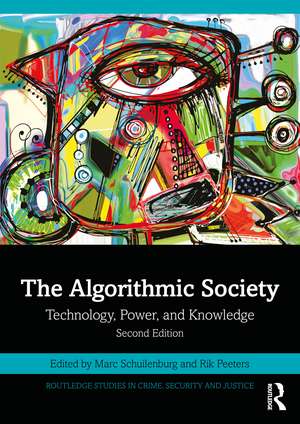
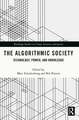
The Algorithmic Society: Technology, Power, and Knowledge: Routledge Studies in Crime, Security and Justice
Editat de Marc Schuilenburg, Rik Peetersen Limba Engleză Paperback – 28 oct 2026
Governments are increasingly turning towards AI tools to predict criminality, deliver public services, allocate resources, and calculate recidivism rates. Mind‑boggling amounts of data regarding our daily actions are analysed to make decisions that manage, control, and nudge our behaviour in everyday life. The contributions in this book offer a broad analysis of the mechanisms and social implications of algorithmic governance. Reporting from the cutting edge of scientific research, the result is illuminating and useful for understanding the relations between AI, power, and knowledge.
This new revised and updated edition includes topics such as:
• Algorithmic governmentality
• Transparency and accountability
• Fairness in criminal justice and predictive policing
• Principles of good digital administration
• Digital sovereignty and responsible AI
• AI and the smart city
This book is essential reading for students and scholars of Sociology, Criminology, Public Administration, Political Sciences, and Cultural Theory interested in the integration of AI and algorithms into the governance of society.





Preț: 447.65 lei
Precomandă
Puncte Express: 671
Carte nepublicată încă
Livrare prin curier în România Precomanda se expediază când titlul devine disponibil.
Transport gratuit pentru acest produs Plată online sau ramburs, în funcție de opțiunile comenzii.
Retur gratuit în 14 zile Comandă securizată și suport în română.
Doresc să fiu notificat când acest titlu va fi disponibil:
Se trimite...
Specificații
ISBN-13: 9781041221944
ISBN-10: 1041221940
Pagini: 270
Ilustrații: 2
Dimensiuni: 174 x 246 mm
Greutate: 0.5 kg
Ediția:2
Editura: Taylor & Francis
Colecția Routledge
Seria Routledge Studies in Crime, Security and Justice
Locul publicării:Oxford, United Kingdom
ISBN-10: 1041221940
Pagini: 270
Ilustrații: 2
Dimensiuni: 174 x 246 mm
Greutate: 0.5 kg
Ediția:2
Editura: Taylor & Francis
Colecția Routledge
Seria Routledge Studies in Crime, Security and Justice
Locul publicării:Oxford, United Kingdom
Public țintă
Postgraduate and Undergraduate AdvancedCuprins
1. The Algorithmic Society: An Introduction Part 1 ALGORITHMIC GOVERNANCE 2. The Data-Level Bureaucracy: AI, Algorithms, Data Mobilities, and Discretionary Space in Algorithmic Governance 3. Governing by Algorithms and Algorithmic Governmentality: Towards Machinic Judgement 4. Algorithmic Regulation: Machine Learning as a Governance Tool 5. Responsible and Accountable Algorithmization: How to Generate Citizen Trust in Governmental Usage of Algorithms 6. Towards Principles of Good Digital Administration: Fairness, Accountability and Proportionality in Automated Decision-Making Part 2 ALGORITHMIC JUSTICE 7. The Seductiveness of Fairness: Is Machine Learning the Answer? – Algorithmic Fairness in Criminal Justice Systems 8. Rethinking Predictive Policing: Towards a Holistic Framework of Democratic Algorithmic Surveillance 9. Algorithmic Reasoning: The Production of Subjectivity Through Data 10. Just Innovation? The Birth of ELSA Labs in an AI Ecosystem Part 3 ALGORITHMIC CITIES 11. Smart City Imaginaries: Looking Beyond the Techno-Utopian Vision 12. Sense in the (Smart) City: Where Personalisation is the Political 13. Inclusive Data Usage for Democratic Debate in Cities: The Role of Intermediaries 14. Five Smart City Futures: A Criminological Analysis of Urban Intelligence Part 4 CONCLUSIONS AND REFLECTIONS 15. Understanding the Algorithmic Society: Concluding Thoughts
Recenzii
It’s testament to the fast-changing pace of digital innovation and the AI disruption underway that a second edition was warranted so shortly after the first. We increasingly live in an algorithmically mediated society and this insightful book details what this means in practice, why it matters, and how to respond.
Rob Kitchin, Maynooth University Social Sciences Institute
AI is increasingly expanding to many aspects of our lives and transforming key elements of modern societies. This book constitutes an exemplar of research on algorithmic governance, particularly the influence of algorithms, automation, and digitalization on governance, justice, and cities. Based on a multidisciplinary perspective, The Algorithmic Society represents a diverse collection of current topics, critical reflections, and essential discussions about how data-driven technologies add new layers to the governance of society. I highly recommend it.
Ramon Gil‐Garcia, State University of New York Albany
This book offers one of the most comprehensive accounts to date of how algorithms and AI are reshaping the exercise of power and the organisation of everyday life. Through empirical engagement with a broad range of cases, it charts a path towards conceptualizing algorithmic governance as fair, accountable, and consistent with the values of an open society.
Matthias Leese, ETH Zurich & University of Zurich
For better and quite possibly for worse, AI will transform governance, politics and public policy. We urgently need to imagine and debate what could happen - and what is already happening. This outstanding volume provides us with the analytical tools and careful reasoning required to come to terms with the AI revolution transforming our societies.
Paul 't Hart, Utrecht University School of Governance
Rob Kitchin, Maynooth University Social Sciences Institute
AI is increasingly expanding to many aspects of our lives and transforming key elements of modern societies. This book constitutes an exemplar of research on algorithmic governance, particularly the influence of algorithms, automation, and digitalization on governance, justice, and cities. Based on a multidisciplinary perspective, The Algorithmic Society represents a diverse collection of current topics, critical reflections, and essential discussions about how data-driven technologies add new layers to the governance of society. I highly recommend it.
Ramon Gil‐Garcia, State University of New York Albany
This book offers one of the most comprehensive accounts to date of how algorithms and AI are reshaping the exercise of power and the organisation of everyday life. Through empirical engagement with a broad range of cases, it charts a path towards conceptualizing algorithmic governance as fair, accountable, and consistent with the values of an open society.
Matthias Leese, ETH Zurich & University of Zurich
For better and quite possibly for worse, AI will transform governance, politics and public policy. We urgently need to imagine and debate what could happen - and what is already happening. This outstanding volume provides us with the analytical tools and careful reasoning required to come to terms with the AI revolution transforming our societies.
Paul 't Hart, Utrecht University School of Governance
Notă biografică
Marc Schuilenburg is Professor of Digital Surveillance at the Erasmus University Rotterdam, the Netherlands. He is the author, editor, or co-editor of 14 books, and focuses in his work on the way in which public safety and policing is changing due to the rise of AI and algorithms.
Rik Peeters is Research Professor of Public Administration at the Centre for Research and Teaching in Economics (CIDE), Mexico City. He analyses the interactions between state and citizens through studies of bureaucracy, digital government, and administrative burdens.
Rik Peeters is Research Professor of Public Administration at the Centre for Research and Teaching in Economics (CIDE), Mexico City. He analyses the interactions between state and citizens through studies of bureaucracy, digital government, and administrative burdens.
Descriere
AI and algorithms have become the main mediators through which power and knowledge are enacted in our society. This book brings together three academic fields, Public Administration, Criminal Justice and Urban Governance, into a single conceptual framework, and offers a broad cultural-political analysis of AI and algorithms.