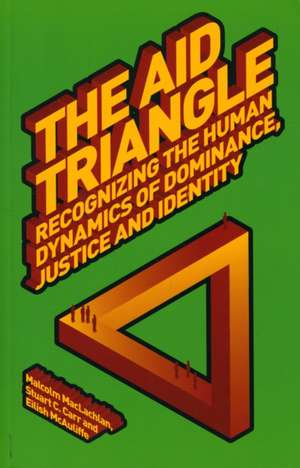
The Aid Triangle: Recognizing the Human Dynamics of Dominance, Justice and Identity
Autor Malcolm MacLachlan, Stuart Carr, Eilish McAuliffeen Limba Engleză Paperback – 10 iun 2010
Using the concept of a triangle of dominance, justice and identity, this timely work explains how the experience of injustice is both a challenge and a stimulus to personal, community and national identity, and how such identities underlie the human potential that international aid should seek to enrich. This insightful new critique provides for the reader an innovative and constructive framework for producing more empowering and more effective aid.
Preț: 202.63 lei
Preț vechi: 247.90 lei
-18%
Puncte Express: 304
Carte tipărită la comandă
Livrare economică 01-15 iunie
Specificații
ISBN-13: 9781842779118
ISBN-10: 1842779117
Pagini: 186
Dimensiuni: 138 x 216 x 11 mm
Greutate: 0.25 kg
Editura: Bloomsbury Publishing
Colecția Zed Books
Locul publicării:London, United Kingdom
ISBN-10: 1842779117
Pagini: 186
Dimensiuni: 138 x 216 x 11 mm
Greutate: 0.25 kg
Editura: Bloomsbury Publishing
Colecția Zed Books
Locul publicării:London, United Kingdom
V-ar putea interesa
-
 A Bed for the NightDavid RieffPreț: 205.89 lei
 -
 Dead AidDambisa Moyo-21%Preț: 58.95 lei74.64 lei
 -
 -20%Preț: 73.67 lei92.37 lei
 -
 -17%Preț: 90.84 lei109.85 lei
 -
 -19%Preț: 351.20 lei435.60 lei
 -
 -28%Preț: 63.94 lei88.71 lei
 -
 Humanitarian InterventionThomas G WeissPreț: 127.62 lei
 -
 Hope in HellDan BortolottiPreț: 124.51 lei
 -
 -26%Preț: 184.79 lei249.14 lei
 -
 An Imperfect OfferingJames Orbinski-21%Preț: 92.09 lei115.95 lei
 -
 Engineering in EmergenciesJan DavisPreț: 392.62 lei
 -
 Aid, NGOs and the Realities of Women's LivesTina WallacePreț: 222.87 lei
Cuprins
Introduction
1. Aid
2. Dominan
3. Justice
4. Identity
5. Learning
Conclusion
1. Aid
2. Dominan
3. Justice
4. Identity
5. Learning
Conclusion
Recenzii
At last! A book that addresses the psychological politics braided through civil society, governmental and multilateral agencies involved in aid. I highly recommend it.
A thought-provoking book that poses key questions about the nature and mechanisms of development.
This book is a most welcome addition to the growing call to rethink this whole dimension of international relations.
This book places justice - between individuals, between organisations and between countries and international organisations - at the heart of international aid and development; explaining its relationship with dominance and identity in a challenging, authoritative and engaging way.
This approachable and imaginative book takes a very different look at the practice of International Aid. Written by social scientists with considerable experience in the area, it offers not only a critique of current practices but also advice about how really to help those who need it. It is written with passion and clarity but always supported by the scientific literature in the area.
A thought-provoking book that poses key questions about the nature and mechanisms of development.
This book is a most welcome addition to the growing call to rethink this whole dimension of international relations.
This book places justice - between individuals, between organisations and between countries and international organisations - at the heart of international aid and development; explaining its relationship with dominance and identity in a challenging, authoritative and engaging way.
This approachable and imaginative book takes a very different look at the practice of International Aid. Written by social scientists with considerable experience in the area, it offers not only a critique of current practices but also advice about how really to help those who need it. It is written with passion and clarity but always supported by the scientific literature in the area.