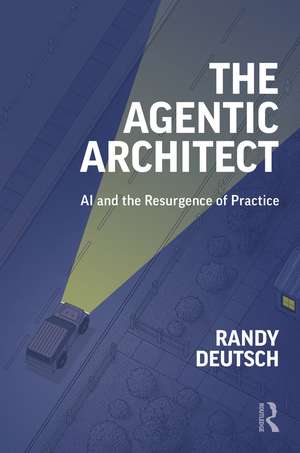
The Agentic Architect: AI and the Resurgence of Practice
Autor Randy Deutschen Limba Engleză Paperback – 15 iul 2026
The Agentic Architect explores how current and future architects can harness AI to become indispensable. The book addresses the critical gap between AI’s current (mis)use in academia and practice and how to pivot towards its full, effective adoption. Central to this pivot is the concept of agency. Agentic AI autonomously completes tasks; an agentic architect acts with purpose, meaning, and fulfillment, making informed decisions and contributing unique insights. Many architects, however, are experiencing a crisis of agency, feeling disempowered and immobilized. This book reveals how agency is lost—from school through professional life—and provides concrete solutions for rebuilding it for career growth, workforce relevance, and societal impact. Beyond technical skills, The Agentic Architect emphasizes educating the “whole architect” to prevent demoralization in the face of powerful AI. It focuses on identifying and cultivating agency, showing how to work agentically with AI throughout one’s career. This isn’t a doom‑and‑gloom narrative, but an optimistic, practical guide on “who we need to be” to thrive alongside AI.
The Agentic Architect is a high‑level, tool‑agnostic resource for students, faculty, design professionals, and firm leaders.
Preț: 351.79 lei
Puncte Express: 528
Carte disponibilă
Livrare economică 05-19 noiembrie
Livrare express 21-27 octombrie pentru 28.64 lei
Livrare prin curier în România Termenul estimat este afișat lângă disponibilitate.
Transport gratuit de la 400.00 lei Plată online sau ramburs, în funcție de opțiunile comenzii.
Retur gratuit în 14 zile Comandă securizată și suport în română.
Specificații
ISBN-13: 9781041167075
ISBN-10: 1041167075
Pagini: 164
Ilustrații: 32
Dimensiuni: 156 x 234 mm
Greutate: 0.3 kg
Ediția:1
Editura: Taylor & Francis
Colecția Routledge
Locul publicării:Oxford, United Kingdom
ISBN-10: 1041167075
Pagini: 164
Ilustrații: 32
Dimensiuni: 156 x 234 mm
Greutate: 0.3 kg
Ediția:1
Editura: Taylor & Francis
Colecția Routledge
Locul publicării:Oxford, United Kingdom
Public țintă
Postgraduate, Professional Practice & Development, Undergraduate Advanced, and Undergraduate CoreCuprins
Introduction: Contemplating & Responding to our Existential Moment. PART 1: FOUNDATIONS OF AGENCY. 1. Architecture and AI today: What we’re missing. 2. Education, Agency and AI: Learning, Fulfillment and Career Advancement. 3. This Appears to Be a Long Chapter. Let AI Summarize It for You. 4. A Day in the Life of an Agentic Architect. PART 2. AGENCY IN ACTION. 5. Identifying, Acquiring and Growing Agency. 6. How to Develop, Build and Protect Your Agency. 7. What We Will Always do Better Than AI. 8. Augmenting, Amplifying and Aligning Architects with AI. Conclusion: Actions to Assure We Not Only Survive but Thrive
Notă biografică
Randy Deutsch, FAIA, LEED AP, is an educator, author, highly respected international keynote speaker, workshop leader, AI researcher, design technology authority and licensed architect. He is a Senior Fellow of the Design Futures Council and currently serves as Clinical Associate Professor in the School of Architecture at the University of Illinois Urbana‑Champaign where he served as the Associate Director for Graduate Studies until 2019, teaching and conducting research in AI, design, design futures, professional practice, building technology and digital technology.
Descriere
Architectural education and the profession are grappling with the rise of AI. AI's true value for architects lies not in replicating existing strengths, but in solving practical, time-consuming problems. This frees architects to tackle larger societal challenges and leverage their core competencies for the public good.