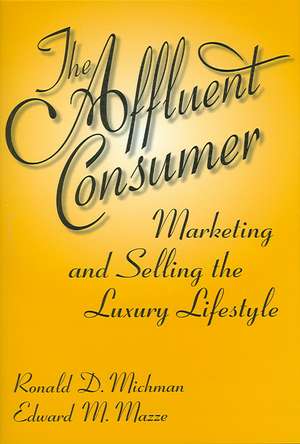
The Affluent Consumer: Marketing and Selling the Luxury Lifestyle
Autor Ronald D. Michman, Edward M. Mazzeen Limba Engleză Hardback – 30 sep 2006
By any measure, the affluent sector is growing exponentially, and is far more diverse (in terms of ethnicity, education, location, and professional background) than at any time in the past. In 2004, there were 8.2 million households in the United States with net worth over $1 million, excluding primary residence. Meanwhile, between 1995 and 2001, the number of families filing tax returns for income exceeding $200,000 doubled. This market represents lucrative opportunities for companies that understand how these consumers think, act, and make purchasing decisions.
Preț: 309.92 lei
Preț vechi: 389.92 lei
-21%
Puncte Express: 465
Carte tipărită la comandă
Livrare economică 21 noiembrie-05 decembrie
Livrare prin curier în România Termenul estimat este afișat lângă disponibilitate.
Transport gratuit de la 400.00 lei Plată online sau ramburs, în funcție de opțiunile comenzii.
Retur gratuit în 14 zile Comandă securizată și suport în română.
Specificații
ISBN-13: 9780275992828
ISBN-10: 0275992829
Pagini: 208
Dimensiuni: 156 x 235 x 21 mm
Greutate: 0.47 kg
Editura: Bloomsbury Publishing
Colecția Praeger
Locul publicării:New York, United States
ISBN-10: 0275992829
Pagini: 208
Dimensiuni: 156 x 235 x 21 mm
Greutate: 0.47 kg
Editura: Bloomsbury Publishing
Colecția Praeger
Locul publicării:New York, United States
V-ar putea interesa
-
 The Selfish CapitalistOliver JamesPreț: 115.45 lei
 -
 DeluxeDana ThomasPreț: 93.75 lei
 -
 Affluent Society, TheJohn Kenneth GalbraithPreț: 106.97 lei
 -
 Preț: 180.82 lei
 -
 The Millionaire MindThomas J. Stanley-19%Preț: 69.23 lei85.23 lei
 -
 -27%Preț: 66.10 lei91.11 lei
 -
 Preț: 424.49 lei
 -
 Stop Acting Rich... and Start Living Like a Real MillionaireThomas J. StanleyPreț: 122.50 lei
 -
 The Road to LuxuryAshok SomPreț: 294.84 lei
 -
 Consumer Behavior, Global EditionLeon G. Schiffman-15%Preț: 663.10 lei780.12 lei
 -
 -19%Preț: 126.15 lei155.82 lei
 -
 Luxury MarketingKent LePreț: 348.51 lei
 -
 Preț: 104.33 lei
 -
 The Wealth LadderNick MaggiulliPreț: 122.10 lei
 -
 -31%Preț: 145.44 lei209.89 lei
 -
 No B.S. Marketing to the AffluentDan S. KennedyPreț: 138.48 lei
 -
 Rethinking LuxuryFabian Sommerrock-11%Preț: 106.28 lei119.57 lei
 -
 Kotler, P: ONLIFE FASHIONRiccardo Pozzoli-13%Preț: 119.51 lei137.30 lei
 -
 -14%Preț: 60.74 lei70.27 lei
 -
 The Classical Marketing BookAnthony Tasgal-12%Preț: 62.54 lei71.01 lei
Cuprins
Preface Acknowledgments Chapter 1. Wealth in America Chapter 2. Bridging the Gap Chapter 3. When Good Is Not Good Enough Chapter 4. Changing Economic Dimensions Chapter 5. The Affluent All-American Consumer Chapter 6. Affluent Groups and Aspirations Chapter 7. Segmenting the Affluent Market Chapter 8. Upscale Strategies Are Not a Panacea Chapter 9. Redefining Affluent Consumer Lifestyles Chapter 10. Myths, Realities and Predictions Notes Selected Bibliography Index
Recenzii
Michman and Mazze describe the affluent consumer according to income and value of assets, and trace the growth of this segment, comparing past profiles to present trends. The increase in dual-income households in the past decade has contributed to this expansion. At one extreme are those confident about the future and concerned with their image, owning large homes and fancy cars; at the other, those who do not see themselves as affluent, maintaining modest homes and cars. The authors provide a wealth of statistical information to underscore the changes in the affluent sector over the years. They also address the impact of stereotypes in targeting the affluent, and the influence of various cultural factors and relevant myths. The affluent market today has blossomed into a global phenomenon. Marketers sorely need an improved understanding of this profitable segment to promote their products and services more effectively, which this book provides. Targeting requires customer cooperation coupled with the use of myriad research sources, via the Internet, telephone, and the traditional library. Eminently readable and highly interesting, this book is directed primarily at practitioners present and future, hence useful to upper-level undergraduate and graduate students as well. Recommended. Academic and professional library collections.
While a single profile no longer fits all affluent consumers, the market for luxury goods is a global one in which shoppers seek relevance, value, and fun. Drawing on their own research, Michman and Mazze examine this booming market, who constitutes it, and how businesses can meet lifestyle-based desires. They examine the strategies of companies from Tiffany to Wal-Mart for attracting wealthier seniors and others in the segmented market who cross-shop at both.
[T]he 194-page book is the first of its kind, according to Mazze, because it includes economic and demographic data, and the authors' expertise developed over decades from studying, teaching and consulting in marketing and consumer behavior. Mazze and Michman's book examines the affluent sector's growth and its increasing diversity, in terms of ethnicity, education, location and professional background..Unlike others, this book examines market segments, such as professional women managers, the African-American, Hispanic, Asian, and the gay and lesbian markets, as well as the aging population.
While a single profile no longer fits all affluent consumers, the market for luxury goods is a global one in which shoppers seek relevance, value, and fun. Drawing on their own research, Michman and Mazze examine this booming market, who constitutes it, and how businesses can meet lifestyle-based desires. They examine the strategies of companies from Tiffany to Wal-Mart for attracting wealthier seniors and others in the segmented market who cross-shop at both.
[T]he 194-page book is the first of its kind, according to Mazze, because it includes economic and demographic data, and the authors' expertise developed over decades from studying, teaching and consulting in marketing and consumer behavior. Mazze and Michman's book examines the affluent sector's growth and its increasing diversity, in terms of ethnicity, education, location and professional background..Unlike others, this book examines market segments, such as professional women managers, the African-American, Hispanic, Asian, and the gay and lesbian markets, as well as the aging population.