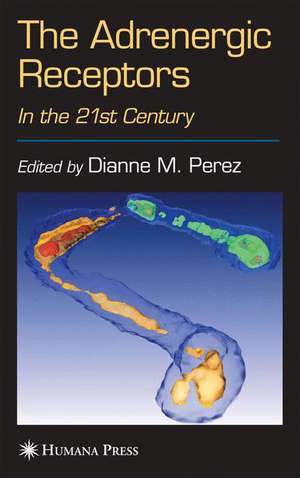
The Adrenergic Receptors: The Receptors
Editat de Dianne M. Perezen Limba Engleză Hardback – sep 2005
Din seria The Receptors
- 15%
 Preț: 675.93 lei
 - 15%
 Preț: 670.50 lei
 - 24%
 Preț: 1216.67 lei
 - 18%
 Preț: 922.72 lei
 - 24%
 Preț: 1294.84 lei
 - 18%
 Preț: 1273.68 lei
 - 15%
 Preț: 640.34 lei
 - 5%
 Preț: 1670.55 lei
 - 18%
 Preț: 913.45 lei
 - 5%
 Preț: 2018.46 lei
 - 18%
 Preț: 1175.66 lei
 - 18%
 Preț: 978.73 lei
 - 18%
 Preț: 1178.99 lei
 - 5%
 Preț: 1148.57 lei
 - 18%
 Preț: 1180.51 lei
 - 18%
 Preț: 1269.03 lei
 - 15%
 Preț: 701.25 lei
 - 5%
 Preț: 1484.61 lei
 - 18%
 Preț: 911.34 lei
 -
 Preț: 382.10 lei
 - 18%
 Preț: 1400.91 lei
 - 18%
 Preț: 1513.36 lei
 - 18%
 Preț: 1279.20 lei
 - 15%
 Preț: 673.93 lei
 - 18%
 Preț: 981.47 lei
 - 18%
 Preț: 994.58 lei
 - 15%
 Preț: 670.25 lei
 - 18%
 Preț: 917.87 lei
 - 24%
 Preț: 879.34 lei
 - 18%
 Preț: 984.66 lei
 - 18%
 Preț: 1275.93 lei
 - 18%
 Preț: 996.70 lei
Preț: 1471.70 lei
Preț vechi: 1549.16 lei
-5%
Puncte Express: 2208
Carte tipărită la comandă
Livrare economică 23 noiembrie-07 decembrie
Livrare prin curier în România Termenul estimat este afișat lângă disponibilitate.
Transport gratuit pentru acest produs Plată online sau ramburs, în funcție de opțiunile comenzii.
Retur gratuit în 14 zile Comandă securizată și suport în română.
Specificații
ISBN-13: 9781588294234
ISBN-10: 1588294234
Pagini: 424
Ilustrații: XII, 404 p.
Dimensiuni: 160 x 241 x 31 mm
Greutate: 0.83 kg
Ediția:2006
Editura: Humana
Colecția The Receptors
Seria The Receptors
Locul publicării:Totowa, NJ, United States
ISBN-10: 1588294234
Pagini: 424
Ilustrații: XII, 404 p.
Dimensiuni: 160 x 241 x 31 mm
Greutate: 0.83 kg
Ediția:2006
Editura: Humana
Colecția The Receptors
Seria The Receptors
Locul publicării:Totowa, NJ, United States
V-ar putea interesa
-
 -27%Preț: 694.89 lei956.08 lei
 -
 -27%Preț: 708.11 lei972.29 lei
 -
 Pharmacy Practice in Developing Countries: Achievements and ChallengesAhmed Fathelrahman-26%Preț: 480.73 lei652.95 lei
 -
 -22%Preț: 536.02 lei686.73 lei
 -
 DNA VaccinesDouglas B Lowrie-5%Preț: 1433.18 lei1508.61 lei
 -
 Novel Anticancer Drug ProtocolsAlex A. Adjei-5%Preț: 1138.80 lei1198.74 lei
 -
 Development of Antibody-Based TherapeuticsMohammad A Tabrizi-5%Preț: 1295.21 lei1363.38 lei
 -
 Handbook of Anticancer Pharmacokinetics and PharmacodynamicsMichelle A. Rudek-5%Preț: 1776.90 lei1870.42 lei
 -
 Drugs of AbuseJohn Q Wang-5%Preț: 1151.82 lei1212.44 lei
 -
 Opioid ResearchZhizhong Z. Pan-5%Preț: 744.98 lei784.18 lei
 -
 Medicinal Plants of the World, Volume 3Ivan A. Ross-5%Preț: 1492.55 lei1571.11 lei
 -
 Oligonucleotide SynthesisPiet Herdewijn-5%Preț: 1310.28 lei1379.24 lei
 -
 ChemoinformaticsJürgen Bajorath-5%Preț: 1154.16 lei1214.90 lei
 -
 Bioinformatics and Drug DiscoveryRichard S Larson-5%Preț: 1117.68 lei1176.51 lei
 -
 Marijuana and Cannabinoid ResearchEmmanuel S Onaivi-5%Preț: 1110.95 lei1169.43 lei
 -
 PharmacogenomicsFederico Innocenti-5%Preț: 742.18 lei781.24 lei
 -
 Cytochrome P450Paul R. Ortiz De Montellano-5%Preț: 2920.72 lei3074.44 lei
 -
 Pharmaceutical Policy in Countries with Developing Healthcare SystemsZaheer-Ud-Din Babar-5%Preț: 1137.66 lei1197.53 lei
 -
 Arzneimittel-SyntheseHans P. Kaufmann-5%Preț: 565.72 lei595.49 lei
 -
 Handbuch der Drogisten-PraxisGustav A. Buchheister-5%Preț: 597.18 lei628.62 lei
 -
 Angewandte ArzneimitteltherapieHubert Schneemann-5%Preț: 1198.52 lei1261.60 lei
 -
 -5%Preț: 546.59 lei575.36 lei
 -
 Hagers Handbuch der Pharmazeutischen PraxisFranz V. Bruchhausen-5%Preț: 598.59 lei630.09 lei
 -
 Endoskopie der NasennebenhöhlenWolfgang Draf-5%Preț: 488.41 lei514.12 lei
 -
 Praktikum der PharmakognosieRobert Fischer-5%Preț: 315.47 lei332.08 lei
 -
 -5%Preț: 365.58 lei384.81 lei
Public țintă
ResearchCuprins
Historical Perspectives.- Adrenergic Receptors.- Structure-Function.- Ligand Binding, Activation, and Agonist Trafficking.- New Signal Transduction Paradigms.- Regulation of the Cellular Localization and Trafficking of the Adrenergic Receptors.- Adrenergic Receptors in Clinical Medicine.- Imaging Adrenergic Receptors and Their Function.- Use of Fluorescent Ligands and Receptors to Visualize Adrenergic Receptors.- Localization of Adrenergic Receptor Subtypes and Transgenic Expression of Fluorescent-Tagged Receptors.- Genetically Altered Mouse Models.- The ?1-Adrenergic Receptors.- The ?2-Adrenergic Receptors.- The ?-Adrenergic Receptors.- Lessons From Overexpressed Mouse Models.- Adrenergic Receptor Signaling Components in Gene Therapy.- Pharmacogenomics.- Genetic, Molecular, and Clinical Characterization of Adrenergic Receptor Polymorphisms.- Microarray Analysis of Novel Adrenergic Receptor Functions.- Summary and Future Endeavors.- Summary and Future Endeavors.
Recenzii
From the reviews:
"...useful to anyone interested in adrenoceptor physiology/pharmacology or in the design of drugs interacting with the receptor or its signal transduction pathway." -Journal of Medicinal Chemistry
"Dianne Perez has assembled a number of important contributors to the research area and grouped the 15 chapters into six parts. … many MDs, biologists, and pharmacologists will find the book … appealing, as the receptor class is involved in numerous cardiovascular and pulmonary diseases." (Boris Schmidt, ChemMedChem, Issue 1, 2006)
"...useful to anyone interested in adrenoceptor physiology/pharmacology or in the design of drugs interacting with the receptor or its signal transduction pathway." -Journal of Medicinal Chemistry
"Dianne Perez has assembled a number of important contributors to the research area and grouped the 15 chapters into six parts. … many MDs, biologists, and pharmacologists will find the book … appealing, as the receptor class is involved in numerous cardiovascular and pulmonary diseases." (Boris Schmidt, ChemMedChem, Issue 1, 2006)
Textul de pe ultima copertă
The adrenergic receptors control many critical functions of the heart, kidney, brain, and all organs under autonomic control. Today significant opportunities exist for molecular and genetic analysis of their function and signaling pathways. In The Adrenergic Receptors: In the 21st Century, senior scientists who have developed novel molecular approaches describe the state-of-the-art understanding of the structure and function of the adrenergic receptor subtypes, as well as the role played by these receptors in physiological and pathophysiological settings. Topics range from structure-function studies and the imaging of adrenergic receptors to the use of genetically altered mouse models and pharmacogenomics. Many of the methods described can be applied to characterize any receptor of interest. Highlights include a survey of the knockout and overexpressed mouse models, a review of the new ways that adrenergic receptors can signal, and the effects of polymorphisms on both clinical outcomes and potential gene therapy applications. Additional chapters address modern techniques for assessing adrenergic function, such as fluorescent labeling and microarrays, and offer an insightful historical survey of the extraordinary progress made in our understanding of these receptors in the twentieth century.
Comprehensive and authoritative, The Adrenergic Receptors: In the 21st Century provides researchers-through its side-by-side comparison of all the adrenergic receptors (a1, a2, and b) and their subtypes-with an excellent survey of the field, including the rationale for how best to design better drugs for control of the heart, blood pressure, and related pathophysiological systems.
Comprehensive and authoritative, The Adrenergic Receptors: In the 21st Century provides researchers-through its side-by-side comparison of all the adrenergic receptors (a1, a2, and b) and their subtypes-with an excellent survey of the field, including the rationale for how best to design better drugs for control of the heart, blood pressure, and related pathophysiological systems.