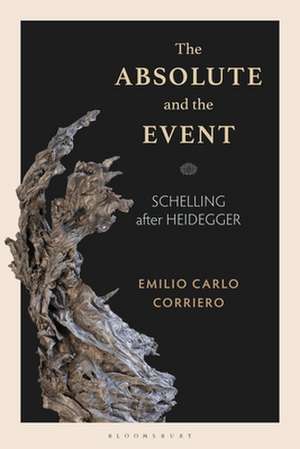
The Absolute and the Event: Schelling after Heidegger
Autor Emilio Carlo Corrieroen Limba Engleză Paperback – 21 oct 2021
This book highlights the theoretical affinity between the results of Schelling's speculations and Heidegger's later theories. Heidegger dedicated a seminar to Schelling's Philosophical Investigations into the Essence of Human Freedom in 1927-28, immediately after the publication of his Sein und Zeit. He then returned to this work during the courses he taught in 1936 and again in 1941, with lectures dedicated to the Metaphysics of German Idealism. Heidegger's introduction of the Event is reminiscent of Schelling's effort to think of "being" in its organic connection to time, and is such a new form of Schelling's positive philosophy.
Thanks to a concept of being intimately linked to that of time, these latter of Heidegger's theories culminate in a form of positive, historical philosophy as well as with a definition of a post-metaphysical Absolute that, in close connection with primal Nothingness, is beyond any form of onto-theology. It also reveals close connections to Nietzsche's introduction of the eternal recurrence, which rethinks being as a never-ending becoming.
Preț: 233.51 lei
Preț vechi: 306.17 lei
-24%
Puncte Express: 350
Carte tipărită la comandă
Livrare economică 04-18 decembrie
Livrare prin curier în România Termenul estimat este afișat lângă disponibilitate.
Transport gratuit de la 400.00 lei Plată online sau ramburs, în funcție de opțiunile comenzii.
Retur gratuit în 14 zile Comandă securizată și suport în română.
Specificații
ISBN-13: 9781350279155
ISBN-10: 1350279153
Pagini: 192
Dimensiuni: 152 x 232 x 14 mm
Greutate: 0.27 kg
Editura: Bloomsbury Publishing
Colecția Bloomsbury Academic
Locul publicării:London, United Kingdom
ISBN-10: 1350279153
Pagini: 192
Dimensiuni: 152 x 232 x 14 mm
Greutate: 0.27 kg
Editura: Bloomsbury Publishing
Colecția Bloomsbury Academic
Locul publicării:London, United Kingdom
Cuprins
Introduction
1. A New Beginning for Western Philosophy: after Schelling and Nietzsche
2. Heidegger's Reading of Schelling
3. The Unyielding Excess of Being
4. The Positive Beyond the Presence
5. Being that can (make happen) being
Index
1. A New Beginning for Western Philosophy: after Schelling and Nietzsche
2. Heidegger's Reading of Schelling
3. The Unyielding Excess of Being
4. The Positive Beyond the Presence
5. Being that can (make happen) being
Index
Recenzii
From Schelling to Nietzsche and back again. That is the path indicated by Heidegger and retraced in an original way by Corriero, who in this book masterfully reconstructs the suggestive affinities between Heidegger's Event and Schelling's Absolute.
This important study turns to the late Schelling's "positive philosophy" to cast new light on Heidegger's own path of thinking, especially his turn to das Ereignis (the event). It is a significant development in our appreciation of Heidegger and it also demonstrates the continuing importance of the rediscovery of Schelling as one of the most indispensable of the early Continental thinkers.
This book is clearly the richest account of Heidegger's appropriation of Schelling's philosophizing yet written. In an important contribution to this century's Schellingian revival, Corriero, a subtle master of the history of modern thought, compellingly argues that Schelling's persistent reconception of nature presciently provides contemporary metaphysics with the ontogenetic means to survive the ruins of ontology over which Heidegger has for so long presided.
This important study turns to the late Schelling's "positive philosophy" to cast new light on Heidegger's own path of thinking, especially his turn to das Ereignis (the event). It is a significant development in our appreciation of Heidegger and it also demonstrates the continuing importance of the rediscovery of Schelling as one of the most indispensable of the early Continental thinkers.
This book is clearly the richest account of Heidegger's appropriation of Schelling's philosophizing yet written. In an important contribution to this century's Schellingian revival, Corriero, a subtle master of the history of modern thought, compellingly argues that Schelling's persistent reconception of nature presciently provides contemporary metaphysics with the ontogenetic means to survive the ruins of ontology over which Heidegger has for so long presided.