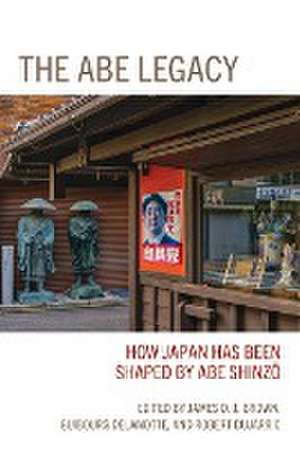
The Abe Legacy: How Japan Has Been Shaped by Abe Shinzo
Editat de James Brown, Guibourg Delamotte, Robert Dujarric Contribuţii de Laney Bahan, Benoit Hardy-Chartrand, Masaki Kakizaki, Jeff Kingston, Tosh Minohara, Hiromi Murakami, R. Taggart Murphy, Naoto Nonaka, Alessio Patalano, David H. Satterwhite, Nancy Snow, Yoshihide Soeyaen Limba Engleză Paperback – 22 aug 2023
The book seeks to answer three questions. How could Abe Shinzo remain in power for nearly a decade in a country where prime ministers usually have much shorter terms, in some cases of only one year? He remained in power in spite of the fact that he sought to conduct massive reforms. What was the policy mix devised to keep voters happy, while promoting structural reforms and growth? He was in power for almost ten years. What is his legacy: what remains of his tenure as chief executive?
Preț: 259.19 lei
Preț vechi: 351.90 lei
-26%
Puncte Express: 389
Carte tipărită la comandă
Livrare economică 27 noiembrie-11 decembrie
Livrare prin curier în România Termenul estimat este afișat lângă disponibilitate.
Transport gratuit de la 400.00 lei Plată online sau ramburs, în funcție de opțiunile comenzii.
Retur gratuit în 14 zile Comandă securizată și suport în română.
Specificații
ISBN-13: 9781793643322
ISBN-10: 1793643326
Pagini: 318
Ilustrații: 5 b/w illustrations; 4 tables; 2 graphs; 1 textboxes;
Dimensiuni: 150 x 226 x 24 mm
Greutate: 0.47 kg
Editura: Bloomsbury Publishing
Colecția Lexington Books
Locul publicării:New York, United States
ISBN-10: 1793643326
Pagini: 318
Ilustrații: 5 b/w illustrations; 4 tables; 2 graphs; 1 textboxes;
Dimensiuni: 150 x 226 x 24 mm
Greutate: 0.47 kg
Editura: Bloomsbury Publishing
Colecția Lexington Books
Locul publicării:New York, United States
V-ar putea interesa
-
 Equal Value/Comparable Worth in the UK and the USAElizabeth Meehan-15%Preț: 641.26 lei754.42 lei
 -
 -18%Preț: 1249.58 lei1523.89 lei
 -
 Peacebuilding and Rule of Law in Africa: Just Peace?Chandra Lekha Sriram-18%Preț: 1256.91 lei1532.82 lei
 -
 The United States and Cuba: Intimate EnemiesMarifeli Pérez-StablePreț: 338.62 lei
 -
 Genocide and the EuropeansKaren E. Smith-11%Preț: 612.90 lei688.64 lei
 -
 -33%Preț: 639.64 lei958.44 lei
 -
 Macao and U.S.-China RelationsYufan Hao-35%Preț: 750.02 lei1157.80 lei
 -
 -29%Preț: 633.67 lei896.40 lei
 -
 British Foreign Policy, National Identity, and Neoclassical RealismAmelia Hadfield-Amkhan-36%Preț: 678.83 lei1053.96 lei
 -
 -28%Preț: 430.77 lei600.45 lei
 -
 Trans-Atlantic Divide: The USA/Euroland Rift?John J. Metzler-24%Preț: 311.54 lei407.97 lei
 -
 -28%Preț: 274.39 lei379.02 lei
 -
 -27%Preț: 271.14 lei369.61 lei
 -
 Border Management ModernizationGerard McLindenPreț: 343.32 lei
 -
 Passport to Freedom: A Guide for World CitizensGarry DavisPreț: 86.84 lei
 -
 The Arms Race in an Era of NegotiationsDavid CarltonPreț: 400.87 lei
 -
 Towards a Future European Peace Order?Stephen K. BadzikPreț: 370.57 lei
 -
 Civil War in Bosnia 1992-94Edgar O'BallancePreț: 387.73 lei
 -
 After the Cold WarAlpo M Rusi-15%Preț: 637.65 lei750.17 lei
 -
 Britain, Aden and South ArabiaKarl PieragostiniPreț: 386.59 lei
 -
 Positive DiplomacyPeter Marshall-15%Preț: 658.19 lei774.34 lei
 -
 European SecurityThomas JägerPreț: 385.28 lei
 -
 Europe: The Cold DivideFergus Carr-15%Preț: 637.78 lei750.34 lei
 -
 Hemispheric Giants: The Misunderstood History of U.S.-Brazilian RelationsBritta H. Crandall-35%Preț: 594.98 lei910.83 lei
 -
 Great Post-Cold War American Thinkers on International RelationsGilbert DoctorowPreț: 103.91 lei
 -
 UNESCOJulian HuxleyPreț: 84.25 lei
 -
 The Fall and Rise of National InterestSerena GiustiPreț: 363.25 lei
Cuprins
Introduction: Eight Years in Power: Assessing Prime Minister Abe's Legacy by James Brown, Guibourg Delamotte, and Robert Dujarric
Chapter 1: Transformation of Domestic Politics: Abe's Durable Legacy? By Nonaka Naoto
Chapter 2: Abe Shinzo's Economic Legacy by R. Taggart Murphy
Chapter 3: Pandemic Downsizes Prime Minister Abe Shinzo by Jeff Kingston
Chapter 4: Gender Policies and Conservative Values by Murakami Hiromi
Chapter 5: Prime Minister Abe's Security Policy: a Broader Spectrum by Guibourg Delamotte
Chapter 6: Japanese Military Diplomacy: Abe's Security Legacy? By Alessio Patalano
Chapter 7: Japan-US Relations by Minohara Toshihiro
Chapter 8: Japan's Diplomacy toward China under the Abe Shinzo Administration by Soeya Yoshihide
Chapter 9: Recriminations & Deepened Distrust: Assessing PM Abe's Legacy of Mismanaging Japan-ROK Relations by Laney Bahan and David Satter White
Chapter 10: Abe Shinzo and the Securitization of Japan-North Korea Relations by Benoît Hardy-Chartrand
Chapter 11: Testing a
Chapter 1: Transformation of Domestic Politics: Abe's Durable Legacy? By Nonaka Naoto
Chapter 2: Abe Shinzo's Economic Legacy by R. Taggart Murphy
Chapter 3: Pandemic Downsizes Prime Minister Abe Shinzo by Jeff Kingston
Chapter 4: Gender Policies and Conservative Values by Murakami Hiromi
Chapter 5: Prime Minister Abe's Security Policy: a Broader Spectrum by Guibourg Delamotte
Chapter 6: Japanese Military Diplomacy: Abe's Security Legacy? By Alessio Patalano
Chapter 7: Japan-US Relations by Minohara Toshihiro
Chapter 8: Japan's Diplomacy toward China under the Abe Shinzo Administration by Soeya Yoshihide
Chapter 9: Recriminations & Deepened Distrust: Assessing PM Abe's Legacy of Mismanaging Japan-ROK Relations by Laney Bahan and David Satter White
Chapter 10: Abe Shinzo and the Securitization of Japan-North Korea Relations by Benoît Hardy-Chartrand
Chapter 11: Testing a
Recenzii
This multi-authored book focuses upon the period of Japanese politics in which Abe Shinzo was prime minister (2012-2020). By contrast with previous decades the 2010s were a period of relative political stability. Much of this stability may be explained by the transformation of Japanese politics from a system of pluralistic factional politics within the 'ruling' Liberal Democratic Party, to a system of centralized power based on the Kantei (prime minister's office). This radical change, ably explained in Chapter 1, forms the essential political background for subsequent chapters, on Abe's economic legacy, handling of the pandemic, gender policies, transformation of security policy, Japanese relations with the United States, China, North and South Korea, Russia, the Middle East and Africa. The book concludes with chapters assessing the impact of the Abe prime ministership on Japanese foreign policy in general and Japan's image in the outside world.
The Abe period was obviously a crucial one for Japan, but also deeply controversial. This book provides the reader with a clear understanding of the complexities involved.
The book updates our knowledge of developments in Japanese politics across the last decade. It will become essential reading for all those teaching and learning about contemporary Japan as well as those outside academic settings who need to understand what is happening within Japanese politics.
These chapters are consistently well-written, with each providing a brief survey of the relevant contextual information before focusing on what Abe did or did not achieve. This set of essays explains what he accomplished while in power and tries to assess what his legacy may be.
Abe Shinzo has been hyped as a transformative figure in japan and on the world stage during his long tenure as prime minister. This edited volume thoroughly and comprehensively evaluates this reputation. It is oriented around three simple questions. How was Abe Shinzo able to remain in power for the best part of a decade; what changes did Abe make and how beneficial were they for Japan; finally, what is his political legacy now that he has left office?
Fourteen substantive chapters cover a wide range of domestic issues, as well as security and foreign policy, concluding with pieces on Abe's contributions to Japan's overseas image and global importance. Despite having successfully used prior political reforms to centralize power and stay in power, sometimes using questionable methods, this volume offers a realistic, critical, and balanced evaluation of Abe's contributions, importance and legacy both domestically and internationally. A major contribution to the literature on Japan's politics, policymaking, and role in world affairs.
The Abe period was obviously a crucial one for Japan, but also deeply controversial. This book provides the reader with a clear understanding of the complexities involved.
The book updates our knowledge of developments in Japanese politics across the last decade. It will become essential reading for all those teaching and learning about contemporary Japan as well as those outside academic settings who need to understand what is happening within Japanese politics.
These chapters are consistently well-written, with each providing a brief survey of the relevant contextual information before focusing on what Abe did or did not achieve. This set of essays explains what he accomplished while in power and tries to assess what his legacy may be.
Abe Shinzo has been hyped as a transformative figure in japan and on the world stage during his long tenure as prime minister. This edited volume thoroughly and comprehensively evaluates this reputation. It is oriented around three simple questions. How was Abe Shinzo able to remain in power for the best part of a decade; what changes did Abe make and how beneficial were they for Japan; finally, what is his political legacy now that he has left office?
Fourteen substantive chapters cover a wide range of domestic issues, as well as security and foreign policy, concluding with pieces on Abe's contributions to Japan's overseas image and global importance. Despite having successfully used prior political reforms to centralize power and stay in power, sometimes using questionable methods, this volume offers a realistic, critical, and balanced evaluation of Abe's contributions, importance and legacy both domestically and internationally. A major contribution to the literature on Japan's politics, policymaking, and role in world affairs.