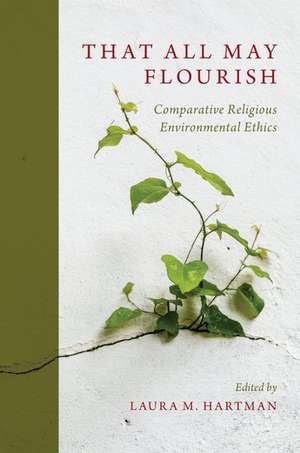
That All May Flourish: Comparative Religious Environmental Ethics
Editat de Laura Hartmanen Limba Engleză Paperback – 12 iul 2018
Preț: 216.16 lei
Puncte Express: 324
Carte disponibilă
Livrare economică 13-24 noiembrie
Livrare prin curier în România Termenul estimat este afișat lângă disponibilitate.
Transport gratuit de la 400.00 lei Plată online sau ramburs, în funcție de opțiunile comenzii.
Retur gratuit în 14 zile Comandă securizată și suport în română.
Specificații
ISBN-13: 9780190456030
ISBN-10: 0190456035
Pagini: 328
Dimensiuni: 155 x 231 x 20 mm
Greutate: 0.46 kg
Editura: Oxford University Press
Colecția OUP USA
Locul publicării:New York, United States
ISBN-10: 0190456035
Pagini: 328
Dimensiuni: 155 x 231 x 20 mm
Greutate: 0.46 kg
Editura: Oxford University Press
Colecția OUP USA
Locul publicării:New York, United States
Recenzii
[That All May Flourish] provides much to advancing interreligious, cross-cultural inquiry into better understanding the ways that human flourishing and ecological well-being are enmeshed.
This is a great text that challenges the dominant language of stewardship and the Anthropocene and offers the metaphor of flourishing instead. It will be a great supplemental text for courses on comparative religion, environmental ethics, and religion and nature. I appreciate that it includes both comparative approaches, but also a topic-centered approach. Furthermore, the case studies that many of the authors use to anchor their work will be valuable in the classroom!
With accessible chapters covering a range of academic disciplines and religious traditions, this book should be studied by scholars and educated lay readers of environmental ethics. Theologians and philosophers will find wisdom from the "flourishing" approach to environmental ethics, not only in their own traditions but in other religious traditions as well. Students will find the brief dialogue chapters an easy entry into key questions.
Overall, though, this book is challenging and impressive in scope, and it is far more successful than most edited volumes at creating insight and interest across its different discussions. The editor and the contributors are to be commended on their collective work on this project.
Written from a process of learned exchange across traditions, this book hosts a focused dialogue on something that matters for every living thing: what it means to flourish. Curated with originality and carefully written, this volume will be especially useful for teaching in courses on religion, on environmental studies, and on cultural dialogue.
Laura Hartman has done something extraordinary: she produced a volume on comparative religious ethics whose organization replicates the type of productive dialogue at the core of this enterprise. When you add that the chapters are written in an accessible and engaging style, and this is the first comparative religious ethics collection that focuses on the non-human world, it is a must read for all ethicists.
In this fascinating, timely, and suggestive collection, the contributors extend the concept of 'flourishing' beyond human-centered virtue ethics to the wider world of ecology and environmental ethics. As a work of comparative religious ethics, it exemplifies a novel and welcome approach to cross-cultural analysis: the chapters each combine specialist attention to particular cases in context, with ongoing constructive dialogue around important aspects of human, animal, and environmental flourishing.
This is a great text that challenges the dominant language of stewardship and the Anthropocene and offers the metaphor of flourishing instead. It will be a great supplemental text for courses on comparative religion, environmental ethics, and religion and nature. I appreciate that it includes both comparative approaches, but also a topic-centered approach. Furthermore, the case studies that many of the authors use to anchor their work will be valuable in the classroom!
With accessible chapters covering a range of academic disciplines and religious traditions, this book should be studied by scholars and educated lay readers of environmental ethics. Theologians and philosophers will find wisdom from the "flourishing" approach to environmental ethics, not only in their own traditions but in other religious traditions as well. Students will find the brief dialogue chapters an easy entry into key questions.
Overall, though, this book is challenging and impressive in scope, and it is far more successful than most edited volumes at creating insight and interest across its different discussions. The editor and the contributors are to be commended on their collective work on this project.
Written from a process of learned exchange across traditions, this book hosts a focused dialogue on something that matters for every living thing: what it means to flourish. Curated with originality and carefully written, this volume will be especially useful for teaching in courses on religion, on environmental studies, and on cultural dialogue.
Laura Hartman has done something extraordinary: she produced a volume on comparative religious ethics whose organization replicates the type of productive dialogue at the core of this enterprise. When you add that the chapters are written in an accessible and engaging style, and this is the first comparative religious ethics collection that focuses on the non-human world, it is a must read for all ethicists.
In this fascinating, timely, and suggestive collection, the contributors extend the concept of 'flourishing' beyond human-centered virtue ethics to the wider world of ecology and environmental ethics. As a work of comparative religious ethics, it exemplifies a novel and welcome approach to cross-cultural analysis: the chapters each combine specialist attention to particular cases in context, with ongoing constructive dialogue around important aspects of human, animal, and environmental flourishing.
Notă biografică
Laura M. Hartman blends her passions for religion and the environment in her work on consumption, climate engineering, ecological restoration, feminism, virtue, and other topics. She is author of The Christian Consumer: Living Faithfully in a Fragile World.
Cuprins
- Table of Contents
- Acknowledgements
- List of Contributors
- Introduction by Laura M. Hartman
- Part 1: Flourishing and Its Costs
- Chapter 1: Buddha, Aristotle, and Science: Rediscovering Purpose and the Value of Flourishing in Nature by Colette Sciberras
- Chapter 2: Eating: Glimpsing God's Infinite Goodness by Nelson Reveley
- Chapter 3: Dialogue: Sciberras and Reveley
- Part 2: Animals and Care
- Chapter 4: Daoism, Natural Life, and Human Flourishing by David E. Cooper
- Chapter 5: All God's Creatures are Communities Like You (Qur'an 6:38): Precedents for Eco-halal Meat in Muslim Traditions by Sarah E. Robinson-Bertoni
- Chapter 6: Dialogue: Cooper and Robinson-Bertoni
- Part 3: Climate and Culture
- Chapter 7: Yoga Bodies and Bodies of Water: Solutions for Climate Change in India? By Christopher Miller
- Chapter 8: Understanding a 'Broken World': Islam, Ritual, and Climate Change in Mali, West Africa by Dianna Bell
- Chapter 9: Dialogue: Miller and Bell
- Part 4: Texts and Traditions
- Chapter 10: Intertextually Modified Organisms: Genetic Engineering, Jewish Ethics, and Rabbinic Text by Rebecca J. Epstein-Levi
- Chapter 11: Flourishing in Crisis: Environmental Issues in the Catholic Social Teachings by Jennifer Phillips
- Chapter 12: Dialogue: Epstein-Levi and Phillips
- Part 5: Communities and Human Agency
- Chapter 13: Flourishing in Nature Religion by Chris Klassen
- Chapter 14: Interfaith Environmentalism and Uneven Opportunities to Flourish by Amanda Baugh
- Chapter 15: Dialogue: Klassen and Baugh
- Part 6: Respect and Relationality
- Chapter 16: Developing a Mengzian Environmental Ethic by Cheryl Cottine
- Chapter 17: Relationality, Reciprocity and Flourishing in an African Landscape by Michael Hannis and Sian Sullivan
- Chapter 18: Dialogue: Cottine, Hannis, and Sullivan
- Conclusion by Laura M. Hartman