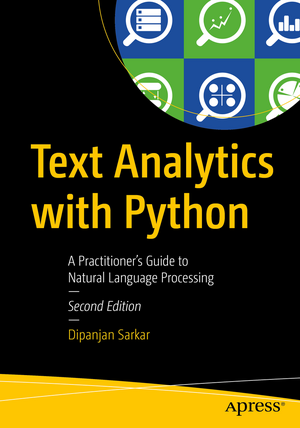
Text Analytics with Python
Autor Dipanjan Sarkaren Limba Engleză Paperback – 22 mai 2019
Metodologia propusă în Text Analytics with Python se bazează pe o arhitectură riguroasă care transformă datele textuale brute în perspective strategice. Observăm o abordare modulară, unde fluxul de lucru începe cu designul mediului de lucru în Python 3.x și avansează sistematic prin etapele critice de curățare a textului, ingineria caracteristicilor și implementarea modelelor de învățare automată. Suntem de părere că forța acestui volum rezidă în echilibrul dintre modelele statistice tradiționale și noile metode bazate pe deep learning embedding, oferind cititorului instrumentele necesare pentru a naviga între algoritmi clasici și arhitecturi neuronale complexe. Structura celor 674 de pagini indică o progresie logică: primele capitole consolidează fundamentele procesării textului, în timp ce secțiunile mediane se concentrează pe clasificare și clustering. Capitolul dedicat analizei semantice este deosebit de valoros, permițând implementarea unui sistem de recunoaștere a entităților numite (NER) fără a depinde exclusiv de biblioteci pre-antrenate. Complementar volumului Natural Language Processing Recipes, care se axează pe soluții punctuale pentru proiecte end-to-end, lucrarea lui Dipanjan Sarkar oferă o profunzime teoretică și o capacitate de personalizare a modelelor pe care rețetarele tehnice adesea o omit. Poziționată ca o extensie naturală a lucrărilor sale anterioare, cum ar fi Practical Machine Learning with Python, această ediție a doua rafinează conceptele de transfer learning și deep learning aplicate specific pe text. Subliniem faptul că autorul nu se limitează la prezentarea codului, ci insistă pe interpretarea modelelor de topicuri și pe tehnici de sumarizare, folosind seturi de date relevante, precum conferințele NIPS, pentru a ancora teoria în realitatea analizei de date contemporane.
Preț: 248.36 lei
Preț vechi: 310.46 lei
-20%
Carte disponibilă
Livrare economică 30 octombrie-13 noiembrie
Specificații
ISBN-10: 1484243536
Pagini: 674
Ilustrații: XXIV, 674 p. 189 illus.
Dimensiuni: 178 x 254 x 37 mm
Greutate: 1.29 kg
Ediția:2nd edition
Editura: Apress
Locul publicării:Berkeley, CA, United States
V-ar putea interesa
-
 Natural Language Processing with PythonSteven Bird-20%Preț: 311.58 lei389.47 lei
 -
 Machine Learning and Cognition in EnterprisesRohit Kumar-20%Preț: 252.87 lei316.08 lei
 -
 Build Better ChatbotsRashid Khan-20%Preț: 129.89 lei162.37 lei
 -
 Practical Machine Learning with PythonDipanjan Sarkar-20%Preț: 489.87 lei612.33 lei
 -
 -20%Preț: 261.24 lei326.55 lei
 -
 -20%Preț: 392.66 lei490.83 lei
 -
 Practical Artificial IntelligenceArnaldo Pérez Castaño-20%Preț: 436.34 lei545.43 lei
 -
 Building Intelligent SystemsGeoff Hulten-20%Preț: 334.89 lei418.61 lei
 -
 -20%Preț: 228.89 lei286.11 lei
 -
 R Machine Learning By ExampleRaghav BaliPreț: 344.67 lei
 -
 RRaghav Bali-20%Preț: 563.79 lei704.74 lei
 -
 Hands-On Transfer Learning with PythonDipanjan Sarkar-20%Preț: 272.04 lei340.05 lei
 -
 The Fundamentals of Computational Intelligence: System ApproachMikhail Z. Zgurovsky-20%Preț: 1002.37 lei1252.97 lei
 -
 Controlled Natural LanguageBrian Davis-20%Preț: 269.62 lei337.03 lei
 -
 Advances in Human Factors and Ergonomics in HealthcareVincent G. Duffy-20%Preț: 967.10 lei1208.88 lei
 -
 -20%Preț: 979.83 lei1224.79 lei
 -
 Advances in Neuroergonomics and Cognitive EngineeringKelly S. Hale-20%Preț: 968.08 lei1210.10 lei
 -
 -20%Preț: 625.03 lei781.28 lei
 -
 Advances in Human Factors in Robots and Unmanned SystemsPamela Savage-Knepshield-20%Preț: 967.65 lei1209.57 lei
 -
 From Animals to Animats 14Elio Tuci-20%Preț: 326.26 lei407.83 lei
 -
 Intelligent Robotics and ApplicationsNaoyuki Kubota-20%Preț: 333.41 lei416.76 lei
 -
 Speech and ComputerAndrey Ronzhin-20%Preț: 369.75 lei462.19 lei
 -
 Swarm IntelligenceMarco Dorigo-20%Preț: 336.09 lei420.10 lei
 -
 -20%Preț: 326.47 lei408.09 lei
 -
 Artificial Neural Networks and Machine Learning - ICANN 2016Alessandro E. P. Villa-20%Preț: 360.05 lei450.06 lei
 -
 PRIMA 2016: Principles and Practice of Multi-Agent SystemsMatteo Baldoni-20%Preț: 342.50 lei428.13 lei
 -
 Parallel Problem Solving from Nature - PPSN XIVJulia Handl-20%Preț: 662.19 lei827.74 lei
 -
 Scalable Uncertainty ManagementSteven Schockaert-20%Preț: 326.05 lei407.56 lei
De ce să citești această carte
Recomandăm această carte profesioniștilor IT și cercetătorilor de date care doresc să stăpânească procesarea limbajului natural dincolo de utilizarea simplă a unor API-uri. Veți câștiga abilitatea de a construi sisteme robuste de analiză a sentimentelor și sumarizare automată, beneficiind de un fundament solid în Python 3. Este resursa ideală pentru a înțelege mecanismele interne ale algoritmilor de text analytics și pentru a implementa soluții scalabile de tip enterprise.
Despre autor
Dipanjan Sarkar este un expert recunoscut în domeniul științei datelor și ingineriei software, cu o specializare pronunțată în învățare automată și procesarea limbajului natural. Autor prolific, acesta a publicat lucrări de referință precum Practical Machine Learning with Python și Hands-On Transfer Learning with Python, demonstrând o capacitate remarcabilă de a simplifica concepte complexe de deep learning pentru practicieni. Experiența sa acoperă atât ecosistemul Python, cât și cel bazat pe R, fiind un promotor al analizelor de date bazate pe dovezi și al implementărilor tehnice riguroase în mediul academic și industrial.
Descriere scurtă
You’ll see how to use the latest state-of-the-art frameworks in NLP, coupled with machine learning and deep learning models for supervised sentiment analysis powered by Python to solve actual case studies. Start by reviewing Python for NLP fundamentals on strings and text data and move on to engineering representation methods for text data, including both traditional statistical models and newer deep learning-based embedding models. Improved techniques and new methods around parsing and processing text are discussed as well.
Text summarization and topic models have been overhauled so the book showcases how to build, tune, and interpret topic models in the context of an interest dataset on NIPS conference papers. Additionally, the book covers text similarity techniques with a real-world example of movie recommenders, along with sentiment analysis using supervised and unsupervised techniques. There is also a chapter dedicated to semantic analysis where you’ll see how to build your own named entity recognition (NER) system from scratch. While the overall structure of the book remains the same, the entire code base, modules, and chapters has been updated to the latest Python 3.x release.
Cuprins
Notă biografică
Dipanjan has been an analytics practitioner for several years now, specializing in machine learning, natural language processing, statistical methods and deep learning. Having a passion for data science and education, he also acts as an AI Consultant and Mentor at various organizations like Springboard, where he helps people build their skills on areas like Data Science and Machine Learning. He also acts as a key contributor and Editor for Towards Data Science, a leading online journal focusing on Artificial Intelligence and Data Science. Dipanjan has also authored several books on R, Python, Machine Learning, Social Media Analytics, Natural Language Processing and Deep Learning.