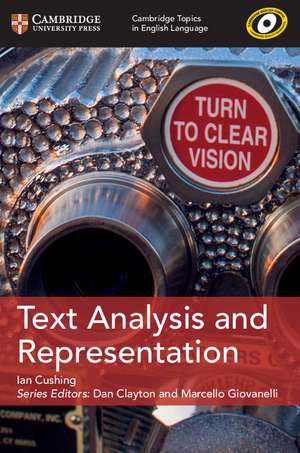
Text Analysis and Representation: Cambridge Topics in English Language
Autor Ian Cushingen Limba Engleză Paperback – 25 ian 2018

Preț: 164.88 lei
Puncte Express: 247
Carte disponibilă
Livrare economică 02-16 noiembrie
Livrare express 16-22 octombrie pentru 19.12 lei
Livrare prin curier în România Termenul estimat este afișat lângă disponibilitate.
Transport gratuit de la 400.00 lei Plată online sau ramburs, în funcție de opțiunile comenzii.
Retur gratuit în 14 zile Comandă securizată și suport în română.
Specificații
ISBN-13: 9781108401111
ISBN-10: 1108401112
Pagini: 134
Dimensiuni: 153 x 228 x 12 mm
Greutate: 0.21 kg
Ediția:Nouă
Editura: Cambridge University Press
Colecția Cambridge Topics in English Language
Seria Cambridge Topics in English Language
Locul publicării:Cambridge, United Kingdom
ISBN-10: 1108401112
Pagini: 134
Dimensiuni: 153 x 228 x 12 mm
Greutate: 0.21 kg
Ediția:Nouă
Editura: Cambridge University Press
Colecția Cambridge Topics in English Language
Seria Cambridge Topics in English Language
Locul publicării:Cambridge, United Kingdom
Cuprins
1. What is text analysis and representation?: 1.1. Big issues; 1.2. Discourse; 1.3. Context; 1.4. Meaning; 1.5. Register; 1.6. What is a text?; 1.7. Using metalanguage; 1.8. Participants in discourse; 1.9. Language as a system of meaning; 1.10. Mode and genre; 1.11. Purpose; 1.12. Approaches to analysing texts; 2. The structure of language: building words: 2.1. How language is organised; 2.2. Phonetics and phonology; 2.3. Grammar: building words; 2.4. Categories of words; 3. The structure of language: building sentences: 3.1. Distribution; 3.2. Phrases; 3.3. Clauses; 3.4. Functions; 3.5. Active and passive voice; 3.6. Sentences; 4. Creating meaning: 4.1. Negotiating meaning: semantics and pragmatics; 4.2. Knowledge; 4.3. Networks of words; 4.4. Metaphor; 4.5. Modality; 4.6. Building and representing the world; 5. Spoken language: 5.1. Working with spoken language; 5.2. Speech acts; 5.3. Narrative; 5.4. Multi-speaker interaction; 5.5. The social nature of speech; Ideas and answers; References.