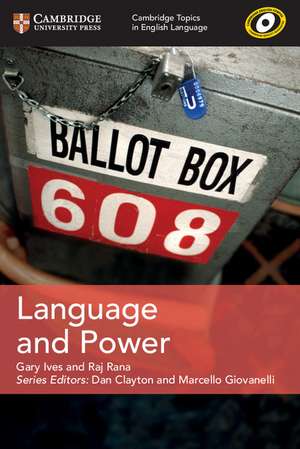
Language and Power: Cambridge Topics in English Language
Autor Gary Ives, Raj Ranaen Limba Engleză Paperback – 25 ian 2018
Preț: 162.74 lei
Puncte Express: 244
Carte disponibilă
Livrare economică 07-21 noiembrie
Livrare express 24-30 octombrie pentru 19.41 lei
Livrare prin curier în România Termenul estimat este afișat lângă disponibilitate.
Transport gratuit de la 400.00 lei Plată online sau ramburs, în funcție de opțiunile comenzii.
Retur gratuit în 14 zile Comandă securizată și suport în română.
Specificații
ISBN-13: 9781108402132
ISBN-10: 1108402135
Pagini: 144
Dimensiuni: 154 x 227 x 12 mm
Greutate: 0.22 kg
Editura: Cambridge University Press
Colecția Cambridge Topics in English Language
Seria Cambridge Topics in English Language
Locul publicării:Cambridge, United Kingdom
ISBN-10: 1108402135
Pagini: 144
Dimensiuni: 154 x 227 x 12 mm
Greutate: 0.22 kg
Editura: Cambridge University Press
Colecția Cambridge Topics in English Language
Seria Cambridge Topics in English Language
Locul publicării:Cambridge, United Kingdom
Cuprins
1. Language and power: 1.1. Inequality and power imbalance in society; 1.2. The power of language; 2. Types of power: 2.1. Concepts about power; 2.2. Politeness as a power tool; 2.3. Power and genre; 3. Language, power and the media: 3.1. Access to the media; 3.2. The language and power of journalism; 3.3. The language and power of advertising; 3.4. The language and power of charity appeals; 4. Language, power and occupation: 4.1. Exclusive features of occupational language; 4.2. Workplace interactions; 4.3. The negotiation of roles: the customer is always right; 5. Language, power and education: 5.1. Traditional classroom discourse; 5.2. A more collaborative classroom; 6. Language, power and politics: 6.1. Ideology and critical discourse analysis; 6.2. Political rhetoric in speeches, interviews and debates; 7. Language, power and the law: 7.1. A register rooted in tradition; 7.2. Functions and features of legal language in written discourse; 7.3. Spoken language in the courtroom; Ideas and answers; References.