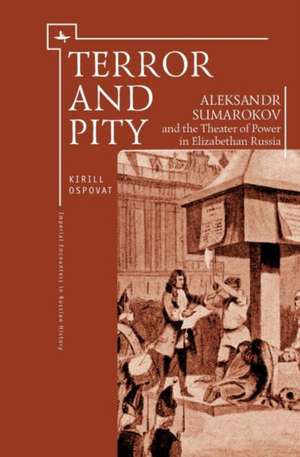
Terror and Pity: Aleksandr Sumarokov and the Theater of Power in Elizabethan Russia: Imperial Encounters in Russian History
Autor Kirill Ospovaten Limba Engleză Hardback – 31 mai 2016

Preț: 513.05 lei
Preț vechi: 681.63 lei
-25%
Puncte Express: 770
Carte disponibilă
Livrare economică 06-20 noiembrie
Livrare express 22-28 octombrie pentru 108.45 lei
Livrare prin curier în România Termenul estimat este afișat lângă disponibilitate.
Transport gratuit pentru acest produs Plată online sau ramburs, în funcție de opțiunile comenzii.
Retur gratuit în 14 zile Comandă securizată și suport în română.
Specificații
ISBN-13: 9781618114723
ISBN-10: 1618114727
Pagini: 336
Dimensiuni: 156 x 234 x 19 mm
Greutate: 0.65 kg
Editura: Academic Studies Press
Colecția Academic Studies Press
Seria Imperial Encounters in Russian History
Locul publicării:Boston, MA, United States
ISBN-10: 1618114727
Pagini: 336
Dimensiuni: 156 x 234 x 19 mm
Greutate: 0.65 kg
Editura: Academic Studies Press
Colecția Academic Studies Press
Seria Imperial Encounters in Russian History
Locul publicării:Boston, MA, United States
V-ar putea interesa
-
 FocusArthur Miller-20%Preț: 72.66 lei90.93 lei
 -
 A Transformational Grammar of IgboPatricia L. CarrellPreț: 274.33 lei
 -
 Preț: 316.98 lei
 -
 Adalbert StifterMartin SwalesPreț: 298.49 lei
 -
 New Essays on DostoyevskyMalcolm V. JonesPreț: 342.35 lei
 -
 Realism in European LiteratureNicholas BoylePreț: 295.99 lei
 -
 Louisa May Alcott: The Contemporary ReviewsBeverly Lyon ClarkPreț: 399.73 lei
 -
 Henry James: The Contemporary ReviewsKevin J. HayesPreț: 384.18 lei
 -
 Reinventing AllegoryTheresa M. KelleyPreț: 345.17 lei
 -
 Hungarian Classical BalladsNinon A. M. LeaderPreț: 382.37 lei
 -
 Preț: 296.31 lei
 -
 Baudelaire and the Poetics of CraftGraham ChestersPreț: 324.66 lei
 -
 French Verse-ArtClive ScottPreț: 366.31 lei
 -
 Russian PoetsPeter Washington-26%Preț: 63.30 lei85.20 lei
 -
 -5%Preț: 120.56 lei126.92 lei
Cuprins
Acknowledgments
Introduction
PART I
POLITICAL THEATER AND THE ORIGINS OF RUSSIAN TRAGIC DRAMA
Theater at Court
Sumarokov and the réformation du theater
Political Theater and the Poetics of Autocracy
“Scenarios of Power”: The Politics of Tragic Plots
Dramatic Experience: Tragedy and the Emotional Economy of the Court
PART II
KHOREV, OR THE TRAGEDY OF ORIGIN
Poetry, History, Allegory
Khorev and the Scenario of Marriage
Pastoral Politics and Tragedy
The Tragedy of Suspicion
PART III
POETIC JUSTICE: COUP D’ÉTAT, POLITICAL THEOLOGY, AND THE POLITICS OF SPECTACLE IN THE RUSSIAN HAMLET
Tragedy and Political Theology
The Drama of Coup d’état
Anatomy of Melancholy, or Gamlet the Hero
Investigations of Malice
The Catharsis of Pardon
EPILOGUE
THE THEATER OF WAR AND PEACE: THE “MIRACLE OF THE HOUSE OF BRANDENBURG” AND THE POETICS OF EUROPEAN ABSOLUTISM
Tragedy and Political Theology on the Battlefield
Frederick, or the Performance of Defeat
Peter, or the Tragedy of Triumph
Conclusion: Tragedy, History, and Theory
Bibliography
PART I
POLITICAL THEATER AND THE ORIGINS OF RUSSIAN TRAGIC DRAMA
Theater at Court
Sumarokov and the réformation du theater
Political Theater and the Poetics of Autocracy
“Scenarios of Power”: The Politics of Tragic Plots
Dramatic Experience: Tragedy and the Emotional Economy of the Court
PART II
KHOREV, OR THE TRAGEDY OF ORIGIN
Poetry, History, Allegory
Khorev and the Scenario of Marriage
Pastoral Politics and Tragedy
The Tragedy of Suspicion
PART III
POETIC JUSTICE: COUP D’ÉTAT, POLITICAL THEOLOGY, AND THE POLITICS OF SPECTACLE IN THE RUSSIAN HAMLET
Tragedy and Political Theology
The Drama of Coup d’état
Anatomy of Melancholy, or Gamlet the Hero
Investigations of Malice
The Catharsis of Pardon
EPILOGUE
THE THEATER OF WAR AND PEACE: THE “MIRACLE OF THE HOUSE OF BRANDENBURG” AND THE POETICS OF EUROPEAN ABSOLUTISM
Tragedy and Political Theology on the Battlefield
Frederick, or the Performance of Defeat
Peter, or the Tragedy of Triumph
Conclusion: Tragedy, History, and Theory
Bibliography
Recenzii
“...this bowdlerized regularization of Shakespeare’s beloved play...elicits considerable scholarly interest. Ospovat’s reading of Gamlet through Machiavelli, Benjamin, and Schmitt transforms it into an astonishingly relevant depiction of the rise of charismatic tyranny during moments of political crisis (states of exception), perceived or real.”
“An impressive work of literary analysis and historical reconstruction that presents the tragedies of Alexander Sumarokov as focal points of the mythology of eighteenth-century Russian absolutism."
“Kirill Ospovat’s Terror and Pity is the most important work on Russian Elizabethan literature since the publication in 1936 of Grigorii Gukovsky’s path-breaking book on the noble fronde. The book analyses Sumarokov’s tragedies through the perspectives of Russian court politics, European political thought of seventeenth and eighteenth centuries, and modern political theory. This approach not only gives new life to the plays that did not look particularly engaging for a long time, but also allows to reinterpret the phenomenon of court theater and Russian eighteenth-century cultural history.”
"The book advances an important claim for eighteenth-century Russian drama. In this study, tragedy, and perhaps even Russian literature of the period more generally, emerges as not merely borrowing from European models, but instantiating and fully participating in the political and literary dynamics broadly characteristic of early modern European court culture. Terror and Pity identifies and skillfully explicates the affective mechanisms that articulated power relationships for the elite theater audiences at the court of Elizaveta Petrovna. Ospovat’s case studies – Alexander Sumarokov’s two early tragedies Khorev and Gamlet – are aptly chosen to capture the Russian tragedic imagination at its very inception and to illustrate the book’s key argument: that in the absence of a full-fledged or fully permissible political theory, court theater came to perform the conceptual structures underwriting autocratic rule. Yet another of Ospovat’s signal achievements is the book’s thought-provoking engagement with the early modern theory of drama and politics in circulation in mid-18th century Russia; the influential twentieth-century writings of Walter Benjamin, Norbert Elias, and Carl Schmitt, as well as a rich array of recent scholarship on Russian history, European neoclassical tragedy, Shakespeare, and early modern court politics.”
“An impressive work of literary analysis and historical reconstruction that presents the tragedies of Alexander Sumarokov as focal points of the mythology of eighteenth-century Russian absolutism."
“Kirill Ospovat’s Terror and Pity is the most important work on Russian Elizabethan literature since the publication in 1936 of Grigorii Gukovsky’s path-breaking book on the noble fronde. The book analyses Sumarokov’s tragedies through the perspectives of Russian court politics, European political thought of seventeenth and eighteenth centuries, and modern political theory. This approach not only gives new life to the plays that did not look particularly engaging for a long time, but also allows to reinterpret the phenomenon of court theater and Russian eighteenth-century cultural history.”
"The book advances an important claim for eighteenth-century Russian drama. In this study, tragedy, and perhaps even Russian literature of the period more generally, emerges as not merely borrowing from European models, but instantiating and fully participating in the political and literary dynamics broadly characteristic of early modern European court culture. Terror and Pity identifies and skillfully explicates the affective mechanisms that articulated power relationships for the elite theater audiences at the court of Elizaveta Petrovna. Ospovat’s case studies – Alexander Sumarokov’s two early tragedies Khorev and Gamlet – are aptly chosen to capture the Russian tragedic imagination at its very inception and to illustrate the book’s key argument: that in the absence of a full-fledged or fully permissible political theory, court theater came to perform the conceptual structures underwriting autocratic rule. Yet another of Ospovat’s signal achievements is the book’s thought-provoking engagement with the early modern theory of drama and politics in circulation in mid-18th century Russia; the influential twentieth-century writings of Walter Benjamin, Norbert Elias, and Carl Schmitt, as well as a rich array of recent scholarship on Russian history, European neoclassical tragedy, Shakespeare, and early modern court politics.”