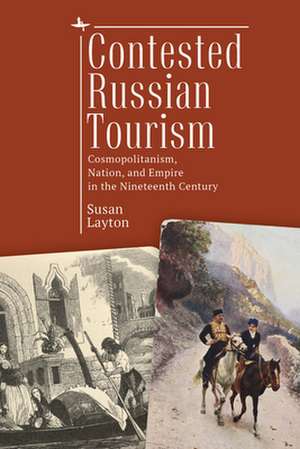
Contested Russian Tourism: Cosmopolitanism, Nation, and Empire in the Nineteenth Century: Imperial Encounters in Russian History
Autor Susan Laytonen Limba Engleză Hardback – 10 aug 2021
This literary, cultural history examines imperial Russian tourism’s entanglement in the vexed issue of cosmopolitanism understood as receptiveness to the foreign and pitted against provinciality and nationalist anxiety about the allure and the influence of Western Europe. The study maps the shift from Enlightenment cosmopolitanism to Byronic cosmopolitanism with special attention to the art pilgrimage abroad. For typically middle-class Russians daunted by the cultural riches of the West, vacationing in the North Caucasus, Georgia, and the Crimea afforded the compensatory opportunity to play colonizer kings and queens in “Asia.” Drawing on Anna Karenina and other literary classics, travel writing, journalism, and guidebooks, the investigation engages with current debates in cosmopolitan studies, including the fuzzy paradigm of “colonial cosmopolitanism.”

Preț: 643.28 lei
Preț vechi: 863.98 lei
-26%
Puncte Express: 965
Carte disponibilă
Livrare economică 06-20 noiembrie
Livrare express 23-29 octombrie pentru 114.32 lei
Livrare prin curier în România Termenul estimat este afișat lângă disponibilitate.
Transport gratuit pentru acest produs Plată online sau ramburs, în funcție de opțiunile comenzii.
Retur gratuit în 14 zile Comandă securizată și suport în română.
Specificații
ISBN-13: 9781644694206
ISBN-10: 1644694204
Pagini: 500
Ilustrații: 14
Dimensiuni: 156 x 234 mm
Greutate: 0.85 kg
Editura: Academic Studies Press
Colecția Academic Studies Press
Seria Imperial Encounters in Russian History
Locul publicării:Boston, MA, United States
ISBN-10: 1644694204
Pagini: 500
Ilustrații: 14
Dimensiuni: 156 x 234 mm
Greutate: 0.85 kg
Editura: Academic Studies Press
Colecția Academic Studies Press
Seria Imperial Encounters in Russian History
Locul publicării:Boston, MA, United States
Cuprins
Table of Contents
AcknowledgementsIllustrations
Note on Transliteration, Translation, and Abbreviations
Introduction
Part One: Becoming Tourists
1. Russia’s Enlightenment Travel Model: Karamzin, the English, and Italy
2. The Romantic Vacation Mentality
3. Nationalist Worries about Tourism: Pogodin, Belinsky, Zagoskin
4. Vacationing in the Caucasus: Authenticity and the Sophisticate/Provincial Divide
Part Two: Shocks of Modernization
5. Inundating the West after the Crimean War
6. Tourist Angst: Aesthetics, Moral Imagination, and Politics in Tolstoy’s Lucerne
7. Cosmopolitans, the Crowd, and Radical Killjoys: Turgenev, Other Writers, and the Critics
8. Dostoevsky’s Anti-Cosmopolitan Animus toward Tourism
Part Three: Embourgeoisement and Its Enemies
9. The Rising Tourist Tide: Foreign Travel from Winter Notes to Anna Karenina
10. Anna Karenina and the Tourist Passion for Italy
11. Tatars and the Tourist Boom in the Crimea: Markov’s Sketches of the Crimea and Other Writings
12. Tourist Decadence at the Fin-de-Siècle: Chekhov, Veselitskaya, and Other Writers
Concluding Observations
Bibliography
Index
Recenzii
"[Layton’s] elucidation of the contexts and interrelationships of her chosen texts displays a remarkable command of detail that provides enriching new insights, even for readers well-versed in Russian literary history…Well written, meticulously edited, and provided with a delightfully detailed index, the book sheds new light on an under-studied topic: the development of a commercialized tourist-service sector in the late imperial Russian period."
— Jahrbücher für Geschichte Osteuropas (translated from German)
“Susan Layton’s Contested Russian Tourism is a significant contribution to our knowledge about tourism’s role in Russian culture. Sweeping in scope, the book covers a range of genres (novels, stories, memoirs, travel notes, narrative poems, and personal letters); it analyzes texts fictional and non-fictional, familiar and obscure, high-brow and popular, serious and light-hearted. Proceeding in chronological order from the eighteenth century through the very end of the imperial period, Layton develops what might fairly be described as a comprehensive survey of Russian (pre-Soviet) primary texts about the experience and phenomenon of tourism. In doing so she is able to illuminate how these writings—so various in ideology, genre, and intended audience— serve as reflections on Russia’s own place in the world: it is abundantly clear that in writing about being in other places (whether those places were deemed more or less ‘civilized’ than Russia itself), tourists were always writing about their homeland…Contested Russian Tourism will be a resource for all scholars of the Russian nineteenth century, well beyond those with a particular interest in tourism.”
— Anne Lounsbery, Slavic Review
“One of the major contributions of this book lies in how Layton does not limit her subjects to their experiences in Western Europe, and by adding the empire’s exotic regions that beckoned to travellers, the Caucasus and Crimea, she adds to our knowledge of the multiple layers that constructed the imperial imagination. Readers already familiar with Alexander Pushkin’s and Mikhail Lermontov’s Romantic and Orientalist fascinations with the Caucasus will meet the antithesis of their Byronic heroes: Lidia Veselitskaia’s narcissistic, adulterous Mimi. . . Despite the Tolstoyan anathema to the sybaritic traveller who can only appreciate culture as a commodity fetish, Layton singles out three writers who best conform to her more expansive notion of a tourist as an agent of cultural reciprocity: Ivan Turgenev, Alexander Herzen, and Anton Chekhov.”
— Katya Hokanson, University of Oregon, Russian Review (October 2022: Vol. 81, No. 4)
“Particulièrement intéressantes sont les pages où l’auteur met à nu les polémiques ouvertes et feutrées, parfois d’oeuvre littéraire à oeuvre littéraire, auxquelles se livrent, par exemple, les pourfendeurs du tourisme bourgeois consumériste et repu et les défenseurs romantiques ou postromantiques du tourisme culturel, censé élever la « spiritualité » (duhovnost´) des élites russes. Contrepoint de la vulgarité et de la recherche des plaisirs bas, l’art, notamment la peinture et par conséquent les musées européens, occupe une place de choix dans toute cette littérature…”
— Wladimir Berelowitch, Cahiers du Monde Russe
“Of special interest are sections where the author brings to light overt or muted polemics between literary texts devoted, for instance, to lambasting the consumerist, satiated bourgeois tourist, as opposed to the romantic or post-romantic defense of cultural tourism as a purported means of enriching the Russian elite’s inner life. In counterpoint to vulgarity and the quest for low-brow pleasures, art has a privileged place in this public discourse which foregrounds painting and, consequently, western Europe’s museums.”
— Wladimir Berelowitch, Cahiers du Monde Russe (excerpt translated from the French)
“Susan Layton plumbs travelogues, letters, novels, stories, humor, and commentaries to probe why and how nineteenth-century Russians traveled. Her rogue’s gallery of characters features the bookish and the boorish; cultural luminaries who opined on travel for the new middle classes, and tourists who simply dressed up and went. The book’s publication during our twenty-first century pandemic lockdown is timely—a reminder of the historical importance of expanded opportunities to travel and the imprint of travel on the Russian identity.”
—Jeffrey Brooks, Johns Hopkins University, author of The Firebird and the Fox: Russian Culture under Tsars and Bolsheviks
— Jahrbücher für Geschichte Osteuropas (translated from German)
“Susan Layton’s Contested Russian Tourism is a significant contribution to our knowledge about tourism’s role in Russian culture. Sweeping in scope, the book covers a range of genres (novels, stories, memoirs, travel notes, narrative poems, and personal letters); it analyzes texts fictional and non-fictional, familiar and obscure, high-brow and popular, serious and light-hearted. Proceeding in chronological order from the eighteenth century through the very end of the imperial period, Layton develops what might fairly be described as a comprehensive survey of Russian (pre-Soviet) primary texts about the experience and phenomenon of tourism. In doing so she is able to illuminate how these writings—so various in ideology, genre, and intended audience— serve as reflections on Russia’s own place in the world: it is abundantly clear that in writing about being in other places (whether those places were deemed more or less ‘civilized’ than Russia itself), tourists were always writing about their homeland…Contested Russian Tourism will be a resource for all scholars of the Russian nineteenth century, well beyond those with a particular interest in tourism.”
— Anne Lounsbery, Slavic Review
“One of the major contributions of this book lies in how Layton does not limit her subjects to their experiences in Western Europe, and by adding the empire’s exotic regions that beckoned to travellers, the Caucasus and Crimea, she adds to our knowledge of the multiple layers that constructed the imperial imagination. Readers already familiar with Alexander Pushkin’s and Mikhail Lermontov’s Romantic and Orientalist fascinations with the Caucasus will meet the antithesis of their Byronic heroes: Lidia Veselitskaia’s narcissistic, adulterous Mimi. . . Despite the Tolstoyan anathema to the sybaritic traveller who can only appreciate culture as a commodity fetish, Layton singles out three writers who best conform to her more expansive notion of a tourist as an agent of cultural reciprocity: Ivan Turgenev, Alexander Herzen, and Anton Chekhov.”
— Louise McReynolds, University of North Carolina, Chapel Hill, Journal of Tourism History
“This very detailed account of tourist travelogues and works of literature featuring tourism creates a revealing continuum between now fairly obscure writers and extremely well-known ones. Susan Layton provides a synthesizing narrative about the course of the nineteenth century seen through the lens of travel. The practice of, and debate over, tourism sheds new light on major literary and cultural debates, particularly between conservatives and radicals. … The real payoff comes when canonical works are seen in a new context, particularly texts by Dostoevsky, Turgenev, and Tolstoy.”— Katya Hokanson, University of Oregon, Russian Review (October 2022: Vol. 81, No. 4)
“Particulièrement intéressantes sont les pages où l’auteur met à nu les polémiques ouvertes et feutrées, parfois d’oeuvre littéraire à oeuvre littéraire, auxquelles se livrent, par exemple, les pourfendeurs du tourisme bourgeois consumériste et repu et les défenseurs romantiques ou postromantiques du tourisme culturel, censé élever la « spiritualité » (duhovnost´) des élites russes. Contrepoint de la vulgarité et de la recherche des plaisirs bas, l’art, notamment la peinture et par conséquent les musées européens, occupe une place de choix dans toute cette littérature…”
— Wladimir Berelowitch, Cahiers du Monde Russe
“Of special interest are sections where the author brings to light overt or muted polemics between literary texts devoted, for instance, to lambasting the consumerist, satiated bourgeois tourist, as opposed to the romantic or post-romantic defense of cultural tourism as a purported means of enriching the Russian elite’s inner life. In counterpoint to vulgarity and the quest for low-brow pleasures, art has a privileged place in this public discourse which foregrounds painting and, consequently, western Europe’s museums.”
— Wladimir Berelowitch, Cahiers du Monde Russe (excerpt translated from the French)
“Susan Layton plumbs travelogues, letters, novels, stories, humor, and commentaries to probe why and how nineteenth-century Russians traveled. Her rogue’s gallery of characters features the bookish and the boorish; cultural luminaries who opined on travel for the new middle classes, and tourists who simply dressed up and went. The book’s publication during our twenty-first century pandemic lockdown is timely—a reminder of the historical importance of expanded opportunities to travel and the imprint of travel on the Russian identity.”
—Jeffrey Brooks, Johns Hopkins University, author of The Firebird and the Fox: Russian Culture under Tsars and Bolsheviks