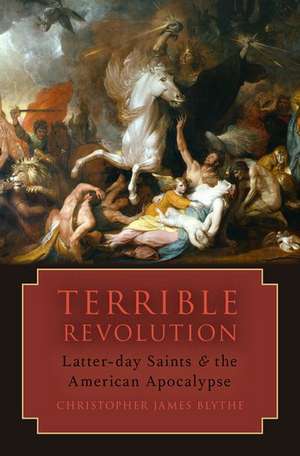
Terrible Revolution: Latter-day Saints and the American Apocalypse
Autor Christopher James Blytheen Limba Engleză Hardback – 13 aug 2020
Preț: 494.32 lei
Preț vechi: 555.41 lei
-11%
Puncte Express: 741
Carte disponibilă
Livrare economică 06-11 noiembrie
Livrare prin curier în România Termenul estimat este afișat lângă disponibilitate.
Transport gratuit pentru acest produs Plată online sau ramburs, în funcție de opțiunile comenzii.
Retur gratuit în 14 zile Comandă securizată și suport în română.
Specificații
ISBN-13: 9780190080280
ISBN-10: 0190080280
Pagini: 348
Dimensiuni: 150 x 236 x 25 mm
Greutate: 0.61 kg
Editura: Oxford University Press
Colecția OUP USA
Locul publicării:New York, United States
ISBN-10: 0190080280
Pagini: 348
Dimensiuni: 150 x 236 x 25 mm
Greutate: 0.61 kg
Editura: Oxford University Press
Colecția OUP USA
Locul publicării:New York, United States
Recenzii
Certainly, the book reveals a rich lode of apocalypticism that persists and changes within religious traditions that lay claim to be the restoration of all things prior to the earth's final dispensation. In so doing, it invites promising further work by scholars of religious futurism.
Blythe's Terrible Revolution offers a smart, original, and compelling analysis of the evolving role of apocalyptic thinking in the LDS Church. In this impressively researched and important book, Blythe has marshalled thousands of sources, some long hidden away in obscure places, and diligently connected them to larger social and political trends. He demonstrates that we cannot understand the rise, growth, and success of Mormonism without taking seriously its apocalyptic origins and proclivities.
It is when he begins to explore understudied material... that this book really starts to break new ground and offer not simply new history, but new perspectives on the trajectory of the new religious movement that Joseph Smith founded.
Blythe's most admirable achievement with this volume is his ability to provide a fascinating, easily accessible, but still truly academic, thoroughly researched, and meticulously presented cultural and social history of the Latter-day Saints in the United States, structured around the theme of the apocalypse ... I wholeheartedly recommend Terrible Revolution.
...this volume is a unique contribution to the literature on American religious history. Highly recommended. Upper-division undergraduates through faculty.
The title may include "Terrible," but this book is anything but. It is a unique contribution to understanding the history, theology, and folklore surrounding the much-anticipated end times through the eyes of the church and its lay members.
Terrible Revolution was one of the most exciting and well-researched books I've read in a while. It is a book that you want to complete in one sitting, but don't. Instead, you show restraint and space out the reading because you want to savor the history and enjoy it a moment longer.
The Latter-day Saints of the nineteenth century belonged to an apocalyptic tradition, argues historian and folklorist Christopher Blythe in his highly informative book Terrible Revolution....Blythe charts the rise and fall of Mormon apocalyptic discourse over the two-hundred- year history of the Restoration. He defines "apocalyptic" as "the belief that society was headed toward cataclysmic events that would uproot the current social order in favor of a divine order that would be established in its place".
Terrible Revolution contributes significantly to religious studies by showcasing how apocalypticism shapes and reflects communal identities. It will interest scholars of American religion, folklore, and millenarianism, as well as those curious about the intersections of faith and culture. For those deeply engaged in these fields, Blythe's work is indispensable.
Blythe's Terrible Revolution offers a smart, original, and compelling analysis of the evolving role of apocalyptic thinking in the LDS Church. In this impressively researched and important book, Blythe has marshalled thousands of sources, some long hidden away in obscure places, and diligently connected them to larger social and political trends. He demonstrates that we cannot understand the rise, growth, and success of Mormonism without taking seriously its apocalyptic origins and proclivities.
It is when he begins to explore understudied material... that this book really starts to break new ground and offer not simply new history, but new perspectives on the trajectory of the new religious movement that Joseph Smith founded.
Blythe's most admirable achievement with this volume is his ability to provide a fascinating, easily accessible, but still truly academic, thoroughly researched, and meticulously presented cultural and social history of the Latter-day Saints in the United States, structured around the theme of the apocalypse ... I wholeheartedly recommend Terrible Revolution.
...this volume is a unique contribution to the literature on American religious history. Highly recommended. Upper-division undergraduates through faculty.
The title may include "Terrible," but this book is anything but. It is a unique contribution to understanding the history, theology, and folklore surrounding the much-anticipated end times through the eyes of the church and its lay members.
Terrible Revolution was one of the most exciting and well-researched books I've read in a while. It is a book that you want to complete in one sitting, but don't. Instead, you show restraint and space out the reading because you want to savor the history and enjoy it a moment longer.
The Latter-day Saints of the nineteenth century belonged to an apocalyptic tradition, argues historian and folklorist Christopher Blythe in his highly informative book Terrible Revolution....Blythe charts the rise and fall of Mormon apocalyptic discourse over the two-hundred- year history of the Restoration. He defines "apocalyptic" as "the belief that society was headed toward cataclysmic events that would uproot the current social order in favor of a divine order that would be established in its place".
Terrible Revolution contributes significantly to religious studies by showcasing how apocalypticism shapes and reflects communal identities. It will interest scholars of American religion, folklore, and millenarianism, as well as those curious about the intersections of faith and culture. For those deeply engaged in these fields, Blythe's work is indispensable.
Notă biografică
Christopher James Blythe is a research associate at the Neal A. Maxwell Institute for Religious Scholarship at Brigham Young University. He is the editor of the Journal of Mormon History and was a documentary editor at the Joseph Smith Papers from 2015 to 2018.
Cuprins
- Acknowledgments
- Introduction
- Chapter One: The Apocalyptic Tradition in Early Mormonism
- Chapter Two: "Long Shall His Blood...Stain Illinois": Martyrology and Malediction
- Chapter Three: The Geography of Mormon Apocalyptic
- Chapter Four: The Judgments Begin: Apocalypticism in Utah Territory
- Chapter Five: The Americanization of Mormon Apocalyptic
- Chapter Six - Twentieth and Twenty-First Century Apocalyptic Trajectories
- Afterword: Apocalypticism in the "Mormon Moment"
- Notes
- Index