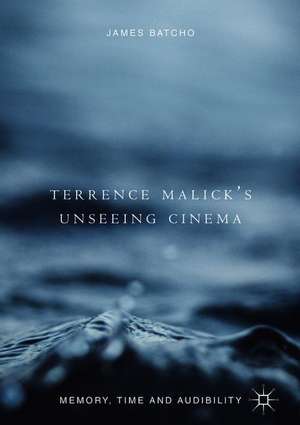
Terrence Malick’s Unseeing Cinema: Memory, Time and Audibility
Autor James Batchoen Limba Engleză Hardback – 4 iun 2018
Preț: 750.75 lei
Preț vechi: 915.55 lei
-18%
Puncte Express: 1126
Carte tipărită la comandă
Livrare economică 12-26 noiembrie
Livrare prin curier în România Termenul estimat este afișat lângă disponibilitate.
Transport gratuit pentru acest produs Plată online sau ramburs, în funcție de opțiunile comenzii.
Retur gratuit în 14 zile Comandă securizată și suport în română.
Specificații
ISBN-13: 9783319764207
ISBN-10: 3319764209
Pagini: 264
Ilustrații: XV, 201 p.
Dimensiuni: 148 x 210 x 20 mm
Greutate: 0.41 kg
Ediția:1st ed. 2018
Editura: Springer International Publishing
Colecția Palgrave Macmillan
Locul publicării:Cham, Switzerland
ISBN-10: 3319764209
Pagini: 264
Ilustrații: XV, 201 p.
Dimensiuni: 148 x 210 x 20 mm
Greutate: 0.41 kg
Ediția:1st ed. 2018
Editura: Springer International Publishing
Colecția Palgrave Macmillan
Locul publicării:Cham, Switzerland
Cuprins
1. Introduction.- 2. Unseeing.- 3. 'Logos' of Cinema.- 4. Days of Heaven and Hell.- 5. Malick's Temporal Shift.- 6. Listening to the 'Logos'.- 7. Continuer.
Notă biografică
James Batcho is Assistant Professor at United International College, China. He is the author of Sound for Independent Audiovisual Storytelling.
Textul de pe ultima copertă
This unique study opens up a new dimension of Terrence Malick’s cinema – its expressions of unseeing and hearing. ‘Unseeing’ is Malick’s means of transcending the moment in order to enter the life that unfolds; to treat cinema as a real experience for those who live its reality. In this way, Terrence Malick’s Unseeing Cinema moves beyond film theory to advance a work of original philosophy, bringing together two thinkers not normally associated with one another: Gilles Deleuze and Søren Kierkegaard. It investigates how Malick’s gatherings of time allow one to explore new philosophical questions about immanence and transcendence, ethics and faith, time and infinity, and the foldings of subjectivity that are central to both philosophers. Beyond cinema, it offers a way to think about our everyday repetitions and recollections and our ephemeral points of connection with those we love.
Caracteristici
Offers a radical reorientation to how we think about films and filmmaking Challenges film theory’s familiar language, representational and visual approaches, to advance the work of Deleuze, particularly the ‘unseeing’ aspects of his philosophy of difference Subverts dominant discourses of sound phenomenology to emphasize experiences of hearing and listening