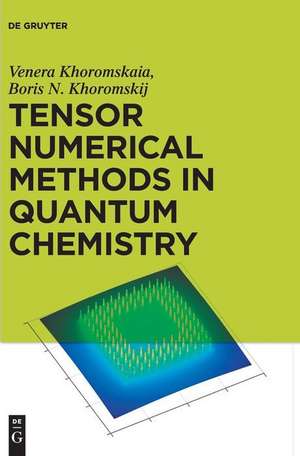
Tensor Numerical Methods in Electronic Structure Calculations: Basic Algorithms and Applications
Autor Venera Khoromskaia, Boris Khoromskijen Limba Engleză Hardback – 14 ian 2017
Preț: 1068.23 lei
Preț vechi: 1387.31 lei
-23%
Puncte Express: 1602
Carte tipărită la comandă
Livrare economică 30 iulie-13 august
Livrare prin curier în România Termenul estimat este afișat lângă disponibilitate.
Transport gratuit pentru acest produs Plată online sau ramburs, în funcție de opțiunile comenzii.
Retur gratuit în 14 zile Comandă securizată și suport în română.
Specificații
ISBN-13: 9783110370157
ISBN-10: 3110370158
Pagini: 250
Dimensiuni: 170 x 240 mm
Greutate: 0.68 kg
Editura: De Gruyter
Colecția De Gruyter
Locul publicării:Berlin/Boston
ISBN-10: 3110370158
Pagini: 250
Dimensiuni: 170 x 240 mm
Greutate: 0.68 kg
Editura: De Gruyter
Colecția De Gruyter
Locul publicării:Berlin/Boston
V-ar putea interesa
-
 Numerical Analysis: A Mathematical IntroductionMichelle Schatzman-19%Preț: 406.60 lei503.78 lei
 -
 Mathematics Masterclasses: Stretching the ImaginationMichael Sewell-18%Preț: 333.21 lei404.40 lei
 -
 A First Course in Combinatorial MathematicsIan Anderson-15%Preț: 524.72 lei615.15 lei
 -
 Core Maths for the BiosciencesMartin B. Reed-20%Preț: 408.19 lei512.96 lei
 -
 -19%Preț: 514.67 lei638.84 lei
 -
 -20%Preț: 508.65 lei636.05 lei
 -
 Hamiltonian Chaos and Fractional DynamicsGeorge M. Zaslavsky-30%Preț: 452.26 lei650.19 lei
 -
 Chaos: The Science of Predictable Random MotionRichard Kautz-21%Preț: 370.32 lei471.08 lei
 -
 It's a Nonlinear WorldRichard H Enns-15%Preț: 479.96 lei564.67 lei
 -
 Models and Algorithms for Biomolecules and Molecular NetworksBhaskar Dasgupta-9%Preț: 706.78 lei776.68 lei
 -
 Fundamentals of Numerical ComputingLawrence Shampine-27%Preț: 1370.34 lei1877.18 lei
 -
 Subgame Consistent Economic OptimizationDavid W. K. YeungPreț: 389.74 lei
 -
 Direct Methods for Sparse Linear SystemsTimothy A. Davis-8%Preț: 622.62 lei676.77 lei
Notă biografică
Venera Khoromskaia and Boris N. Khoromskij, Max-Planck-Institute for Mathematics in the Sciences,Leipzig, Germany.
Descriere
Descriere de la o altă ediție sau format:
The conventional numerical methods when applied to multidimensional problems suffer from the so-called "curse of dimensionality", that cannot be eliminated by parallel methods and high performance computers. The novel tensor numerical methods are based on a "smart" rank-structured tensor representation of the multidimensional functions and operators discretized on uniform Cartesian grids. We explain basic tensor formats and algorithms showing how the Tucker tensor decomposition originating from chemometrics made a revolution when applied to problems of the numerical analysis. On several examples from electronic structure calculations we show how the calculation of the 3D convolution integrals for functions with multiple singularities is replaced by a sequence of 1D operations, enabling Matlab simulations using 3D grids of the size of 1015. This research monograph on a new field on numerical analysis written by the originators of tensor methods can be interesting for a wide audience of students and researchers from both numerical analysis and material science.
The conventional numerical methods when applied to multidimensional problems suffer from the so-called "curse of dimensionality", that cannot be eliminated by parallel methods and high performance computers. The novel tensor numerical methods are based on a "smart" rank-structured tensor representation of the multidimensional functions and operators discretized on uniform Cartesian grids. We explain basic tensor formats and algorithms showing how the Tucker tensor decomposition originating from chemometrics made a revolution when applied to problems of the numerical analysis. On several examples from electronic structure calculations we show how the calculation of the 3D convolution integrals for functions with multiple singularities is replaced by a sequence of 1D operations, enabling Matlab simulations using 3D grids of the size of 1015. This research monograph on a new field on numerical analysis written by the originators of tensor methods can be interesting for a wide audience of students and researchers from both numerical analysis and material science.
- Novel numerical methods beating the supercomputing for multidimensional problems. They provide low-rank separable grid-based representation for arbitrary multivariate functions. Thus numerical integration of 3D convolution integrals is performed by 1D vector operations.
- Novel 3D grid-based approach for the problems in electronic structure calculations. Enables calculation of 3D convolution integrals (with singularities) in1D complexity. Enables usage of grids of the order of 1014 in Matlab calculations on a laptop. General type grid-based basis functions can be used in Hartree-Fock calculations. Black-box type of calculations for arbitrary molecular geometries.
- Efficient methods for periodic structures in the framework of the Hartree-Fock model.