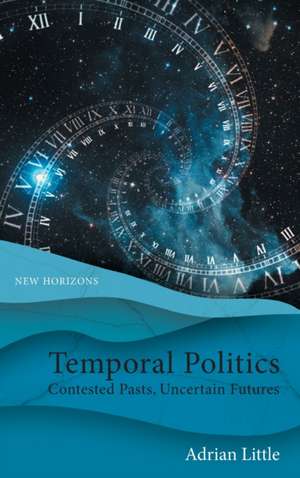
Temporal Politics
Autor Adrian Littleen Limba Engleză Hardback – 4 iul 2022
| Toate formatele și edițiile | Preț | Express |
|---|---|---|
| Paperback (1) | 137.78 lei 22-36 zile | +30.35 lei 5-11 zile |
| EDINBURGH UNIVERSITY PRESS – 31 mai 2024 | 137.78 lei 22-36 zile | +30.35 lei 5-11 zile |
| Hardback (1) | 572.18 lei 43-57 zile | |
| EDINBURGH UNIVERSITY PRESS – 4 iul 2022 | 572.18 lei 43-57 zile |
Preț: 572.18 lei
Preț vechi: 769.50 lei
-26%
Puncte Express: 858
Preț estimativ în valută:
101.19€ • 119.98$ • 88.10£
101.19€ • 119.98$ • 88.10£
Carte tipărită la comandă
Livrare economică 30 martie-13 aprilie
Specificații
ISBN-13: 9781399504645
ISBN-10: 1399504649
Pagini: 232
Dimensiuni: 156 x 234 x 14 mm
Greutate: 0.5 kg
Editura: EDINBURGH UNIVERSITY PRESS
ISBN-10: 1399504649
Pagini: 232
Dimensiuni: 156 x 234 x 14 mm
Greutate: 0.5 kg
Editura: EDINBURGH UNIVERSITY PRESS
V-ar putea interesa
-
 Wittgenstein in ExileJames C. KlaggePreț: 302.60 lei
 -
 Politics: The Key ConceptsLisa HarrisonPreț: 309.52 lei
 -
 The Flame of Eternity – An Interpretation of Nietzsche`s ThoughtKrzysztof MichalskiPreț: 224.52 lei
 -
 Civil Passions – Moral Sentiment and Democratic DeliberationSharon R. KrausePreț: 219.07 lei
 -
 The Politics of Radical DemocracyAdrian Little-26%Preț: 572.54 lei769.74 lei
 -
 How To Hustle and WinSupreme UnderstandingPreț: 129.47 lei
 -
 The Stoic's BibleGiles LaurénPreț: 209.63 lei
 -
 The Architects of ExistenceTeresa N Washington-8%Preț: 476.65 lei518.09 lei
 -
 ORIGINAL PERCEPTIONSAlcides VidalPreț: 130.34 lei
 -
 Alenka Zupancic: Das Reale einer Illusion - Eine Ethik jenseits des LustprinzipsSandra KerschbaumerPreț: 75.16 lei
 -
 Preț: 81.49 lei
 -
 Das richtige LebenNorbert BolzPreț: 253.83 lei
 -
 Gottlob FregeLothar Kreiser-23%Preț: 1163.00 lei1510.39 lei
 -
 Rameau, du Cas à la Singularité - Tome INancy Diguerher-23%Preț: 845.88 lei1098.54 lei
 -
 Swetskoe i religioznoe nachalo w nauke, kul'ture i obrazowaniiEkaterina PerowaPreț: 263.89 lei
Descriere
Descriere de la o altă ediție sau format:
Adrian Little demonstrates how different conceptions of past, present and future contribute to the nature of political conflict in the world today. He forms his argument around three major cases: Indigenous politics in settler colonies; the politics of bordering and migration; and debates over the future of democracy.
Adrian Little demonstrates how different conceptions of past, present and future contribute to the nature of political conflict in the world today. He forms his argument around three major cases: Indigenous politics in settler colonies; the politics of bordering and migration; and debates over the future of democracy.