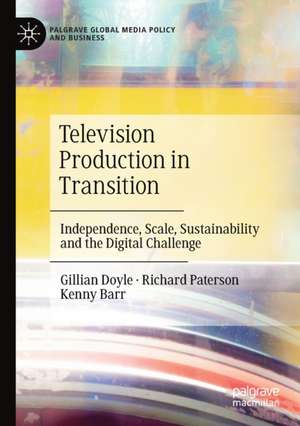
Television Production in Transition
Autor Gillian Doyle, Kenny Barr, Richard Patersonen Limba Engleză Paperback – 4 mai 2022
| Toate formatele și edițiile | Preț | Express |
|---|---|---|
| Paperback (1) | 450.85 lei 43-57 zile | |
| Springer International Publishing – 4 mai 2022 | 450.85 lei 43-57 zile | |
| Hardback (1) | 617.72 lei 43-57 zile | |
| Springer International Publishing – 4 mai 2021 | 617.72 lei 43-57 zile |
Preț: 450.85 lei
Preț vechi: 530.41 lei
-15%
Puncte Express: 676
Preț estimativ în valută:
79.71€ • 94.07$ • 69.81£
79.71€ • 94.07$ • 69.81£
Carte tipărită la comandă
Livrare economică 13-27 aprilie
Specificații
ISBN-13: 9783030632175
ISBN-10: 3030632172
Pagini: 272
Ilustrații: XV, 253 p. 8 illus.
Dimensiuni: 148 x 210 x 15 mm
Greutate: 0.36 kg
Ediția:1st edition 2021
Editura: Springer International Publishing
Locul publicării:Cham, Switzerland
ISBN-10: 3030632172
Pagini: 272
Ilustrații: XV, 253 p. 8 illus.
Dimensiuni: 148 x 210 x 15 mm
Greutate: 0.36 kg
Ediția:1st edition 2021
Editura: Springer International Publishing
Locul publicării:Cham, Switzerland
Cuprins
1. Why does TV production matter.- 2. International trends in TV production.- 3. The history and development of the UK TV sector: From minnows to sharks.- 4. Configuration and business performance in TV production companies.- 5. Scale, independence and economic sustainability in TV production.- 6. How ownership of TV production companies affects configuration and content.- 7. Cultural production, indigeneity and globalisation.- 8. Implications for media-related public policy.
Notă biografică
Gillian Doyle is Professor of Media Economics and directs Glasgow’s MSc in Media Management. A former President of the Association for Cultural Economics International, she has led funded projects for the OECD, Council of Europe and UK research councils and her research on media economics, policy and on the impact of digitisation has been published in several languages.
Richard Paterson is former Head of Research and Scholarship at the BFI where he had been on the staff for more than 30 years. He has published widely on film and television industry issues and led two major longitudinal research projects in the 1990s: the Television Audience Tracking Study and the Television Industry Tracking Study.
Kenny Barr was a post-doctoral researcher on the Television Production in Transition project based in CCPR. Funded by a Lord Kelvin/ Adam Smith Scholarship his doctoral research investigated music copyright in the digital age. His main researchinterests centre on creative and commercial decision making and intellectual property.
Richard Paterson is former Head of Research and Scholarship at the BFI where he had been on the staff for more than 30 years. He has published widely on film and television industry issues and led two major longitudinal research projects in the 1990s: the Television Audience Tracking Study and the Television Industry Tracking Study.
Kenny Barr was a post-doctoral researcher on the Television Production in Transition project based in CCPR. Funded by a Lord Kelvin/ Adam Smith Scholarship his doctoral research investigated music copyright in the digital age. His main researchinterests centre on creative and commercial decision making and intellectual property.
Textul de pe ultima copertă
Focusing on the growing power of transnational media corporations in an increasingly globalized environment for distribution of television content, and on the effects of mergers and acquisitions involving local and independent television production companies, this book examines how current and recent re-structurings in ownership across the television industry reflect changing business models, how they affect creativity and diversity of television output, and to what extent they call for new approaches to regulation and policy. Based on a major study of the UK production sector as a case study, it offers a unique analysis of wider transformations in ownership affecting the television production industry worldwide and of their economic, socio-cultural and policy implications.
Caracteristici
Provides a forensic and empirically grounded examination of how and why seismic shifts have taken place in the structure of ownership of the television production industry Draws on interviews with leading television executives and industry stakeholders and on extensive ground-breaking quantitative analysis of company data and programme content Offers major advances in understanding the economic and socio-cultural significance of restructurings of ownership in the television industry and examines the wider interplay between cultural production, indigeneity and globalisation