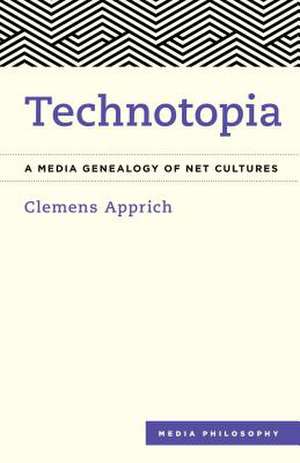
Technotopia: A Media Genealogy of Net Cultures: Media Philosophy
Autor Clemens Apprichen Limba Engleză Paperback – 29 noi 2017
This highly original book informs our understanding of new forms of media and social practices, such that have become part of our everyday culture. Apprich revisits a critical time when the Internet was not yet an everyday reality, but when its potential was already understood and fiercely debated. The historical context of net cultures provides the basis from which the author critically engages with current debates about the weal and woe of the Internet and challenges today's predominant network model.

Preț: 312.75 lei
Preț vechi: 406.43 lei
-23%
Puncte Express: 469
Carte tipărită la comandă
Livrare economică 03-17 decembrie
Livrare prin curier în România Termenul estimat este afișat lângă disponibilitate.
Transport gratuit de la 400.00 lei Plată online sau ramburs, în funcție de opțiunile comenzii.
Retur gratuit în 14 zile Comandă securizată și suport în română.
Specificații
ISBN-13: 9781786603142
ISBN-10: 1786603144
Pagini: 210
Ilustrații: 6 b/w illustrations
Dimensiuni: 134 x 214 x 14 mm
Greutate: 0.27 kg
Editura: Bloomsbury Publishing
Colecția Rowman & Littlefield
Seria Media Philosophy
Locul publicării:New York, United States
ISBN-10: 1786603144
Pagini: 210
Ilustrații: 6 b/w illustrations
Dimensiuni: 134 x 214 x 14 mm
Greutate: 0.27 kg
Editura: Bloomsbury Publishing
Colecția Rowman & Littlefield
Seria Media Philosophy
Locul publicării:New York, United States
Cuprins
Foreword by Geert Lovink / Acknowledgments / 1.Introducing Technotopia / 2. Postmodern Complexity / 3. Net Cultures / 4. Space of Flows / 5. Digital Urbanism / 6. Network Dispositif / 7. Transindividuality / 8. Critical Infrastructures / Bibliography / Index
Recenzii
This remarkable book reformulates what network theory is and can be by uncovering the "forgotten futures" of early 1990s net cultures. It reveals the importance of social and political experimentation to the building of alternative network infrastructures and inspires us to action. A must-read for anyone who cares about the networked future.
This is that rare book that combines close attention to the materiality of digital media, with careful attention to reinterpreting theory and a sustained engagement with artistic and political practices. The book creatively reminds us that there is a genealogy of alternative models by which to envision networks and the internet, while developing an original and sophisticated critique of contemporary ubiquitous computing. Technotopia thus makes timely and important interventions into rethinking discourses of both smartness and infrastructure that will be informative to media theorists and practitioners alike. Apprich reminds us that the future is not technically ordained; there might yet exist other worlds and other networks, possibilities for critique that will also be "critical" in providing different forms of information infrastructures for more plural and just worlds.
Finally, a history of our present mined from the golden decade of network cultures: the 1990s. The indie music scene had the Pixies, Nirvana, Sonic Youth, and Radiohead. For radical technocultures, it was collaborative text filtering of Nettime, The Yes Men, DIY tactical media, barcamps, hackers, movemements, and an all-out critical assault on the Californian Ideology. Scouring the vanishing archives and forgotten concepts of this lost decade, Clemens Apprich returns to our miserable century the experimental horizon of a past whose autonomy is not so long lost.
As "surveillance capitalism" is undermining our democracies, alternatives are urgently needed. Apprich provides an insightful account of early net-cultures and their radical experiments. This book helps us to look back in order to envision a different future.
Technotopia revisits the as-yet-unrealised potential of early experiments in net criticism. But it does far more than show the continuing relevance of initiatives such as Critical Art Ensemble and nettime. By shifting the analysis of internet culture from the static approach of media archaeology to the dynamism of media genealogy, Apprich makes an important critical intervention in his own right.
This is that rare book that combines close attention to the materiality of digital media, with careful attention to reinterpreting theory and a sustained engagement with artistic and political practices. The book creatively reminds us that there is a genealogy of alternative models by which to envision networks and the internet, while developing an original and sophisticated critique of contemporary ubiquitous computing. Technotopia thus makes timely and important interventions into rethinking discourses of both smartness and infrastructure that will be informative to media theorists and practitioners alike. Apprich reminds us that the future is not technically ordained; there might yet exist other worlds and other networks, possibilities for critique that will also be "critical" in providing different forms of information infrastructures for more plural and just worlds.
Finally, a history of our present mined from the golden decade of network cultures: the 1990s. The indie music scene had the Pixies, Nirvana, Sonic Youth, and Radiohead. For radical technocultures, it was collaborative text filtering of Nettime, The Yes Men, DIY tactical media, barcamps, hackers, movemements, and an all-out critical assault on the Californian Ideology. Scouring the vanishing archives and forgotten concepts of this lost decade, Clemens Apprich returns to our miserable century the experimental horizon of a past whose autonomy is not so long lost.
As "surveillance capitalism" is undermining our democracies, alternatives are urgently needed. Apprich provides an insightful account of early net-cultures and their radical experiments. This book helps us to look back in order to envision a different future.
Technotopia revisits the as-yet-unrealised potential of early experiments in net criticism. But it does far more than show the continuing relevance of initiatives such as Critical Art Ensemble and nettime. By shifting the analysis of internet culture from the static approach of media archaeology to the dynamism of media genealogy, Apprich makes an important critical intervention in his own right.